Highland Beauty
Apple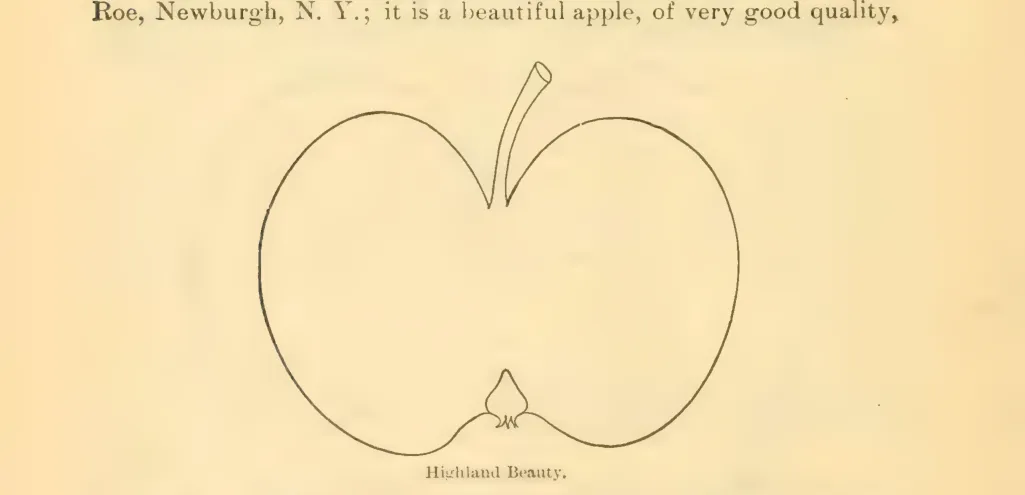
Highland Beauty
Origin/History
Originated as a seedling of the Lady apple in the garden of the late William Roe, Newburgh, N.Y. Exhibited before the Massachusetts Horticultural Society in 1881 as a new variety. Manning (1881) noted: "In size it surpasses its parent but not in quality." Downing (1900) describes it as a beautiful apple of very good quality that keeps well and is a promising addition for the dessert. Beach (1905) observes that it does not appear to be known in cultivation to any considerable extent.
Tree
Thrifty, moderately vigorous, forming a round head. An abundant bearer on alternate years, with a light crop the non-bearing season. (Downing.)
Fruit
Size and Form: Small to medium, oblate, slightly conical, somewhat angular; of the Lady type. (Downing gives small to medium; Manning notes it surpasses its parent the Lady in size.)
Stem: Short to medium. (Downing.)
Cavity: Broad, deep, sometimes a little russet. (Downing.)
Calyx: Closed. (Downing.)
Basin: Large, deep, corrugated. (Downing.)
Skin: Smooth, almost waxen white — Beach adds "clear, smooth yellow or almost waxen white." Both sources agree the ground color is waxen white; Beach additionally notes a yellow cast. Blushed or shaded with bright red or brilliant carmine in the sun. Downing notes a few scattering grayish dots; Beach does not mention dots.
Flesh and Flavor: White, fine, crisp, tender, juicy, mild, refreshing subacid flavor, of very good quality. (Downing adds "fine" and "refreshing"; both sources agree on the core description of white, crisp, tender, juicy, mild subacid, very good.)
Core: Rather small. (Downing.)
Season
January to March. (Both sources.)
Uses
Dessert. Keeps well. (Downing.)
Subtypes/Variants
Not described in source.
Other
Not described in source.
Book Sources
Described in 2 period pomological works
Nursery Catalog Sources
Found in 2 catalogs (1901–1913) from Illinois
- Benjamin Buckman (personal inventory) , Farmingdale , Illinois — 1901
- Benjamin Buckman (personal inventory) , Farmingdale , Illinois — 1913
View original book sources (2)
— A.J. Downing, The Fruits and Fruit Trees of America (1900)Highland Beauty.
A new variety which originated in the garden of the late William Roe, Newburgh, N. Y.; it is a beautiful apple, of very good quality, keeps well, and is a promising addition for the dessert. Tree thrifty, moderately vigorous, forming a round head; an abundant bearer on alternate years, with a light crop the non-bearing season.
Fruit small to medium, oblate, slightly conical, somewhat angular; skin smooth, almost waxen white, often a shade of bright red or carmine in the sun, and a few scattering grayish dots; stalk short to medium; cavity broad, deep, sometimes a little russet; calyx closed; basin large, deep, corrugated; flesh white, fine, crisp, tender, juicy, mild, refreshing subacid flavor, of very good quality; core rather small. Season January, March.
— S.A. Beach, The Apples of New York, Vol. 1 (1905)HIGHLAND BEAUTY.
REFERENCES. 1. Manning, Mass. Hort. Soc. Rpt., 1881:232. 2. Downing, 1881:88 app. fig. 3. Dempsey, Ont. Fr. Stas. An. Rpt., 2:32. 1895.
A seedling of the Lady exhibited before the Massachusetts Horticultural Society in 1881 as a new variety. "In size it surpasses its parent but not in quality" (1). The fruit is of the Lady type. Skin clear, smooth yellow or almost waxen white, blushed with brilliant carmine. Flesh white, crisp, tender, juicy, mild subacid, very good. Season January to March (1, 2, 3). It does not appear to be known in cultivation to any considerable extent.