Hubbard's Pearmain
Apple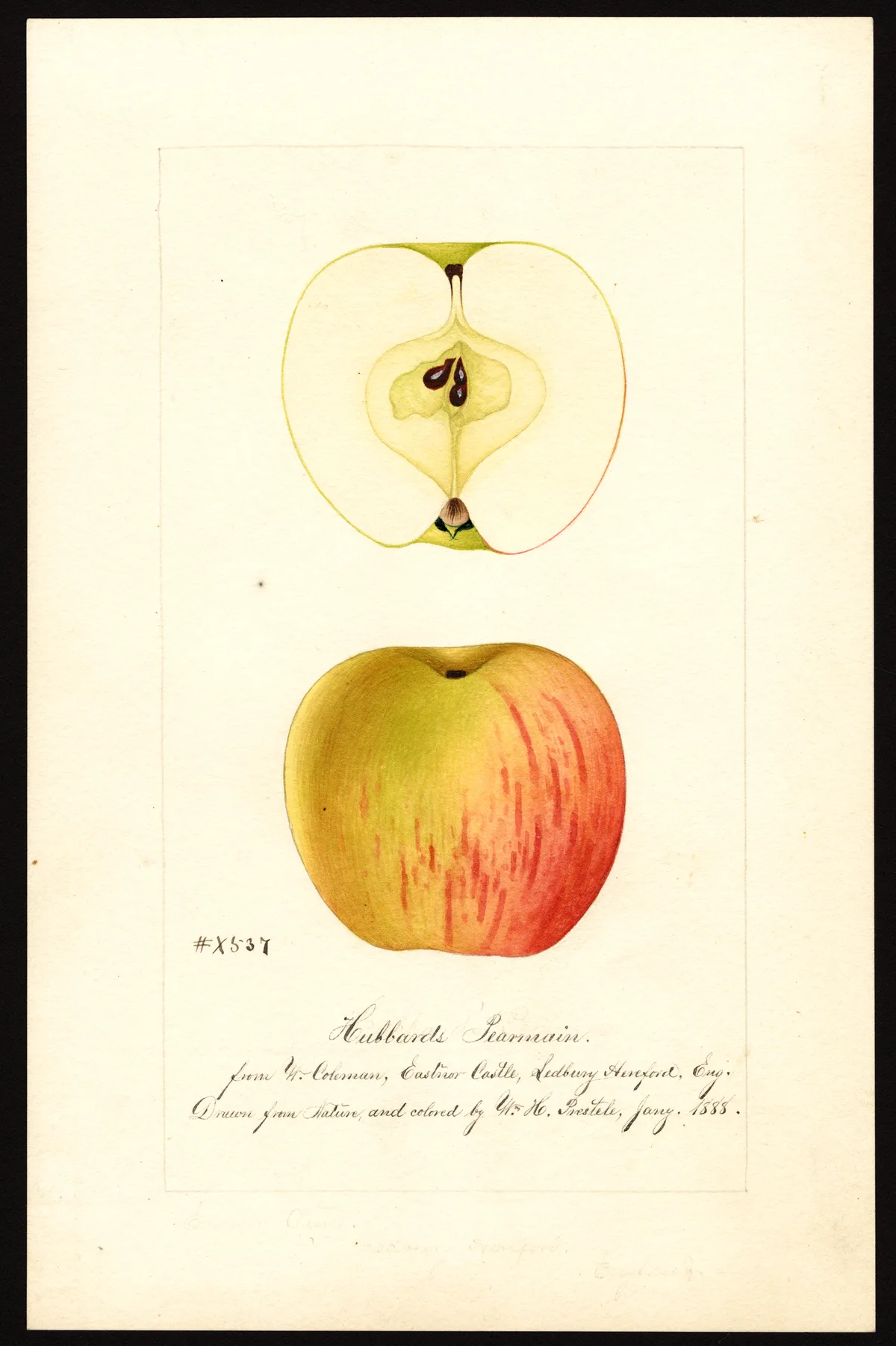
USDA Pomological Watercolor Collection
Hubbard's Pearmain
Origin / History
A Norfolk variety of English origin, known before 1800 (Bunyard). By Lindley's account, it is "by no means uncommon in Norfolk and Suffolk, but it appears to be little known elsewhere, unless in Devonshire," where specimens were seen under the name Golden Vining. It was first formally described by Mr. G. Lindley in the Transactions of the Horticultural Society (vol. iv, p. 68), and listed in the Horticultural Society Fruit Catalogue, no. 758. Downing characterizes it as "one of the richest of dessert Apples." Bunyard judges it "an old English variety deserving more recognition for late use."
Tree
Wood slender and wiry, of a pale grayish brown color, by which young trees are readily recognized (Lindley; confirmed by Downing). Tree described as healthy (Downing). A great bearer as an open standard (Lindley); Bunyard likewise notes growth as slender and the tree very fertile.
Buds: Very downy (Lindley).
Leaves: Rather small, flat, oval, slightly downy beneath, somewhat irregularly but finely serrated, with a very red midrib (Lindley). Bunyard describes the leaf similarly: small, oval, nearly flat, irregularly and finely serrate.
Fruit
Size: Small. Bunyard gives dimensions of 2¼ inches by 2 inches.
Form: Downing describes the fruit as roundish conical, regular, and without angles. Lindley describes it as ovate, with a short stalk, and destitute of angles. Bunyard calls it conical and regular.
Stem: Short (Lindley). Bunyard specifies "rather short."
Cavity: Even (Bunyard, describing the stem cavity). Not described by Lindley or Downing.
Calyx / Eye: Sources conflict. Lindley describes the eye as "small and close." Bunyard describes the eye as "open."
Basin: Shallow (Bunyard). Not described by Lindley or Downing.
Skin: Sources agree on variability of appearance, which Lindley flags as an important identification point. Lindley describes the typical appearance as "pale russet, or cinnamon colour, with a little green or red breaking through it here and there." He adds that "in some seasons all the fruit is smooth and bright yellow,—a circumstance which it is necessary to bear in mind, or otherwise trees may be supposed to be false which are not so," noting that in such specimens the color is "a uniform, clear, yellowish green, without russet." Downing describes the skin as yellow, sometimes covered with pale brown russet, mottled red, bronzed in the sun. Bunyard describes it as pale yellowish-green, occasionally flushed with dull brownish-red, slightly russet.
Flesh / Flavor: Sources agree on richness and firmness but differ on moisture and color. Lindley: firm, rather dry, exceedingly sweet and rich, with an excellent subacid flavour. Downing: yellow, firm, very rich, sugary, aromatic. Bunyard: crisp, juicy, greenish, very richly flavoured. (Note conflict: Lindley calls the flesh "rather dry"; Bunyard calls it "juicy." Downing's flesh color is yellow; Bunyard's is greenish.)
Core / Seeds: Not described in any source.
Season
Ripens at the beginning or middle of November and keeps well until March or April (Lindley). Downing and Bunyard both give the season as November to March.
Uses
Dessert (all sources). Lindley calls it "this invaluable table fruit."
Subtypes / Variants
No distinct named subtypes, but Lindley emphasizes the importance of the yellow form: in some seasons, all fruit on a tree is smooth and bright yellow rather than the typical dull russet with a little red, and this variation should not be mistaken for mislabeled or incorrect trees.
Other
The specimen from which Lindley's Pomologia Britannica drawing was made was communicated by N. S. Hodson, Esq., of Bury St. Edmund's (Lindley).
Book Sources
Described in 3 period pomological works
- Bunyard, A Handbook of Hardy Fruits (1920)
- Downing, Fruits and Fruit Trees of America (1900)
- Lindley, Pomologia Britannica Vol. 1 (1841) — listed as THE HUBBARD'S PEARMAIN APPLE.
Nursery Catalog Sources
Found in 2 catalogs (1900) from England
- George Bunyard & Co. , Royal Nurseries, Maidstone, Kent , England — 1900
- Central Experimental Farm , Dominion Department of Agriculture, Agassiz, British Columbia (under test; Bulletin No. 3, Second Series) — 1900
View original book sources (3)
— A.J. Downing, The Fruits and Fruit Trees of America (1900)Hubbard's Pearmain. Hubbard's Russet Pearmain. Golden Vining.
This little English fruit is described by Lindley as one of the richest of dessert Apples. Tree healthy, with slender young wood of a pale grayish brown color.
Fruit small, roundish conical, regular, yellow, sometimes covered with pale brown russet, mottled red, bronzed in the sun. Flesh yellow, firm, very rich, sugary, aromatic. November to March.
— John Lindley, Pomologia Britannica, Vol. 1 (1841)THE HUBBARD'S PEARMAIN APPLE.
Hubbard's Pearmain. G. Lindley in Hort. Trans. vol. iv. p. 68. Hort. Soc. Fruit Cat. no. 758. Golden Vining, of Devonshire.
This invaluable table fruit is by no means uncommon in Norfolk and Suffolk, but it appears to be little known elsewhere, unless in Devonshire, whence we have seen specimens under the name of the Golden Vining. It was first described in the Transactions of the Horticultural Society, by Mr. Lindley.
It is a great bearer as an open standard, ripens about the beginning or middle of November, and keeps well till March or April. Its usual appearance is that of a dull russet, with a little red on one side; but in some seasons all the fruit is smooth and bright yellow,—a circumstance which it is necessary to bear in mind, or otherwise trees may be supposed to be false which are not so.
The Wood is slender and wiry, of a pale grayish brown, by which the young trees are readily known. Buds very downy. Leaves rather small, flat, oval, slightly downy beneath, somewhat irregularly but finely serrated, with a very red midrib.
Fruit small, ovate, with a short stalk, and destitute of angles. Eye small and close. Skin pale russet, or cinnamon colour, with a little green or red breaking through it here and there; in some specimens, of a uniform, clear, yellowish green, without russet. Flesh firm, rather dry, exceedingly sweet and rich, with an excellent subacid flavour.
The specimen from which the drawing was made was communicated by N. S. Hodson, Esq. of Bury St. Edmund's.
— E.A. Bunyard, A Handbook of Hardy Fruits (1920)HUBBARD'S PEARMAIN. Lind. Pom. Brit., 27. Dessert, November to March, small, 2¼ by 2, conical, regular. Colour, pale yellowish-green, occasionally flushed with dull brownish-red, slightly russet. Flesh, crisp, juicy, greenish, very richly flavoured. Eye, open, in a shallow basin. Stem, rather short in an even cavity. Growth, slender; very fertile. Leaf, small, oval, nearly flat, irregularly and finely serrate. Origin, a Norfolk variety, known before 1800. An old English variety deserving more recognition for late use.