Hurlbut
Apple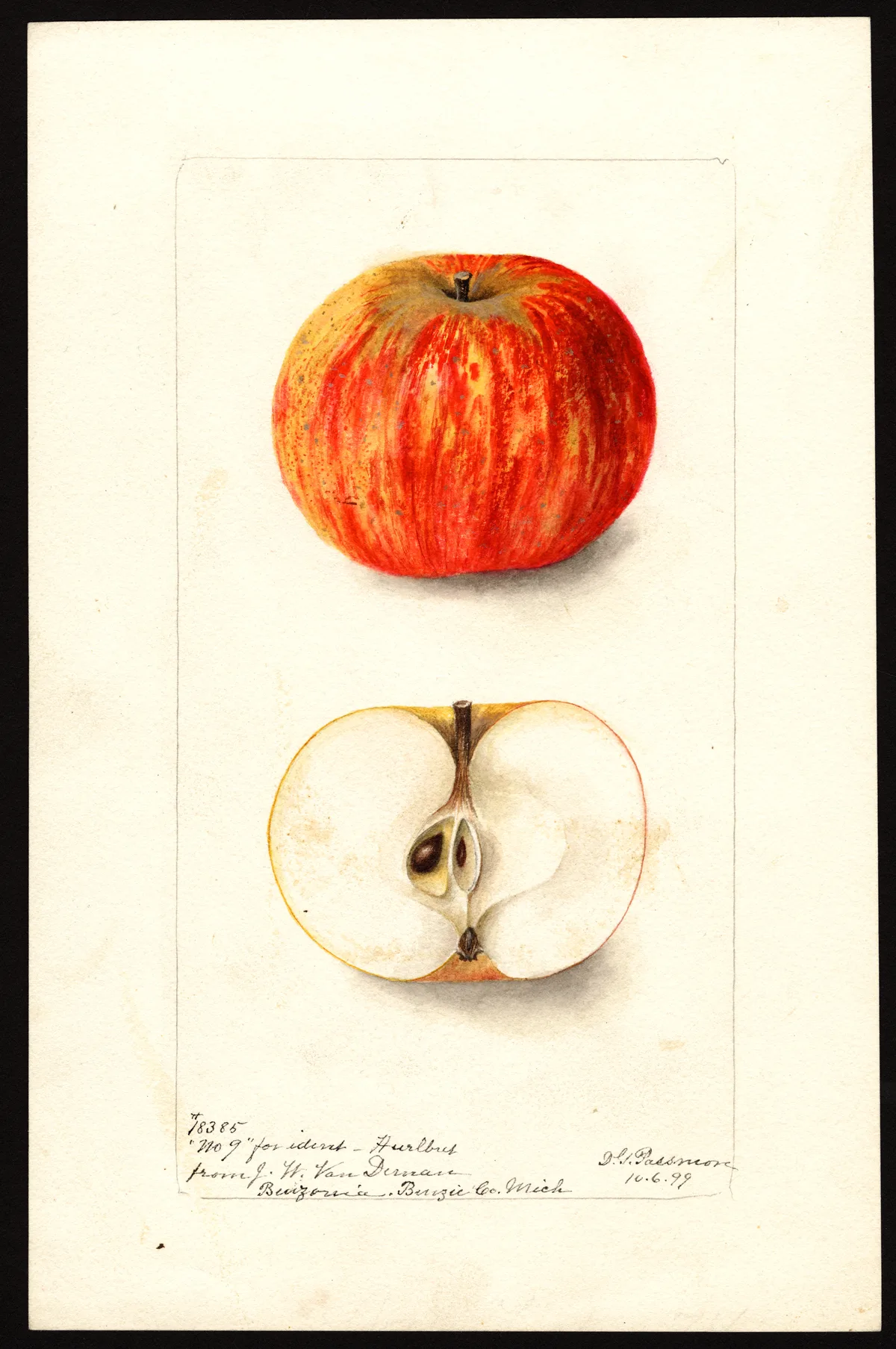
USDA Pomological Watercolor Collection
Hurlbut
Origin / History
Hurlbut originated on the farm of General Leonard Hurlbut, Winchester, Connecticut. It was first described by Cole in 1849, who noted that "the original tree is still flourishing on the farm of General Leonard Hurlbut, Winchester, Conn." Hedrick (1922) records that the variety originated "nearly a century ago," placing its origin in the early 1800s. Although it has long been known in cultivation and has been quite widely disseminated, its cultivation has not spread far from the place of its nativity, and it has nowhere gained prominence as a commercial variety. It has continued to be listed by nurserymen but is not being planted to any considerable extent. Hedrick characterizes it as "one of the many mediocre apples having just sufficient merit to keep them in the limbo of the nurserymen's catalogs." Beach notes that Hurlbut has proved to be a profitable variety with some fruit growers.
Tree
Tree rather large to large, vigorous or moderately vigorous, and a great bearer. Form spreading or roundish and somewhat inclined to droop. Comes into bearing moderately young and yields heavy crops biennially. Because of the tendency of the tree to overproduction in bearing years, the size of the fruit is in many cases reduced and a considerable portion of it is too small to be marketable.
Young wood dark brownish red, slightly downy (Downing). Twigs moderately long, slightly curved, moderately stout to rather slender; internodes below medium to short. Bark dark brown to clear brownish-red, heavily mottled with scarfskin; slightly pubescent. Lenticels scattering, small, round, slightly raised. Buds medium size, broad, plump, obtuse, free, slightly pubescent; Downing describes the buds as prominent.
Fruit
Size: Medium; Beach gives "below medium to above," fairly uniform in size and shape; Hedrick gives "medium to large, uniform in size and shape."
Form: Oblate, slightly conic, angular; variously described as roundish, slightly oblate or inclined to oblate conic (Beach), or round-oblate to oblate-conic (Hedrick); somewhat angular, rather symmetrical.
Stem: Short, rather slender; Thomas describes the stalk as small.
Cavity: Downing and Elliott describe the cavity as broad and deep, surrounded by russet; Thomas describes it as large; Beach and Hedrick describe it as acute, shallow to medium in depth, medium in width, symmetrical or compressed, usually covered with heavy outspreading russet.
Calyx: Closed; medium or below to small. Lobes medium to long (Beach) or long (Hedrick), narrow, acute. Calyx tube very short, wide, truncate conical with fleshy pistil point projecting into the base. Stamens marginal.
Basin: Rather shallow to medium in depth, narrow to nearly medium in width, somewhat abrupt, smooth or slightly wrinkled.
Skin: Thick, tough, smooth. Yellow or greenish-yellow, shaded or largely overspread with brownish-red or dull red, splashed and striped with carmine (darker red), and thinly sprinkled with light dots. Dots scattering, inconspicuous, usually submerged, sometimes russet. Lowther gives color as yellow-red. The general appearance is good, yet it is not particularly attractive either in size or color.
Flesh / Flavor: White or yellowish, crisp, tender, juicy (very juicy), moderately firm to firm, rather fine, aromatic, with a mild, sprightly, subacid flavor. Quality good to very good.
Core / Seeds: Core small (Downing) to medium size, abaxile; cells wide open to nearly closed (Beach) or wide open to closed (Hedrick); core lines meeting or slightly clasping. Carpels nearly round to round. Seeds numerous, rather large to large, moderately wide to wide, long, rather plump to plump, acute.
Season
October to December (Downing); November to December (Elliott); October to December or January (Beach); October to January (Hedrick). Season variable. Lowther reports the season as early autumn.
Uses
Both kitchen and market (Lowther). Does not take first rank for either home use or market (Beach).
Subtypes / Variants
Not described in source.
Other
Lowther's regional reports: Northern Division reports none; Central Division reports none; Southern Division reports 2, also reported in another division.
Book Sources
Described in 6 period pomological works
Nursery Catalog Sources
Found in 8 catalogs (1890–1913) from Illinois, Maryland, Massachusetts, New Jersey, Pennsylvania
- William H. Moon Co. , Morrisville, Bucks County , Pennsylvania — 1890
- Rogers Nursery Co. , Moorestown , New Jersey — 1893
- Reading Nursery , Jacob W. Manning, Proprietor, Reading , Massachusetts — 1898
- Brown Brothers Co. , Continental Nurseries, Rochester, NY (also operated from Toronto, Canada) — 1899
- Brown Brothers Co. , Continental Nurseries, Rochester, NY (also operated from Toronto, Canada) — 1901
- Benjamin Buckman (personal inventory) , Farmingdale , Illinois — 1901
- Wm. J. Corse (successor to Robert Sinclair / Sinclair Nurseries) , Baltimore , Maryland — 1909
- Benjamin Buckman (personal inventory) , Farmingdale , Illinois — 1913
View original book sources (6)
— A.J. Downing, The Fruits and Fruit Trees of America (1900)HURLBUT.
Hurlbut Stripe.
Origin, farm of General Hurlbut, Winchester, Conn. Tree very vigorous, and great bearer. Young wood dark brownish red, slightly downy. Buds prominent.
Fruit medium, oblate, slightly conic, angular. Skin yellow, shaded with red stripes, and splashed with darker red, and thinly sprinkled with light dots. Stalk short, rather slender, inserted in a broad deep cavity, surrounded by russet. Calyx closed. Basin rather shallow. Flesh white, crisp, tender, juicy, mild, sprightly subacid. Good to very good. Core small. October, December.
— S.A. Beach, The Apples of New York, Vol. 2 (1905)HURLBUT.
REFERENCES. 1. Cole, 1849:118. fig. 2. Emmons, Nat. Hist. N. Y., 3:31. 1851. col. pl. and fig. 3. Downing, 1857:155. 4. Am. Pom. Soc. Cat., 1862. 5. Warder, 1867:722. 6. Thomas, 1875:201. 7. Barry, 1883:347. 8. Lyon, Mich. Hort. Soc. Rpt., 1890:292. 9. Bailey, An. Hort., 1892:241. 10. Munson, Me. Sta. Rpt., 1893:133. 11. Dempsey, Ont. Fr. Stas. An. Rpt., 1:24. 1894. 12. Burrill and McCluer, Ill. Sta. Bul., 45:326. 1896. 13. Munson, Me. Sta. An. Rpt., 18:89. 1902. 14. Powell and Fulton, U. S. B. P. I. Bul., 48:45. 1903. 15. Beach and Clark, N. Y. Sta. Bul., 248:126. 1904.
SYNONYMS. HURLBURT (2). HURLBUT (1, 3, 4, 6, 7, 8, 9, 10, 11, 12, 13, 14, 15). Hurlbut Stripe (3). HURLBUTT (5).
The general appearance of Hurlbut is good yet it is not particularly attractive either in size or color nor does it take first rank for either home use or market. The tree is a strong grower, comes into bearing moderately young and yields heavy crops biennially. Because of the tendency of the tree to overproduction in bearing years the size of the fruit is in many cases reduced and a considerable portion of it is too small to be marketable. Hurlbut has proved to be a profitable variety with some fruit growers but although it has long been known in cultivation and has been quite widely disseminated it has nowhere gained prominence as a commercial variety.
Historical. In 1849 Cole (1) wrote: "The original tree is still flourishing on the farm of General Leonard Hurlbut, Winchester, Conn." It is still quite frequently listed by nurserymen (9) but is not being planted to any considerable extent.
TREE.
Tree rather large, vigorous or moderately vigorous. Form spreading or roundish and somewhat inclined to droop. Twigs moderately long, slightly curved, moderately stout to rather slender; internodes below medium to short. Bark dark brown to clear brownish-red, heavily mottled with scarfskin; slightly pubescent. Lenticels scattering, small, round, slightly raised. Buds medium size, broad, plump, obtuse, free, slightly pubescent.
FRUIT.
Fruit below medium to above, fairly uniform in size and shape. Form roundish, slightly oblate or inclined to oblate conic, somewhat angular, rather symmetrical. Stem medium to short, rather slender. Cavity acute, shallow to medium in depth, medium in width, symmetrical or compressed, usually covered with heavy outspreading russet. Calyx medium or below, usually closed; lobes medium to long, narrow, acute. Basin shallow to medium in depth, narrow to nearly medium in width, somewhat abrupt, smooth or slightly wrinkled. Skin thick, tough, smooth, greenish-yellow largely overspread with brownish-red or dull red, splashed and striped with carmine. Dots scattering, inconspicuous, usually submerged, sometimes russet. Calyx tube very short, wide, truncate conical with fleshy pistil point projecting into the base. Stamens marginal. Core medium size, abaxile; cells wide open to nearly closed; core lines meeting or slightly clasping. Carpels nearly round. Seeds numerous, rather large, moderately wide, long, rather plump, acute. Flesh white or yellowish, moderately firm, rather fine, tender, crisp, very juicy, aromatic, mildly subacid, good to very good. Season variable; October to December or January (15).
— Granville Lowther (ed.), Encyclopedia of Practical Horticulture (1914)Hurlbut: size medium; form roundish (oblate); color yellow-red; quality good; use both kitchen and market; season early autumn; Northern Division reports none; Central Division reports none; Southern Division reports 2, also reported in another division.
— F.R. Elliott, The Western Fruit Book (1865)HURLBUT. Hurlbut Stripe.
Origin, farm of Gen. Hurlbut, Winchester, Conn. Tree, very vigorous, and great bearer. Fruit, medium, oblate, slightly conic angular ; skin, yellow, shaded with red stripes, and splashed with darker red, and thinly sprinkled with light dots ; stalk, short, rather slender, inserted in a broad, deep cavity, surrounded by russet ; calyx, closed, basin rather shallow ; flesh, white, crisp, tender, juicy, with a mild sprightly sub-acid flavor. November, December. (Downing.)
— John J. Thomas, The American Fruit Culturist (1903)Hurlbut. Size medium, oblate, conic; yellow striped with red; stalk small; cavity large; basin shallow; flesh white, crisp, tender, with a mild sub-acid flavor. Connecticut.
— U.P. Hedrick, Cyclopedia of Hardy Fruits (1922)HURLBUT. Hurlbut Stripe. Hurlbut is one of the many mediocre apples having just sufficient merit to keep them in the limbo of the nurserymen's catalogs. It will be seen from the description that fruit and tree of Hurlbut are good but in no case superior. The variety originated at Winchester, Connecticut, nearly a century ago on the farm of General Leonard Hurlbut. Its cultivation has not spread far from the place of its nativity. It was first described by Cole in 1849.
Tree large, vigorous, spreading. Fruit medium to large, uniform in size and shape, round-oblate to oblate-conic, angular, symmetrical; stem short, slender; cavity acute, shallow, medium in width, symmetrical or compressed; calyx small, usually closed; lobes long, narrow, acute; basin shallow, narrow, abrupt, smooth or wrinkled; skin thick, tough, smooth, greenish-yellow overspread with brownish-red or dull red, splashed and striped with carmine; dots scattering, inconspicuous, usually submerged, sometimes russet; calyx-tube very short, wide, truncate conical with fleshy pistil point projecting into the base; stamens marginal; core of medium size, abaxile; cells wide open to closed; core-lines meeting; carpels round; seeds numerous, large, wide, long, plump, acute; flesh white or yellowish, firm, fine, tender, crisp, very juicy, aromatic, mild subacid; good to very good; October to January.