Isham
Apple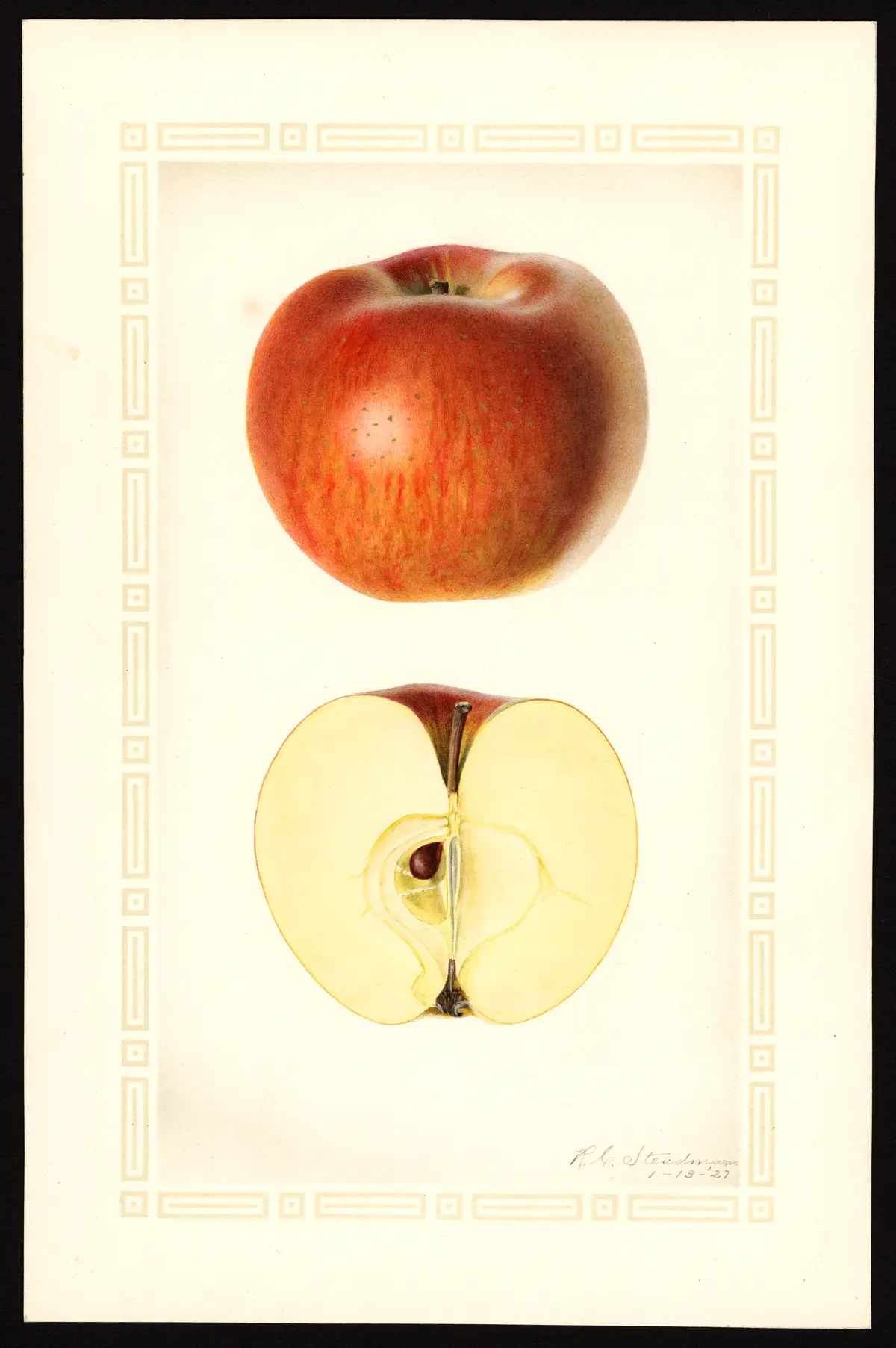
USDA Pomological Watercolor Collection
Origin/History
Isham originated from seed of Bailey Sweet. It was introduced about 1864 by F. K. Phoenix, Delavan, Wisconsin. It has been grown to some extent in some of the Western states but has not been much tested in New York, and it is doubtful whether it is desirable for planting in any portion of that state.
Tree
Tree moderately vigorous. Form upright spreading. Twigs medium to long, rather stout, in some cases quite blunt at the tips, straight or nearly so; internodes rather long. Bark reddish-brown overlaid with heavy grayish scarf-skin, not pubescent or very sparingly so. Lenticels rather inconspicuous, rather scattering, irregular in size and shape, not raised. Buds large, prominent, fleshy, heavily pubescent, adhering to bark.
Fruit
Size: Medium.
Form: Roundish, slightly tapering.
Stem: Short.
Cavity: Regular, acute, with much radiating russet.
Calyx: Open; segments flat, convergent.
Basin: Very shallow, minutely wrinkled.
Skin: Yellowish-green mostly covered with brownish-red, solid and mixed on the sunny side, striped and broadly splashed on the shady side. Dots distinct, russet, numerous, minute; a few large russet dots.
Flesh/Flavor: Flesh very yellow with yellow veinings, firm, very sweet, very good.
Core/Seeds: Core closed; cells round, entire. Calyx tube funnel-shape. Stamens median. Seeds long, large, flat.
Season
Late fall and early winter.
Uses
Not described in source.
Subtypes/Variants
Not described in source.
Other
Encyclopedia of Practical Horticulture (Lowther, 1914): description absent; variety present in variety-characteristic table.
Isham (I. Sweet)............ L rob + G k W
Book Sources
Described in 2 period pomological works
Nursery Catalog Sources
Found in 6 catalogs (1901–1912) from Illinois, Oregon, Washington
- Washington Nursery Co. , Toppenish , Washington — 1901
- Phoenix Nursery Company (W. E. Rossney , President; Sidney Tuttle, Vice-President), Bloomington , Illinois — 1904
- Washington Nursery Company , Toppenish , Washington — 1909
- Pacific Nursery Company , Portland , Oregon — 1912
- Vineland Nurseries Company , Clarkston , Washington — 1912
- Washington Nursery Company , Toppenish , Washington — 1912
View original book sources (2)
— S.A. Beach, The Apples of New York, Vol. 2 (1905)ISHAM.
REFERENCES. 1. Bailey, An. Hort., 1892:242. 2. Hoskins, Rural N. Y., 53:310. 1894. 3. Am. Pom. Soc. Cat., 1899:17. 4. Hansen, S. D. Sta. Bul., 76:60. 1902. fig. 5. Kan. Sta. Bul., 106:53. 1902. 6. Budd-Hansen, 1903:105.
SYNONYMS. ISHAM SWEET (1, 2, 3, 4, 5). ISHAM Sweet (6).
A red sweet apple of medium size, in season in late fall and early winter. It has been grown to some extent in some of the Western states but it has not been much tested in New York and it is doubtful whether it is desirable for planting in any portion of this state.
Historical. Isham originated from seed of Bailey Sweet. It was introduced about 1864 by F. K. Phoenix, Delavan, Wis. (2).
TREE.
Tree moderately vigorous. Form upright spreading. Twigs medium to long, rather stout, in some cases quite blunt at the tips, straight or nearly so; internodes rather long. Bark reddish-brown overlaid with heavy grayish scarf-skin, not pubescent or very sparingly so. Lenticels rather inconspicuous, rather scattering, irregular in size and shape, not raised. Buds large, prominent, fleshy, heavily pubescent, adhering to bark.
FRUIT (4, 6).
Fruit medium. Form roundish, slightly tapering. Stem short. Cavity regular, acute, with much radiating russet. Calyx open; segments flat, convergent. Basin very shallow, minutely wrinkled. Skin yellowish-green mostly covered with brownish-red, solid and mixed on sunny side, striped and broadly splashed on the shady side. Dots distinct, russet, numerous, minute; a few large russet dots. Calyx tube funnel-shape. Stamens median. Core closed; cells round, entire. Seeds long, large, flat. Flesh very yellow with yellow veinings, firm, very sweet, very good.
— Granville Lowther (ed.), Encyclopedia of Practical Horticulture (1914)Isham (I. Sweet)............ L rob + G k W