Jackson
Apple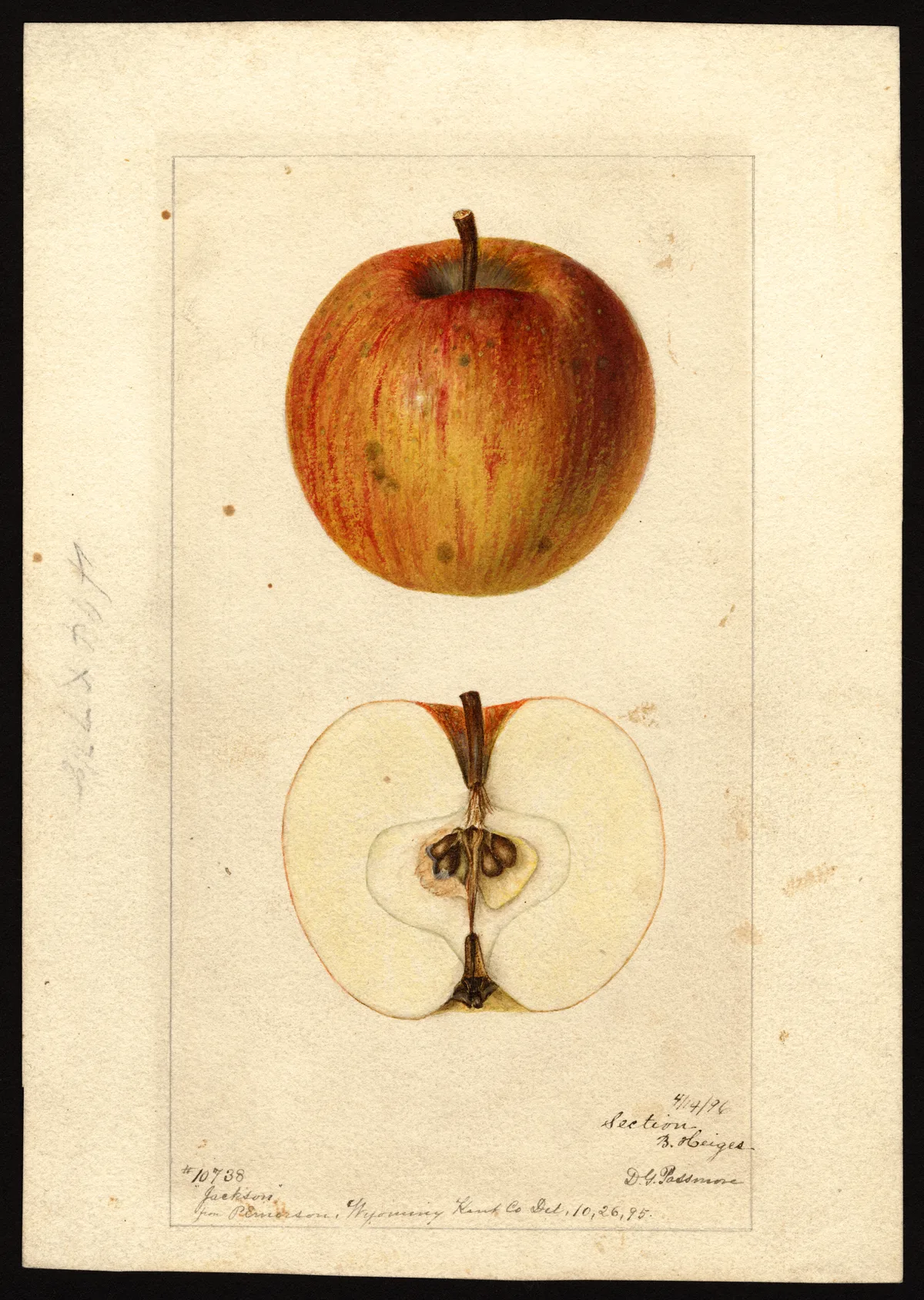
USDA Pomological Watercolor Collection
Jackson
Origin / History
Origin: Bucks County, Pennsylvania. Although it has long been known in Pennsylvania, it has not been disseminated to any considerable extent in New York, and is not recommended for planting there (Beach). Historical references trace it from at least 1856 (Smith, Horticulturist, 11:286, 1856; Brinckle, Horticulturist, 12:520, 1857; Downing, 1857; Warder, 1867; Thomas, 1885).
Tree
Vigorous; branches moderately long, stout, crooked (Beach). Downing describes the tree as an upright grower. Form roundish or spreading, rather dense (Beach). Twigs long, curved, stout; internodes medium (Beach). Bark dark brown, lightly streaked with scarf-skin, pubescent near the tips; young wood dark brown (Beach, Downing). Lenticels numerous, small, round, not raised (Beach). Buds deeply set in bark, of medium size, broad, obtuse, appressed, slightly pubescent (Beach).
Fruit
Size and Form: Medium, uniform in size and shape (Beach). Form roundish to roundish oblate, symmetrical (Beach, Downing). Elliott describes simply as roundish.
Stem: Medium to rather long, slender (Beach).
Cavity: Usually acuminate, deep, narrow to rather broad, often heavily russeted and with outspreading irregular rays (Beach). Elliott describes the cavity as deep and narrow.
Calyx: Medium in size, closed or sometimes open (Beach, Elliott). Lobes long, rather narrow, acute (Beach).
Basin: Abrupt, medium in depth to deep, moderately wide, slightly furrowed and wrinkled (Beach). Elliott notes the basin slightly furrowed.
Skin: Moderately thick, tender (Beach). Color greenish-yellow, with many dark green blotches and gray dots; a very few faint red stripes, scarcely perceptible; on the exposed side a warm mottled brown blush (Downing, Beach, Elliott). Beach adds that the skin contains numerous white dots with a central gray speck in each, citing Brinckle. Elliott describes the blotches and red markings as appearing particularly on the sun-exposed side, with faint stripes and mottlings of red.
Flesh and Flavor: Flesh greenish (Downing, Elliott); Beach describes it as slightly tinged with yellow. Fine-grained, crisp, very tender, juicy (Beach, Downing). Flavor very mild subacid mingled with sweet (Beach). Elliott notes an aromatic flavor. Quality good to very good (Downing); Beach rates it good.
Core and Seeds: Calyx tube large, long, conical to funnel-form, extending nearly to the core (Beach). Stamens marginal to median (Beach). Core medium in size, abaxile; cells unsymmetrical, wide open; core lines clasping (Beach). Carpels smooth, nearly cordate to broadly ovate (Beach). Seeds numerous, dark brown, medium in size, plump, obtuse (Beach).
Season
October to February (Downing, Beach). Elliott gives the season as October through December.
Uses
Not described in source.
Subtypes / Variants
Not described in source.
Other
A greenish-yellow apple of medium size, not particularly attractive in appearance (Beach). Also known in references as Jackson Seedling (Smith, 1856).
Book Sources
Described in 3 period pomological works
View original book sources (3)
— A.J. Downing, The Fruits and Fruit Trees of America (1900)Jackson.
Origin, Bucks Co., Pa. Tree upright grower. Young wood dark brown.
Fruit medium, roundish oblate, greenish yellow, with many dark green blotches and gray dots, a very few faint stripes, and warm mottled brown cheek. Flesh greenish, fine texture, tender, juicy. Good to very good. October, February.
— S.A. Beach, The Apples of New York, Vol. 1 (1905)JACKSON.
REFERENCES. 1. Smith, Horticulturist, 11:286. 1856. 2. Brinckle, Ib., 12:520. 1857. fig. 3. Downing, 1857:156. 4. Warder, 1867:723. 5. Thomas, 1885:514.
SYNONYM. Jackson Seedling (1).
A greenish-yellow apple of medium size, not particularly attractive. In season from October to February. Not recommended for planting in New York.
Historical. Origin, Bucks county, Pa. (1, 2, 3). Although it has long been known in Pennsylvania it has not been disseminated to any considerable extent in this state.
TREE.
Tree vigorous; branches moderately long, stout, crooked. Form roundish or spreading, rather dense. Twigs long, curved, stout; internodes medium. Bark dark brown lightly streaked with scarf-skin, pubescent near the tips. Lenticels numerous, small, round, not raised. Buds deeply set in bark, of medium size, broad, obtuse, appressed, slightly pubescent.
FRUIT.
Fruit medium, uniform in size and shape. Form roundish to roundish oblate, symmetrical. Stem medium to rather long, slender. Cavity usually acuminate, deep, narrow to rather broad, often heavily russeted and with outspreading irregular rays. Calyx medium in size, closed or sometimes open; lobes long, rather narrow, acute. Basin abrupt, medium in depth to deep, moderately wide, slightly furrowed and wrinkled. Skin moderately thick, tender, greenish-yellow with many dark green blotches and gray dots, a very few faint red stripes scarcely perceptible, and on the exposed side a warm mottled brown blush, containing numerous white dots with a central gray speck in each (2). Calyx tube large, long, conical to funnel-form, extending nearly to core. Stamens marginal to median. Core medium in size, abaxile; cells unsymmetrical, wide open; core lines clasping. Carpels smooth, nearly cordate to broadly ovate. Seeds numerous, dark brown, medium in size, plump, obtuse. Flesh slightly tinged with yellow, fine, crisp, very tender, juicy, very mild subacid mingled with sweet, good.
— F.R. Elliott, The Western Fruit Book (1865)Jackson.
From Bucks Co., Pa. Fruit, medium, roundish; color, greenish yellow, with dark blotches and gray dots in sun, faint stripes and mottlings of red; stem, in a deep narrow cavity; calyx, closed; basin, slightly furrowed; flesh, greenish, tender, juicy, aromatic flavor. October, December.