July
Apple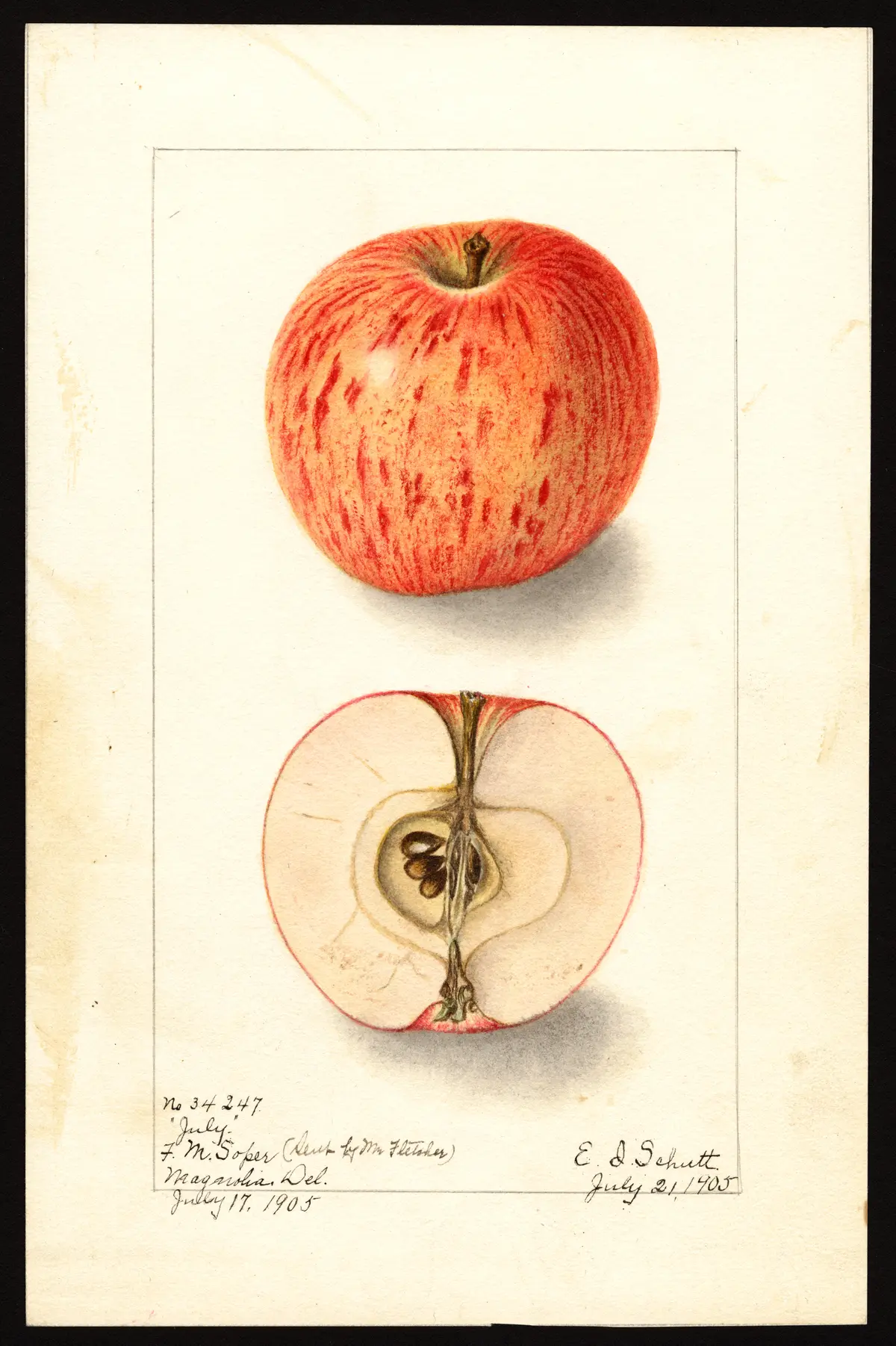
USDA Pomological Watercolor Collection
July
Origin / History
July is an old Russian variety, introduced into America sometime previous to the Civil War as an apple suitable for cold regions (Hedrick). Hovey states that "The Fourth of July apple, in Germany called the Siberian August apple, was sent from the Russian province Liefland, in the year 1807, to the celebrated pomologist, Dr. Diel, and is celebrated, like all our summer apples which originated in Russia, for its great productiveness and hardiness" (Beach, quoting Hovey). It was introduced into Columbus, Ohio, from Cassel, Germany (Beach); Downing identifies it as a German apple introduced by C. F. Jaeger of Columbus, Ohio. It has been disseminated to a considerable extent in various parts of the country and is still listed by a considerable number of nurserymen (Beach).
Warder records it as an early apple "quite a favorite in Clarke County, Ohio," reported under the local name Stewart's Nonpareil, with fruits received from his brother, J. T. Warder; he suggested it might prove on closer examination to be the Tetofski or some other known variety. Beach explicitly addresses this: the fruit closely resembles Tetofsky and some have considered the two varieties identical, but they are quite distinct in tree. Downing likewise notes that in fruit it closely resembles the Tetofsky, but "the color of the wood, habit of growth, and foliage of old trees render its distinctiveness plain." Hedrick concurs: "July, in fruit, is almost a facsimile of the well-known Tetofsky, which surpasses it in tree-characters, in which the two are quite distinct." Beach notes it is not recommended for planting in New York because it is not equal to standard varieties of its season.
Tree
Tree vigorous, a strong upright grower, forming a fine head (Downing); form upright, roundish and rather dense (Beach, Hedrick). Young shoots long, dark reddish brown (Downing). Twigs short, straight, stout, with large terminal buds; internodes medium (Beach). Bark dull brown tinged with green, lightly streaked with scarf-skin; slightly pubescent (Beach). Lenticels scattering, small, oblong, not raised (Beach). Buds medium size, plump, obtuse, free, slightly pubescent (Beach). Productive (Thomas).
Fruit
Size: Sources vary. Warder: medium. Downing: medium or below. Thomas: above medium. Beach: below medium to above, pretty uniform in shape but not in size. Hedrick: medium, uniform in shape but not in size. Lowther: medium.
Form: Roundish, conical, irregular, angular (Warder); roundish oblate conical, slightly ribbed (Downing); roundish oblate, often slightly conic (Thomas); usually roundish conical, irregularly ribbed, sides often unequal (Beach); round-conical, irregularly ribbed, sides often unequal (Hedrick); roundish (oblate) (Lowther).
Stem: Long, slender (Warder); rather short and slender, often with bracts (Downing); medium to long, moderately slender, often bracted (Beach); long, slender, often bracted (Hedrick).
Cavity: Deep, acute, narrow (Warder); medium, regular (Downing); acuminate to acute, moderately deep, medium to narrow, slightly furrowed, thinly russeted (Beach); acuminate, deep, medium, furrowed, thinly russeted (Hedrick).
Calyx / Eye: Eye very small, closed (Warder). Calyx closed; segments rather long, generally recurved (Downing). Calyx medium to large, usually closed; lobes medium in length, moderately narrow, acuminate (Beach). Calyx large, usually closed; lobes narrow, acuminate (Hedrick). Calyx tube variable in length, funnel-shape (Beach, Hedrick). Stamens median to marginal (Beach); stamens median (Hedrick).
Basin: Small, abrupt, folded (Warder); small, slightly uneven (Downing); rather shallow to medium in depth, narrow, somewhat abrupt, furrowed and wrinkled (Beach); shallow to medium, narrow, abrupt, furrowed and wrinkled (Hedrick).
Skin / Surface: Surface smooth, yellowish-green, splashed carmine; dots minute, scattered, indented (Warder). Whitish yellow, covered with a thin whitish bloom, and striped and splashed with bright red, large light dots (Downing). Striped red on pale yellow, with a white bloom (Thomas). Skin thin, tough, smooth, rather glossy, pale yellow washed and mottled with red, striped and splashed with carmine and overspread with whitish bloom; dots small, numerous, submerged, inconspicuous, light, areolar (Beach). Skin thin, tough, smooth, glossy, pale yellow washed and mottled with red, striped and splashed with carmine and overspread with bloom; dots small, numerous, submerged, inconspicuous, light, areolar (Hedrick). Striped or splashed (red) (Lowther).
Flesh / Flavor: White, tender, fine-grained, juicy; flavor sub-acid (Warder). White, juicy, sprightly, brisk subacid (Downing). Yellowish, tender, rather acid, of moderate quality (Thomas). Yellowish, a little coarse, crisp, tender, moderately juicy, sprightly subacid, fair to good (Beach). Yellow, coarse, crisp, tender, juicy, sprightly subacid; fair to good (Hedrick).
Quality: Good to best (Warder); good (Downing); moderate (Thomas); fair to good (Beach, Hedrick); good (Lowther).
Core / Seeds: Core large, oval, open, clasping the eye; seeds numerous, brown (Warder). Core small (Downing). Core medium or below, axile; cells closed; core lines slightly clasping or meeting; carpels roundish ovate or elongated ovate; seeds very dark dull brown, medium size, moderately wide, short, plump, obtuse (Beach). Core medium, axile; cells closed; core-lines clasping; carpels round-ovate or elongated-ovate; seeds dark dull brown, wide, short, plump, obtuse (Hedrick).
Season
July and August in latitude 40° (Warder). July (Downing). Ripens very early (Thomas). Last of July to September (Beach). July to September (Hedrick). Summer (Lowther).
Uses
Table and kitchen (Warder). Valuable mainly for its hardiness and early maturity as a cooking or market variety (Downing). Valuable for cooking and profitable for market (Thomas). Market (Lowther).
Subtypes / Variants
Not described in source.
Other
Lowther's geographic distribution by division: N. Div.: 3 (also reported in another division); C. Div.: 2 (also reported in another division); S. Div.: 2 (also reported in another division).
Book Sources
Described in 6 period pomological works
- Beach, The Apples of New York Vol. 2 (1905)
- Downing, Fruits and Fruit Trees of America (1900)
- Lowther (ed.), Encyclopedia of Practical Horticulture (1914)
- Hedrick, Cyclopedia of Hardy Fruits (1922)
- Thomas, The American Fruit Culturist (1903)
- Warder, American Pomology: Apples (1867) — listed as Stewart's Nonpareil
USDA Nomenclature (1905)
From W.H. Ragan, Nomenclature of the Apple, USDA Bulletin No. 56
Closely resembles Tetofski.
Nursery Catalog Sources
Found in 4 catalogs (1901–1913) from Illinois
- Benjamin Buckman (personal inventory) , Farmingdale , Illinois — 1901
- Benjamin Buckman (personal inventory) , Farmingdale , Illinois — 1901 — listed as Stewart's Nonpareil
- Benjamin Buckman (personal inventory) , Farmingdale , Illinois — 1913
- Benjamin Buckman (personal inventory) , Farmingdale , Illinois — 1913 — listed as Stewart's Nonpareil
View original book sources (6)
— John A. Warder, American Pomology: Apples (1867)Stewart's Nonpareil — Local Name.
This early apple is quite a favorite in Clarke County, Ohio, and may prove to be the Tetofski, or some other known variety, when it comes to be more thoroughly examined. Fruits received from my brother, J. T. Warder.
Fruit medium, roundish, conical, irregular, angular; Surface smooth, yellowish-green, splashed carmine; Dots minute, scattered, indented.
Basin small, abrupt, folded; Eye very small, closed.
Cavity deep, acute, narrow; Stem long, slender.
Core large, oval, open, clasping the eye; Seeds numerous, brown; Flesh white, tender, fine-grained, juicy; Flavor sub-acid; Quality good to best; Use, table and kitchen; Season, July and August, in latitude 40°.
— A.J. Downing, The Fruits and Fruit Trees of America (1900)Fourth of July.
Siberian August. Tetofsky, erroneously. McAdow's June. Stewart's Nonpareil ? August Apple.
A German Apple, introduced by C. F. Jaeger, of Columbus, Ohio.
Valuable mainly for its hardiness and early maturity as a cooking or market variety. Tree a strong upright grower, forming a fine head. Young shoots long dark reddish brown.
Fruit medium or below, roundish oblate conical, slightly ribbed, whitish yellow, covered with a thin whitish bloom, and striped and splashed with bright red, large light dots. Stalk rather short and slender, often with bracts. Cavity medium, regular. Calyx closed. Segments rather long, generally recurved. Basin small, slightly uneven. Flesh white, juicy, sprightly, brisk subacid. Good. Core small. July.
In fruit this closely resembles the Tetofsky, but the color of the wood, habit of growth, and foliage of old trees render its distinctiveness plain.
— John J. Thomas, The American Fruit Culturist (1903)Fourth of July. Above medium, roundish oblate, often slightly conic; striped red on pale yellow, with a white bloom; flesh yellowish, tender, rather acid, of moderate quality; ripens very early, productive. Valuable for cooking and profitable for market. Cultivated at the West. Of foreign origin.
— S.A. Beach, The Apples of New York, Vol. 2 (1905)JULY.
REFERENCES. 1. Rural N. Y., 1861 (cited by 15). 2. Hovey, Mag. Hort., 29:112. 1863. 3. Hanford, Horticulturist, 19:273. 1864. fig. 4. Warder, 1867:719. 5. Downing, 1869:181. fig. 6. Thomas, 1875:499. 7. Ill. Hort. Soc. Rpt., 1876:252. 8. Ia. Hort. Soc. Rpt., 1879:471. 9. Hoskins, Rural N. Y., 47:646. 1888. 10. Lyon, Mich. Hort. Soc. Rpt., 1890:292. 11. Amer. Gard., 12:870. 1891. figs. 12. Bailey, An. Hort., 1892:239. 13. Burrill and McCluer, Ill. Sta. Bul., 45:321. 1896. 14. Budd-Hansen, 1903:108. 15. Ragan, U. S. B. P. I. Bul., 56:160. 1905.
SYNONYMS. August (4, 15, of Cassel, Germany, 3). FOURTH OF JULY (2, 4, 6, 8, 9, 10, 11, 12, 13). Fourth of July (15, ? 5). JULY (1, 3, 7, 15). JULY, Fourth of (14). McAdow's June (4, 15). Siberian August (4, 15, of Germany 2). Stewart's Nonpareil (15, ? 4). TETOFSKI (5). Tetofsky, erroneously (4, 15).
This fruit closely resembles Tetofsky and some have considered the two varieties identical (4) but they are quite distinct in tree. It is not recommended for planting in New York because it is not equal to standard varieties of its season.
Historical. Hovey states that "The Fourth of July apple, in Germany called the Siberian August apple, was sent from the Russian province Liefland, in the year 1807, to the celebrated pomologist, Dr. Diel, and is celebrated, like all our summer apples which originated in Russia, for its great productiveness and hardiness" (2). It was introduced into Columbus, O., from Cassel, Germany (3). It has been disseminated to a considerable extent in various parts of this country and is still listed by a considerable number of nurserymen (12).
TREE. Tree vigorous. Form upright, roundish and rather dense. Twigs short, straight, stout with large terminal buds; internodes medium. Bark dull brown tinged with green, lightly streaked with scarf-skin; slightly pubescent. Lenticels scattering, small, oblong, not raised. Buds medium size, plump, obtuse, free, slightly pubescent.
FRUIT. Fruit below medium to above, pretty uniform in shape but not in size. Form usually roundish conical, irregularly ribbed; sides often unequal. Stem medium to long, moderately slender, often bracted. Cavity acuminate to acute, moderately deep, medium to narrow, slightly furrowed, thinly russeted. Calyx medium to large, usually closed; lobes medium in length, moderately narrow, acuminate. Basin rather shallow to medium in depth, narrow, somewhat abrupt, furrowed and wrinkled. Skin thin, tough, smooth, rather glossy, pale yellow washed and mottled with red striped and splashed with carmine and overspread with whitish bloom. Dots small, numerous, submerged, inconspicuous, light, areolar. Calyx tube variable in length, funnel-shape. Stamens median to marginal. Core medium or below, axile; cells closed; core lines slightly clasping or meeting. Carpels roundish ovate or elongated ovate. Seeds very dark dull brown, medium size, moderately wide, short, plump, obtuse. Flesh yellowish, a little coarse, crisp, tender, moderately juicy, sprightly subacid, fair to good. Season last of July to September.
— Granville Lowther (ed.), Encyclopedia of Practical Horticulture (1914)Fourth of July. Size: medium. Form: roundish (oblate). Color: striped or splashed (red). Quality: good. Use: market. Season: summer. N. Div.: 3 (also reported in another division). C. Div.: 2 (also reported in another division). S. Div.: 2 (also reported in another division).
— U.P. Hedrick, Cyclopedia of Hardy Fruits (1922)JULY. August. Fourth of July. July, in fruit, is almost a facsimile of the well-known Tetofsky, which surpasses it in tree-characters, in which the two are quite distinct. It is an old Russian variety introduced into America sometime previous to the Civil War as an apple suitable for cold regions.
Tree vigorous, upright, roundish, dense. Fruit medium, uniform in shape but not in size, round-conical, irregularly ribbed, sides often unequal; stem long, slender, often bracted; cavity acuminate, deep, medium, furrowed, thinly russeted; calyx large, usually closed; lobes narrow, acuminate; basin shallow to medium, narrow, abrupt, furrowed and wrinkled; skin thin, tough, smooth, glossy, pale yellow washed and mottled with red, striped and splashed with carmine and overspread with bloom; dots small, numerous, submerged, inconspicuous, light, areolar; calyx-tube variable in length, funnel-shape; stamens median; core medium, axile; cells closed; core-lines clasping; carpels round-ovate or elongated-ovate; seeds dark dull brown, wide, short, plump, obtuse; flesh yellow, coarse, crisp, tender, juicy, sprightly subacid; fair to good; July to September.