Long Island Russet
Apple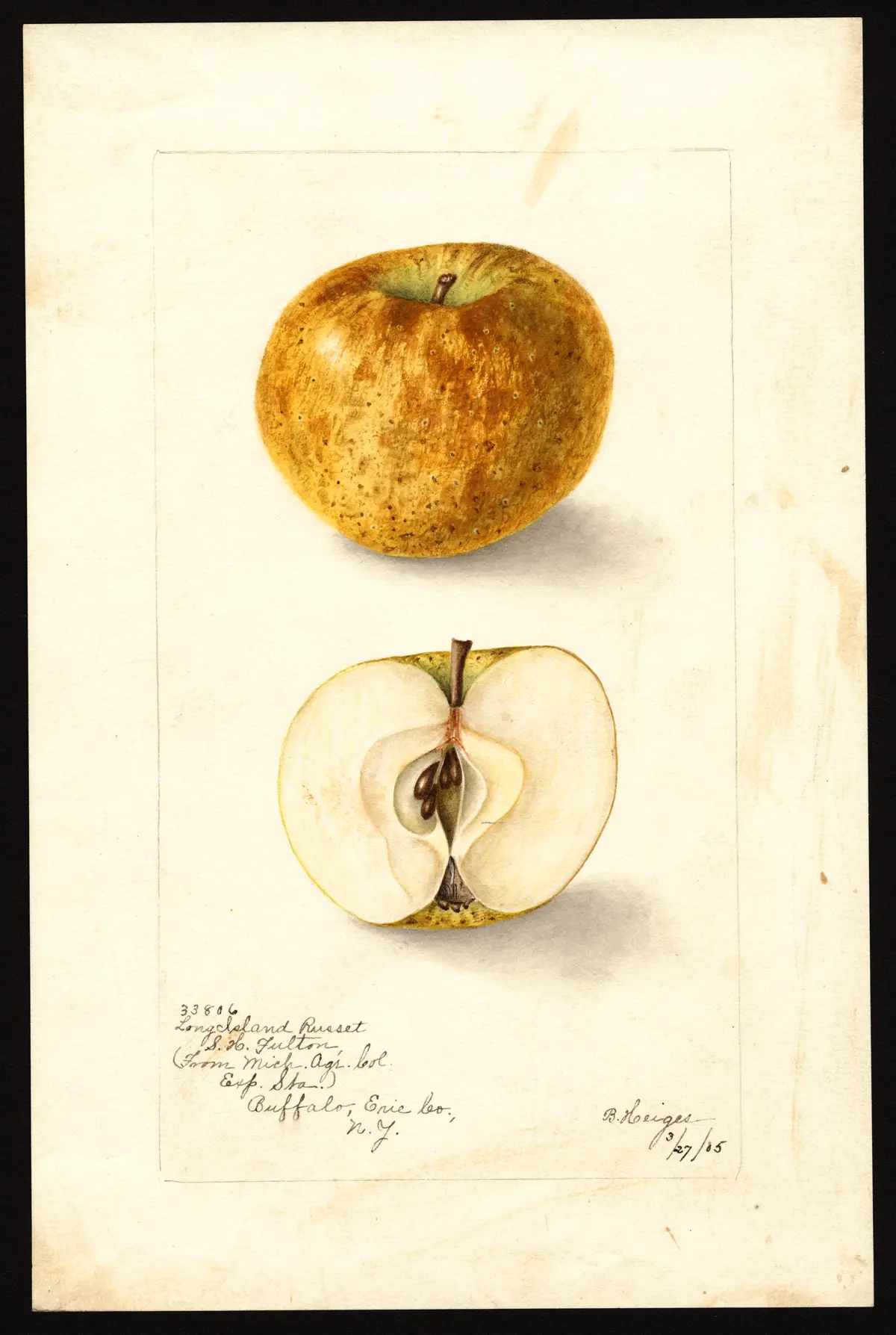
USDA Pomological Watercolor Collection
Long Island Russet
[NOTE: Source text may be incorrect — Beach's second account, his "(H)" section, describes fruit he received under the name Long Island Russet. He states that it "does not correspond with the description by Coxe" and that he could not identify it with any named variety. Its details are kept below and marked as Beach's fruit. They may describe a different apple from the Long Island Russet of Coxe, Elliott, and Downing.]
Origin / History
An old apple, described by Coxe in 1817. Much grown in New Jersey and on Long Island (Downing). Formerly much grown on Long Island and in Westchester county, where it was considered profitable, but nearly obsolete by 1905 (Beach).
Tree
Vigorous, spreading, and productive (Downing).
Fruit
Size: Small to medium, mostly given as small or below medium; Elliott calls it medium. Beach's fruit is medium to small, sometimes nearly large, and not very uniform in size.
Form: Roundish to rather oblong; Coxe has it diminishing toward the crown. Beach's fruit is roundish to somewhat oblong, narrowing toward the basin, sometimes approaching truncate cylindrical. It often has an oblique axis, and is irregular and not very uniform in shape.
Stem: A full inch in length, planted very deep (Coxe). The stem of Beach's fruit is short to medium and moderately slender.
Cavity: Beach's fruit has a large, acute cavity, usually deep and broad, green or russeted, sometimes furrowed.
Calyx: Beach's fruit has the calyx closed or partly open, with rather narrow, acute lobes. Calyx tube conical to funnel-shaped, with a wide limb and narrow cylinder. Stamens basal to nearly median.
Basin: Very hollow at the crown (Coxe). Beach's fruit has the basin often oblique and of medium depth. It is rather narrow to moderately wide, rather abrupt, and a little furrowed and wrinkled.
Skin: Yellow to dull yellowish, mostly overspread with dull russet, clouded with black spots or blotches; Downing says the spots or blotches appear when fully ripe. Coxe finds it very much in appearance like the Coopers Russeting, and Beach calls its general appearance attractive for a russet. Beach's fruit has a tough skin, more or less covered with golden russet. It usually keeps some patches of smooth bright yellow or green, irregularly marked with indistinct grayish scarf-skin. Its prevailing effect is usually golden russet.
Dots: Beach's fruit has inconspicuous, scattering dots, gray or russet.
Flesh and flavor: Flesh yellowish (Downing) or greenish (Elliott), tough (Downing), dry to rather dry. Flavor "sweet" (Coxe) or "almost sweet" (Downing), though Warder, as cited by Beach, classes it with the subacid apples. Beach's fruit has flesh tinged a decided deep yellow, firm, at first rather crisp or hard but often becoming tough. It is moderately fine, juicy, and sprightly subacid; quality "very good."
Core and seeds: Beach's fruit has a rather small core, sometimes medium, abaxile or sometimes axile. Cells often unsymmetrical, closed or open. Core lines meeting or somewhat clasping. Carpels smooth or nearly so, broadly roundish to angular-ovate. They are wide at the middle and taper toward base and apex, slightly emarginate if at all, sometimes slightly tufted. Seeds numerous, dark brown, medium in size, moderately narrow, plump, obtuse to acute, sometimes tufted.
Season
October to February or December to March. A long keeper: Coxe says "this apple keeps well," and Hicks, quoted by Beach, calls it "a long keeper, sometimes keeping till apples come again." Beach's fruit is in season November to midwinter or later.
Uses
A cider apple, valued highly for cider purposes (Downing) and particularly valued for cider on Long Island and in Westchester county (Beach). Coxe says it "makes a very sweet sirupy cider, which when fined is much admired."
Subtypes / Variants
Beach received an unidentified apple under the name Long Island Russet and illustrated it in a color plate. It came from various parts of Long Island, from the Hudson valley, and from one locality in Michigan. He found it did not correspond with Coxe's description and could not identify it with any named variety. In 1905 he reported it no longer planted and fast becoming obsolete, represented only by old trees.
Other
Not described in source.
Book Sources
Described in 4 period pomological works
View original book sources (4)
— William Coxe, A View of the Cultivation of Fruit Trees (1817)NO. 36. LONG ISLAND RUSSET. This is a small apple, very much in appearance like the Coopers Russeting; the form is rather oblong, diminishing towards the crown, which is very hollow; the stalk is a full inch in length, planted very deep the flesh is dry and sweet; makes a very sweet sirupy cider, which when fined is much admired the skin is of a yellow russet, clouded with black spots this apple keeps well.
— F.R. Elliott, The Western Fruit Book (1865)Long Island Russet.
Medium, roundish oblong, dull yellowish russet ; flesh, greenish, dry. December, March.
— A.J. Downing, The Fruits and Fruit Trees of America (1900)Long Island Russet.
An old Apple, much grown in New Jersey and Long Island, and valued highly for cider purposes. Tree vigorous, spreading, and productive.
Fruit below medium, roundish, yellow, mostly overspread with dull russet, black spots or blotches when fully ripe. Flesh yellowish, tough, rather dry, almost sweet. October to February.
— S.A. Beach, The Apples of New York, Vol. 1 (1905)(I) LONG ISLAND RUSSET.
REFERENCES. 1. Coxe, 1817:123. fig. 2. Robey, Horticulturist, 11:89. 1856. 3. Elliott, 1858:173. 4. Warder, 1867:725. 5. Downing, 1869:255. 6. Am. Pom. Soc. Cat., 1875:10. 7. Bailey, An. Hort., 1892:243. 8. Hicks, Rural N. Y., 53:205. 1894. 9. Thomas, 1897:643.
SYNONYM. English Russet (8).
This variety was formerly much grown on Long Island and in Westchester county, where it was considered profitable and particularly valued for cider (1, 8). It is now nearly obsolete. Coxe describes it as "Small, * * * rather oblong, diminishing towards the crown, which is very hollow; the stalk is a full inch in length, planted very deep the flesh is dry and sweet; makes a very sweet, sirupy cider, which when fined is much admired the skin is a yellow russet, clouded with black spots this apple keeps well." Elliott gives its season as December to March (3). Downing (5) gives the season as October to February. "Flesh yellowish, tough, rather dry, almost sweet." Warder (4) classes it with the subacid apples. Hicks (8) says "it is a long keeper, sometimes keeping till apples come again." Its general appearance is attractive for a russet.
(H) LONG ISLAND RUSSET.
From various parts of Long Island and from one locality in Michigan we have received under the name Long Island Russet the variety which is described below and illustrated in the accompanying color plate. This fruit has also come to us from the Hudson valley. It is evident that it does not correspond with the description by Coxe cited above. We have been unable to identify it with any named variety. So far as we can learn this variety is no longer being planted and is fast becoming obsolete, being represented now only by old trees.
FRUIT. Fruit medium to small, sometimes nearly large. Form roundish to somewhat oblong, narrowing toward the basin, sometimes approaching truncate cylindrical, often with an oblique axis, irregular; not very uniform in size and shape. Stem short to medium, moderately slender. Cavity large, acute, usually deep, broad, green or russeted, sometimes furrowed. Calyx closed or partly open; lobes rather narrow, acute. Basin often oblique, of medium depth, rather narrow to moderately wide, rather abrupt, a little furrowed and wrinkled. Skin tough, more or less covered with golden russet but usually with some patches of smooth bright yellow or green, irregularly marked with indistinct grayish scarf-skin. Dots inconspicuous, scattering, gray or russet. Prevailing effect is usually golden russet. Calyx tube conical to funnel-shape, with a wide limb and narrow cylinder. Stamens basal to nearly median. Core rather small, sometimes medium, abaxile or sometimes axile; cells often unsymmetrical, closed or open; core lines meeting or somewhat clasping. Carpels smooth or nearly so, broadly roundish to angular-ovate, wide at the middle and tapering toward the base and apex, but slightly emarginate if at all, sometimes slightly tufted. Seeds numerous, dark brown, medium in size, moderately narrow, plump, obtuse to acute, sometimes tufted. Flesh tinged with a decided deep yellow, firm, at first rather crisp or hard, but often becoming tough, moderately fine, sprightly subacid, juicy, very good. Season November to midwinter or later.