Louise
Apple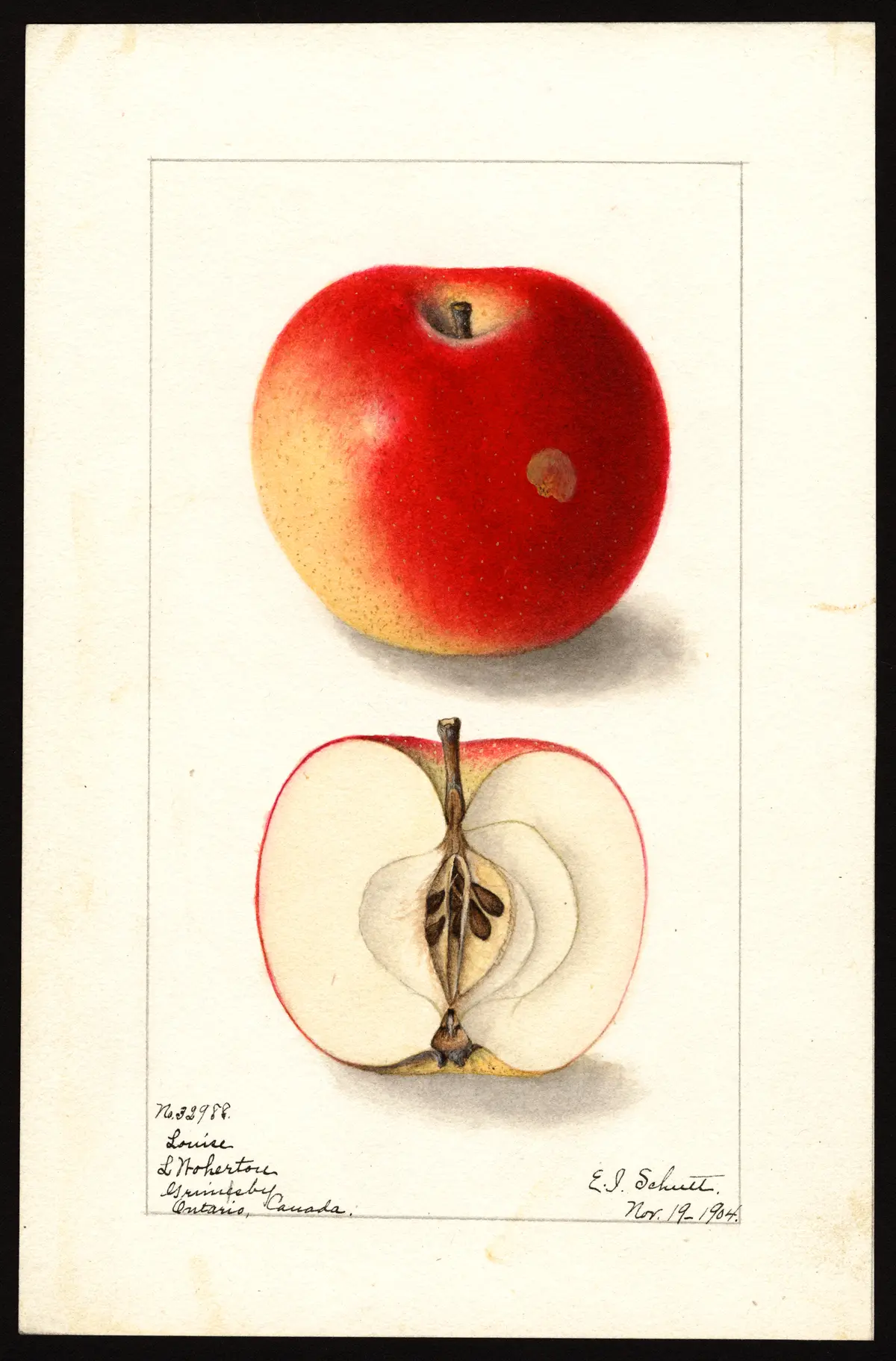
USDA Pomological Watercolor Collection
Louise
Origin/History
Louise originated with L. Woolverton near Grimsby, Ontario, Canada, about 1875 (per Hedrick), as a chance seedling that sprang up among a half dozen old Fameuse trees on Woolverton's farm. It is probably from Fameuse seed and belongs to the Fameuse group. It was first exhibited before the Ontario Fruit Growers' Association in 1879 under the name "Woolverton." It was disseminated to a limited extent only in New York, and the McIntosh has sometimes been mistakenly disseminated for this variety. Louise is little known outside of Canada (Hedrick).
Tree
Tree medium in size, moderately vigorous to vigorous (Beach) / vigorous (Hedrick), with long, slender branches and willowy laterals. Form upright-spreading to roundish, rather dense. Twigs moderately long, straight or somewhat irregularly curved, rather geniculate, slender; internodes medium. Bark reddish-brown with some pale olive-green, lightly mottled with scarf-skin; somewhat pubescent toward the tips. Lenticels scattering, small to medium, roundish to oblong. Buds small to medium, deep-set, plump, acute, free or nearly so, somewhat pubescent.
The tree is hardy, healthy, comes into bearing rather young, and yields fair to moderately good crops almost annually. The tree is much the same as that of its parent Fameuse (Hedrick).
Fruit
Size: Sources differ slightly. Hansen describes the fruit as medium; Beach as "good medium size"; Hedrick as medium; Lowther lists it as large. Louise is larger than Fameuse but not as large as McIntosh (Beach). Fairly uniform in size and shape.
Form: Roundish (Lowther, Hedrick), or roundish oblate, regular, obscurely angular (Hansen); usually roundish, sometimes roundish oblate, often somewhat elliptical or obscurely angular, with sides often unequal (Beach, Hedrick).
Stem: Red, medium to rather long (Beach) / long (Hedrick), usually slender.
Cavity: Wide, obtuse, regular, green (Hansen); obtuse to acute or sometimes approaching acuminate, shallow to medium in depth, moderately broad, frequently furrowed (Beach); obtuse, sometimes acuminate, shallow, broad, furrowed (Hedrick).
Calyx: Closed, with segments connivent (Hansen); medium size, closed or sometimes slightly open (Beach, Hedrick).
Basin: Smooth, rather shallow (Hansen); usually shallow to medium in depth, narrow to moderately wide, rather obtuse, lightly furrowed and wrinkled (Beach); shallow, narrow, obtuse, lightly furrowed and wrinkled (Hedrick).
Skin: Sources differ on ground color and amount of red. Hansen: surface greenish yellow, almost or wholly covered with a fine solid dark red, with obscure splashes of darker red, sometimes with thin open network of russet. Beach: skin thin, rather tough, clear pale yellow or greenish, with lively red or pinkish blush, striped obscurely if at all, overspread with thin bloom; of a clear pale yellow color with lively blush and delicate bloom; shows bruises readily and requires very careful handling. Hedrick: skin thin, tough, pale yellow, with lively red blush, striped obscurely if at all, overspread with thin bloom; the red overlays a very yellow background with a lively blush, the whole apple overspread with soft bloom; less red in color than Fameuse. Lowther codes the color as "wr" (white/red blush type). Louise has less red color than Fameuse and is less attractive than either Fameuse or McIntosh (Beach).
Dots: Obscure, numerous, minute, whitish (Hansen); inconspicuous, pale, usually submerged (Beach); inconspicuous, pale, submerged (Hedrick).
Calyx tube: Funnel-shaped (Hansen); short, wide, conical to funnel-form (Beach); short, wide, conical (Hedrick).
Stamens: Median (Hansen, Hedrick); median to basal (Beach).
Core: Half open (Hansen); medium to rather large, somewhat abaxile (Beach); large, abaxile (Hedrick). Cells round, entire (Hansen); cells symmetrical, partly open (Beach, Hedrick); core lines meeting (Beach, Hedrick). Carpels elongated ovate, sometimes emarginate (Beach); elongated-ovate (Hedrick).
Seeds: Few, short, plump (Hansen); medium or below, moderately long, acute to acuminate (Beach); long, acute (Hedrick).
Flesh and Flavor: Tender, juicy, snow white, fine grained, pleasant, aromatic subacid, of the Fameuse type, very good (Hansen). Flesh whitish, not very firm, fine, crisp, very tender, very juicy, mild subacid, aromatic, with some of the perfume and texture of McIntosh, very good for dessert (Beach). Flesh white, fine, crisp, tender, juicy, mild subacid, aromatic, with some of the perfume of McIntosh; good to very good (Hedrick). Quality: good (Lowther). Has a distinctive flavor and aroma, though in general the fruits fall short of those of Fameuse and the better-known McIntosh of the same group (Hedrick).
Season
October to December (Hansen); October to February or later (Beach, Hedrick); winter (Lowther).
Uses
Very desirable for dessert use, but for culinary purposes decidedly inferior to other varieties of its season (Beach). Family use (Lowther). It is doubtful whether it will ever prove a desirable commercial variety (Beach). Shows bruises readily and requires very careful handling (Beach).
Subtypes/Variants
Not described in source.
Other
Not described in source.
Book Sources
Described in 4 period pomological works
Nursery Catalog Sources
Found in 3 catalogs (1900–1913) from Illinois
- Central Experimental Farm , Dominion Department of Agriculture, Agassiz, British Columbia (under test; Bulletin No. 3, Second Series) — 1900
- Benjamin Buckman (personal inventory) , Farmingdale , Illinois — 1901
- Benjamin Buckman (personal inventory) , Farmingdale , Illinois — 1913
View original book sources (4)
— N.E. Hansen, A Study of Northwestern Apples (1902)Louise (Princess Louise)— Originated near Grimsby, Ontario, Canada, on farm of L. Woolverton, probably from Fameuse seed—Fruit medium, roundish oblate, regular, obscurely angular, surface greenish yellow, almost or wholly covered with a fine solid dark red, with obscure splashes of darker red, sometimes with thin open network of russet; dots obscure, numerous, minute, whitish; cavity wide, obtuse, regular, green; stem medium, slender; basin smooth, rather shallow; calyx closed, segments connivent. Core half open; cells round, entire; tube funnel-shaped; stamens median; seeds few, short, plump; flesh tender, juicy, snow white, fine grained, pleasant, aromatic subacid, (Fameuse type), very good. October to December.
— S.A. Beach, The Apples of New York, Vol. 2 (1905)LOUISE.
REFERENCES. 1. Woolverton, Am. Pom. Soc. Rpt., 1889:155. 2. Can. Hort., 15:19, 28. 1892. 3. Bailey, An. Hort., 1892:247. 4. Can. Hort., 16:401. 1893. 5. Beach, N. Y. Sta. An. Rpt., 12:601. 1893. 6. Hoskins, Rural N. Y., 53:278. 1894. 7. Smith, Can. Hort., 18:349. 1895. 8. Lyon, Mich. Sta. Bul., 143:200. 1897. 9. Am. Pom. Soc. Cat., 1899:18. 10. Waugh, Vt. Sta. Bul., 83:91. 1900. 11. Woolverton, Can. Hort., 23:46. 1900. fig. 12. Ib., Ont. Fr. Stas. An. Rpt., 7:8. 1900. figs. 13. Hansen, S. D. Sta. Bul., 76:69. 1902. 14. Budd-Hansen, 1903:117. fig. 15. Farrand, Mich. Sta. Bul., 205:45. 1903.
SYNONYMS. LOUISE (8, 10, 13, 15). LOUISE, Princess (9, 14). PRINCESS LOUISE (1, 2, 3, 4, 5, 6, 11, 12). Princess Louise (7, 10, 13). WOOLVERTON (7). Woolverton (4, 11, 12).
Louise is an apple of the Fameuse group. It is larger than Fameuse but not as large as McIntosh and has less red color and is less attractive than either of these apples. It is very desirable for dessert use but for culinary purposes it is decidedly inferior to other varieties of its season. It is of a clear pale yellow color with lively blush and delicate bloom. It shows bruises readily and requires very careful handling. The tree is hardy, healthy, comes into bearing rather young and yields fair to moderately good crops almost annually. It is doubtful whether it will ever prove a desirable commercial variety.
Historical. Originated with L. Woolverton, Grimsby, Ontario, who states that it was a chance seedling that sprung up among a half dozen old Fameuse trees.¹ It was first exhibited before the Ontario Fruit Growers' Association in 1879 under the name of "Woolverton." It has been disseminated to a limited extent only in New York. The McIntosh has sometimes been mistakenly disseminated for this variety.
TREE.
Tree medium size, moderately vigorous to vigorous with long, slender branches and willowy laterals. Form upright spreading to roundish, rather dense. Twigs moderately long, straight or somewhat irregularly curved, rather geniculate, slender; internodes medium. Bark reddish-brown with some pale olive-green, lightly mottled with scarf-skin; somewhat pubescent toward the tips. Lenticels scattering, small to medium, roundish to oblong. Buds small to medium, deep-set, plump, acute, free or nearly so, somewhat pubescent.
FRUIT.
Fruit of good medium size; fairly uniform in size and shape. Form usually roundish, sometimes roundish oblate, often somewhat elliptical or obscurely angular; sides often unequal. Stem red, medium to rather long, usually slender. Cavity obtuse to acute or sometimes approaching acuminate, shallow to medium in depth, moderately broad, frequently furrowed. Calyx medium size, closed or sometimes slightly open. Basin usually shallow to medium in depth, narrow to moderately wide, rather obtuse, lightly furrowed and wrinkled.
Skin thin, rather tough, clear pale yellow or greenish, with lively red or pinkish blush, striped obscurely if at all, overspread with thin bloom. Dots inconspicuous, pale, usually submerged.
Calyx tube short, wide, conical to funnel-form. Stamens median to basal.
Core medium to rather large, somewhat abaxile; cells symmetrical, partly open; core lines meeting. Carpels elongated ovate, sometimes emarginate. Seeds medium or below, moderately long, acute to acuminate.
Flesh whitish, not very firm, fine, crisp, very tender, very juicy, mild subacid, aromatic, with some of the perfume and texture of McIntosh, very good for dessert.
Season October to February or later.
— Granville Lowther (ed.), Encyclopedia of Practical Horticulture (1914)Louise (also called Princess L.). Size: large. Form: roundish. Color: wr. Quality: good. Use: family. Season: winter.
— U.P. Hedrick, Cyclopedia of Hardy Fruits (1922)LOUISE. Princess Louise. Woolverton.
Louise is a seedling of Fameuse, from which it differs in having fruits a little larger and much less red in color, the red overlaying a very yellow background with a lively blush, the whole apple being overspread with soft bloom. The tree is much the same as that of its parent. Though at best very handsome, with a distinctive flavor and aroma, in general the fruits fall short of those of Fameuse and the better-known McIntosh of the same group. Louise originated with L. Woolverton, Grimsby, Ontario, about 1875, and is little known outside of Canada.
Tree medium in size, vigorous, upright-spreading, dense, with long, slender branches and willowy laterals. Fruit medium in size, uniform in size and shape, round or round-oblate, often elliptical or obscurely angular, sides often unequal; stem red, long, slender; cavity obtuse, sometimes acuminate, shallow, broad, furrowed; calyx closed or slightly open; basin shallow, narrow, obtuse, lightly furrowed and wrinkled; skin thin, tough, pale yellow, with lively red blush, striped obscurely if at all, overspread with thin bloom; dots inconspicuous, pale, submerged; calyx-tube short, wide, conical; stamens median; core large, abaxile; cells symmetrical, partly open; core-lines meeting; carpels elongated-ovate; seeds long, acute; flesh white, fine, crisp, tender, juicy, mild subacid, aromatic, with some of the perfume of McIntosh; good to very good; October to February or later.