Loy
Apple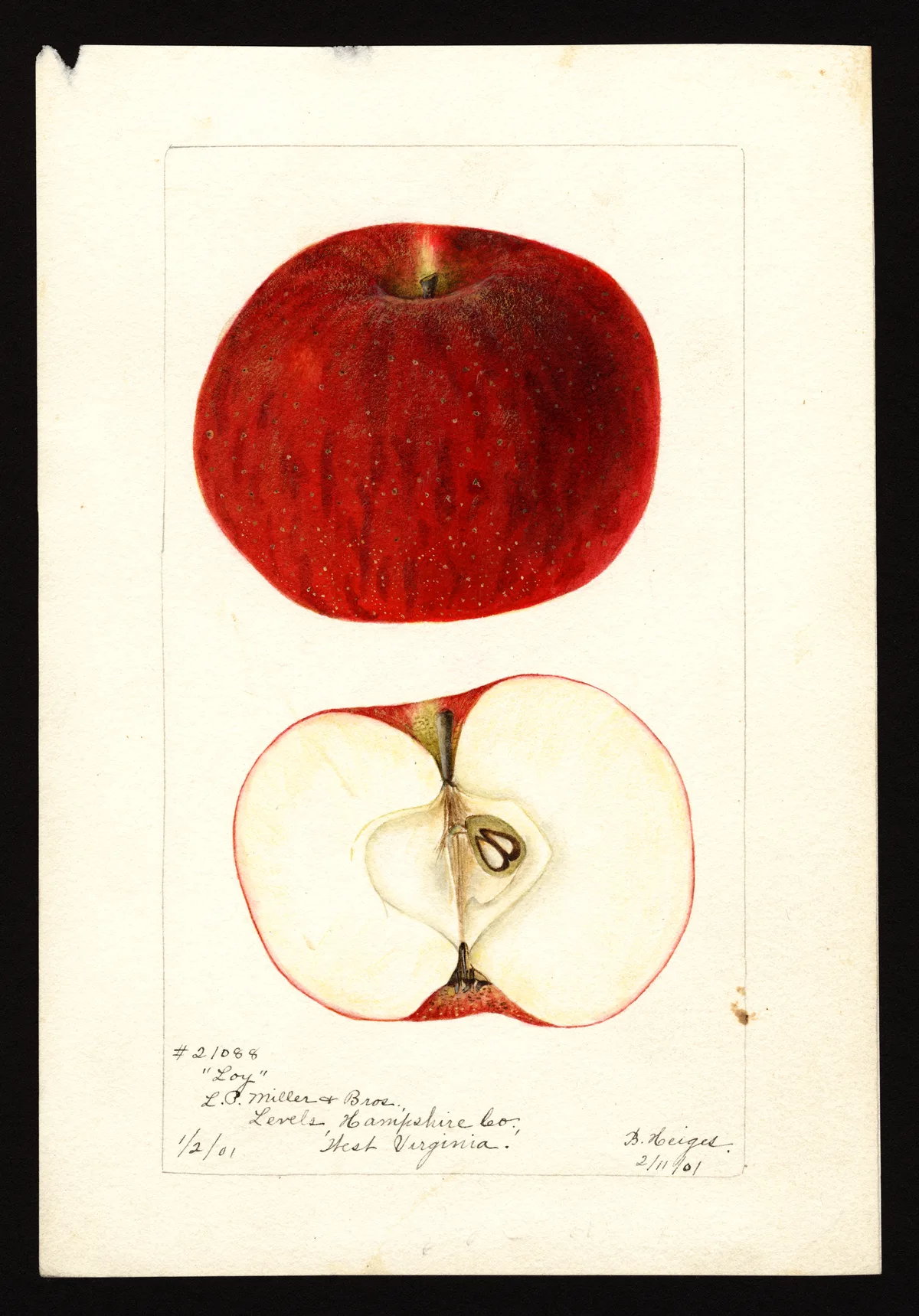
USDA Pomological Watercolor Collection
Loy
[NOTE: Source text may be incorrect — the entries under "Locy" (Downing, quoted by Elliott) describe a greenish apple shaded and striped with dull red, ripe November to February. Beach's entry (headed "LOU") describes a striped red apple ripe in early August, originated by Gideon in the 1880s or earlier. The two may be different varieties.]
Origin / History
Originated from seed of Oldenburg by Peter M. Gideon, Excelsior, Minn., from whom it was received in 1888 for testing at the Station (Beach). Beach: "A striped red apple of fairly good quality in season in early August"; "It is not valuable for planting in New York." Beach gives no synonyms. Downing describes the fruit under the name "Locy"; Elliott (1865) quotes his description, crediting "(Downing.)". No origin is given in either.
Tree
Beach: a good grower, comes into bearing rather young, and is a reliable biennial cropper.
Fruit
Size: Not described in source.
Form: Globular, sometimes inclining to oblate, and sometimes oblong or conic.
Stem: Short.
Cavity: Small, acute.
Calyx: Closed.
Basin: Open, furrowed.
Skin: Greenish, shaded and striped with dull red. Beach describes a striped red apple.
Dots: Not described in source.
Flesh and flavor: Flesh greenish, crisp, tender, juicy. Flavor "very pleasant, brisk, vinous." Downing's verdict: "Hardly good." Beach: "fairly good quality."
Core and seeds: Not described in source.
Season
Early August (Beach). November to February (Downing, quoted by Elliott).
Uses
Not described in source.
Subtypes / Variants
Not described in source.
Other
Beach's references: Am. Pom. Soc. Rpt., 1885:28; Mo. Hort. Soc. Rpt., 1886:233; Mich. Sta. Bul., 118:60, 1895; Beach, Paddock and Close, N. Y. Sta. An. Rpt., 15:272, 1896; Mich. Sta. Bul., 143:200, 1897.
Book Sources
Described in 3 period pomological works
- Beach, The Apples of New York Vol. 2 (1905) — listed as Lou
- Downing, Fruits and Fruit Trees of America (1900) — listed as Locy
- Elliott, The Western Fruit Book (1865) — listed as Locy
Nursery Catalog Sources
Found in 7 catalogs (1891–1913) from Illinois, Missouri
- Missouri Nursery Co. , Louisiana , Missouri — 1891
- The Vineland Nurseries (Kelsey & Co. , Proprietors), St. Joseph, Missouri (Office: 13th and Atchison Sts., 2 Blocks East of the Citizens St. Car Line) — 1894
- J.V. Cotta (Cotta Nursery) , Carroll County , Illinois — 1898
- Central Experimental Farm , Dominion Department of Agriculture, Agassiz, British Columbia (under test; Bulletin No. 3, Second Series) — 1900
- Mountain Grove Nurseries (Tippin & Moore , Proprietors; Geo. T. Tippin, J. W. Tippin, J. C. Moore), Mountain Grove , Missouri — 1901
- Benjamin Buckman (personal inventory) , Farmingdale , Illinois — 1901
- Benjamin Buckman (personal inventory) , Farmingdale , Illinois — 1913
View original book sources (3)
— F.R. Elliott, The Western Fruit Book (1865)Locy.
Globular, sometimes inclining to oblate, and sometimes oblong or conic; skin, greenish, shaded and striped with dull red; stalk, short, inserted in a small, acute cavity; calyx, closed, in an open, furrowed basin; flesh, greenish, crisp, tender, juicy, with a very pleasant, brisk, vinous flavor. November, February. (Downing.)
— A.J. Downing, The Fruits and Fruit Trees of America (1900)Locy. Fruit globular, sometimes inclining to oblate, and sometimes oblong or conic, greenish, shaded and striped with dull red. Flesh greenish, crisp, tender, juicy, pleasant. Hardly good. November, February.
— S.A. Beach, The Apples of New York, Vol. 2 (1905)LOU.
REFERENCES. 1. Am. Pom. Soc. Rpt., 1885:28. 2. Mo. Hort. Soc. Rpt., 1886:233. 3. Mich. Sta. Bul., 118:60. 1895. 4. Beach, Paddock and Close, N. Y. Sta. An. Rpt., 15:272. 1896. 5. Mich. Sta. Bul., 143:200. 1897.
SYNONYMS. None.
A striped red apple of fairly good quality in season in early August. The tree is a good grower, comes into bearing rather young and is a reliable biennial cropper. It was originated from seed of Oldenburg by Peter M. Gideon, Excelsior, Minn., from whom it was received in 1888 for testing at this Station. It is not valuable for planting in New York.