Mason's Stranger
Apple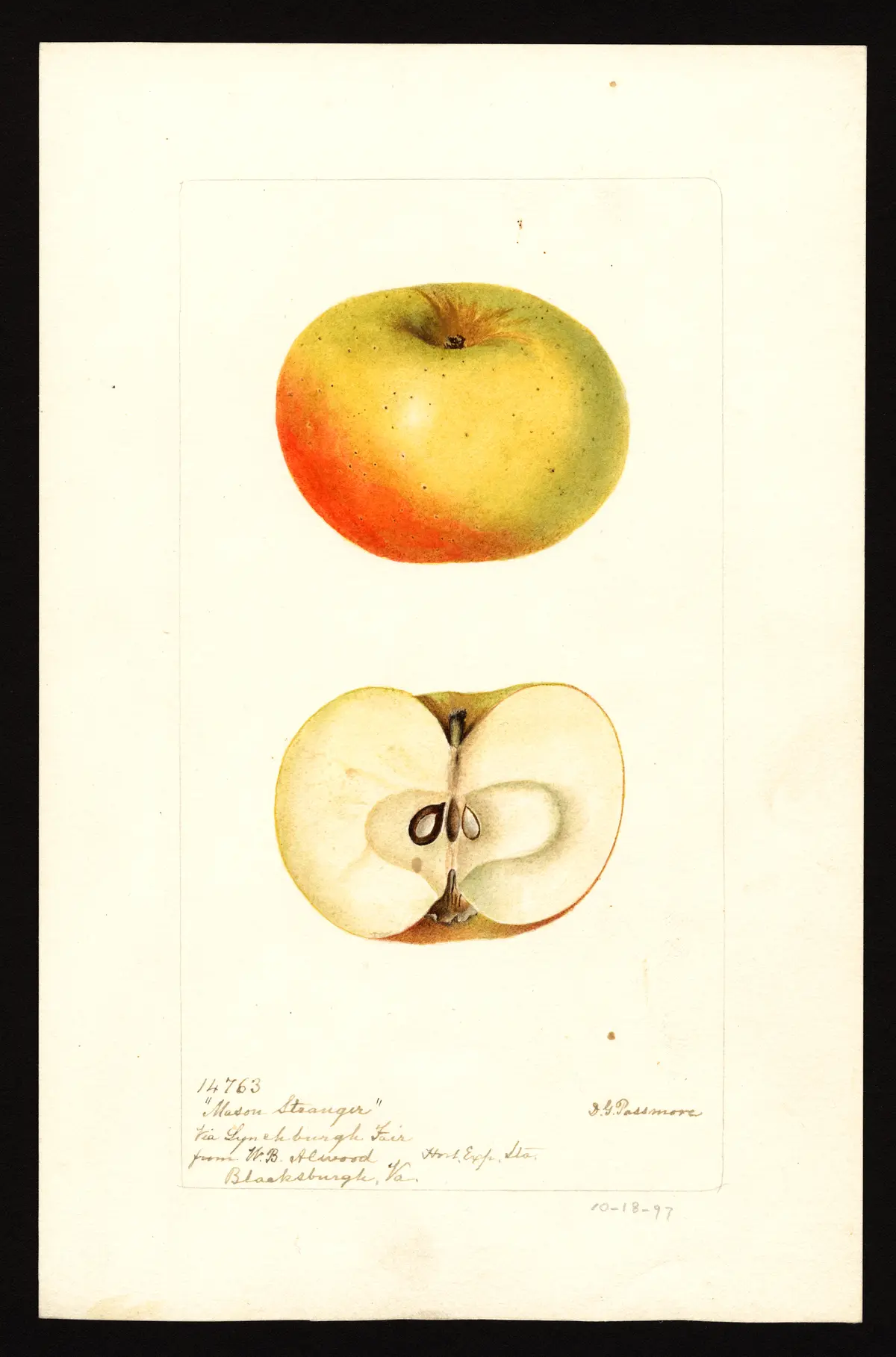
USDA Pomological Watercolor Collection
Mason's Stranger
Origin / History
A chance seedling found on the farm of Dr. George Mason, Virginia. Downing calls it a popular and favorite apple where it originated.
Tree
Tree vigorous, forming a large symmetric head; very productive, a heavy annual bearer. Young shoots brownish red.
Fruit
Size: Medium.
Form: Oblate, somewhat depressed; Lowther gives "flat".
Stem: Short, small.
Cavity: Large, slight russet.
Calyx: Open.
Basin: Large, deep, smooth.
Skin: Light, bright yellow, sometimes a shade of light red where exposed to the sun.
Dots: Few, brownish.
Flesh and flavor: Flesh whitish, fine, rather compact, crisp, juicy. Flavor mild subacid, inclining to sweet, somewhat spicy and rich. Quality "very good".
Core and seeds: Core small.
Season
Winter; December to February.
Uses
Both kitchen and market (Lowther).
Subtypes / Variants
Not described in source.
Other
Not described in source.
Book Sources
Described in 3 period pomological works
- Downing, Fruits and Fruit Trees of America (1900)
- Budd & Hansen, Systematic Pomology (1914) — listed as Mason Stranger
- Lowther (ed.), Encyclopedia of Practical Horticulture (1914) — listed as Mason's Strange
Nursery Catalog Sources
Found in 2 catalogs (1901–1913) from Illinois
- Benjamin Buckman (personal inventory) , Farmingdale , Illinois — 1901
- Benjamin Buckman (personal inventory) , Farmingdale , Illinois — 1913
View original book sources (3)
— A.J. Downing, The Fruits and Fruit Trees of America (1900)Mason's Stranger.
Mason's Pippin. Old Field. Izzard.
A chance seedling found on the farm of Dr. George Mason, Virginia. Tree of vigorous growth, forming a large symmetric head, very productive annually; a popular and favorite apple where it originated; young shoots brownish red.
Fruit medium, oblate, somewhat depressed; skin bright yellow, sometimes a shade of light red where exposed to the sun, and a few brownish dots; stalk short, small; cavity large, slight russet; calyx open; basin large, deep, smooth; flesh whitish, fine, rather compact, crisp, juicy, mild subacid, inclining to sweet, somewhat spicy and rich; very good; core small. December, February.
— J.L. Budd & N.E. Hansen, American Horticultural Manual, Part II: Systematic Pomology (1914)Mason Stranger.—Origin, Virginia; a chance seedling on the farm of Dr. Geo. Mason; tree vigorous, a heavy annual bearer.
Fruit medium, oblate, somewhat depressed; surface light, bright yellow, sometimes a shade of light red where exposed to the sun; dots few, brownish; cavity large, slight russet; stem short, small; basin large, deep, smooth; calyx open. Core small; flesh whitish, fine, rather compact, crisp, juicy, mild subacid, inclining to sweet, somewhat spicy and rich, very good. December, February.
— Granville Lowther (ed.), Encyclopedia of Practical Horticulture (1914)Mason's Strange. Size: medium. Form: flat. Quality: very good. Use: both kitchen and market. Season: winter. No division station counts recorded.