Monsees
Apple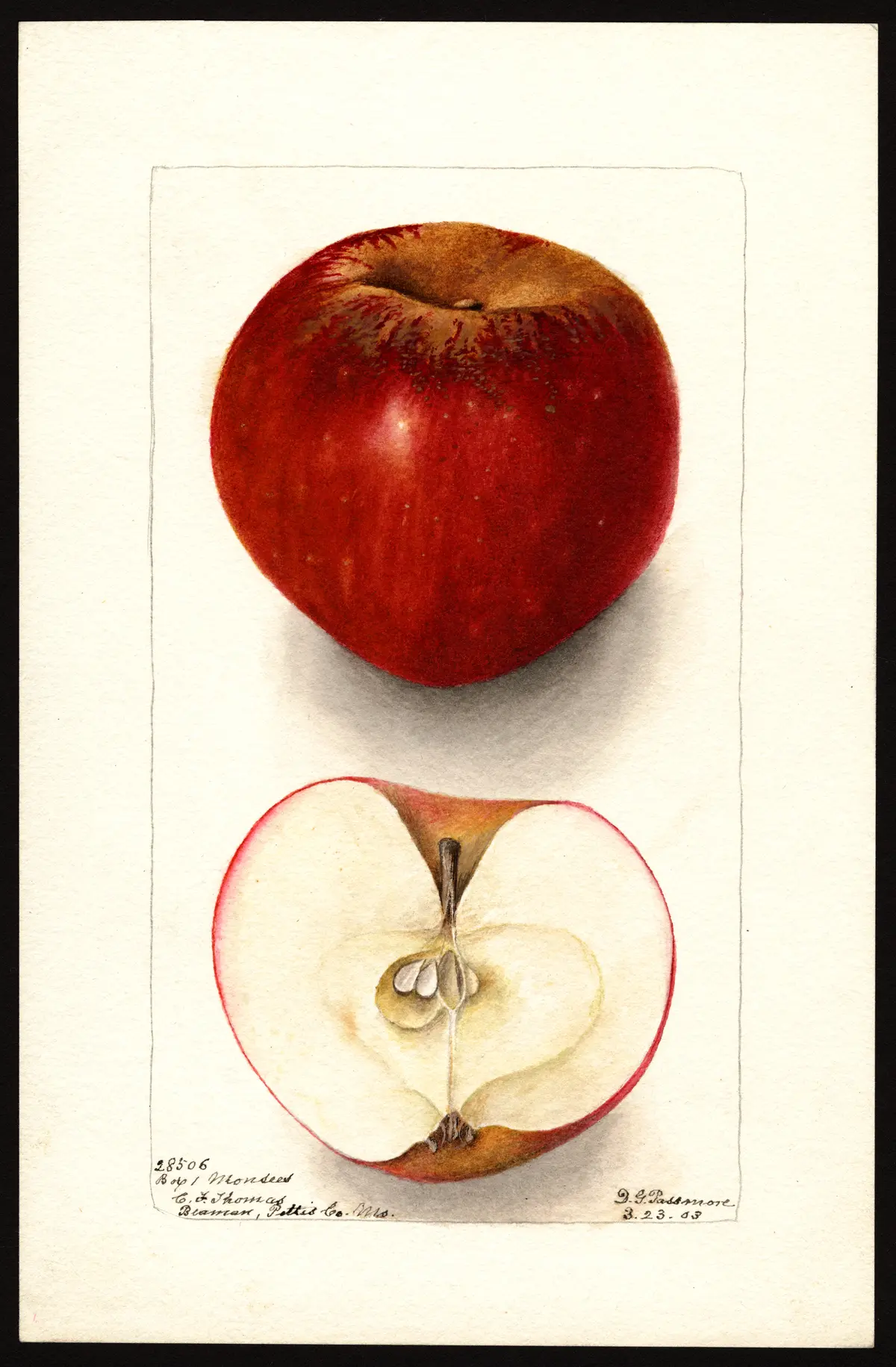
USDA Pomological Watercolor Collection
Monsees
Origin and History
Monsees was originated by J. H. Monsees of Beaman, Missouri. Initially named Hopewell, but this name was already occupied by a Pennsylvania variety, so the variety was renamed after its originator. It is a recent introduction and is described as a handsome fruit that is intermediate in appearance between Ben Davis and Winesap.
Fruit
Size and Form: Large to very large, roundish, conical.
Surface: Rich yellow, almost or wholly covered with fine dark red with crimson stripes and splashes.
Dots: Distinct, few, minute, russet.
Stem: Short.
Cavity: Deep, acute, russeted, with rays often extending out over base.
Basin: Shallow, ribbed and corrugated; sometimes very shallow.
Calyx: Open; segments short, erect convergent.
Core and Seeds: Core closed; cells round, slit; tube funnel-shaped; stamens median; seeds plump.
Flesh and Flavor: White, pleasant subacid, good.
Season
Winter.
Tree
Not described in source.
Uses
Not described in source.
Subtypes and Variants
Not described in source.
Book Sources
Described in 1 period pomological work
Nursery Catalog Sources
Found in 1 catalog (1913) from Illinois
- Benjamin Buckman (personal inventory) , Farmingdale , Illinois — 1913
View original book sources (1)
— J.L. Budd & N.E. Hansen, American Horticultural Manual, Part II: Systematic Pomology (1914)Monsees. — Originated by J. H. Monsees, Beaman, Mo. At first named Hope well, but this name is already occupied by a variety from Pennsylvania. The Monsees is of recent introduction and is a handsome fruit, intermediate in appearance between Ben Davis and Winesap.
Fruit large to very large, roundish, conical ; surface a rich yellow, almost or wholly covered with fine dark red with crimson stripes and splashes; dots distinct, few, minute, russet; cavity deep, acute, russeted, the rays often extending out over base; stem short; basin shallow, ribbed and corrugated, sometimes very shallow; calyx open; segments short, erect convergent. Core closed; cells round, slit; tube funnel-shaped; stamens median; seeds plump; flesh white, pleasant subacid, good. Season, winter.