Northwestern Greening
Apple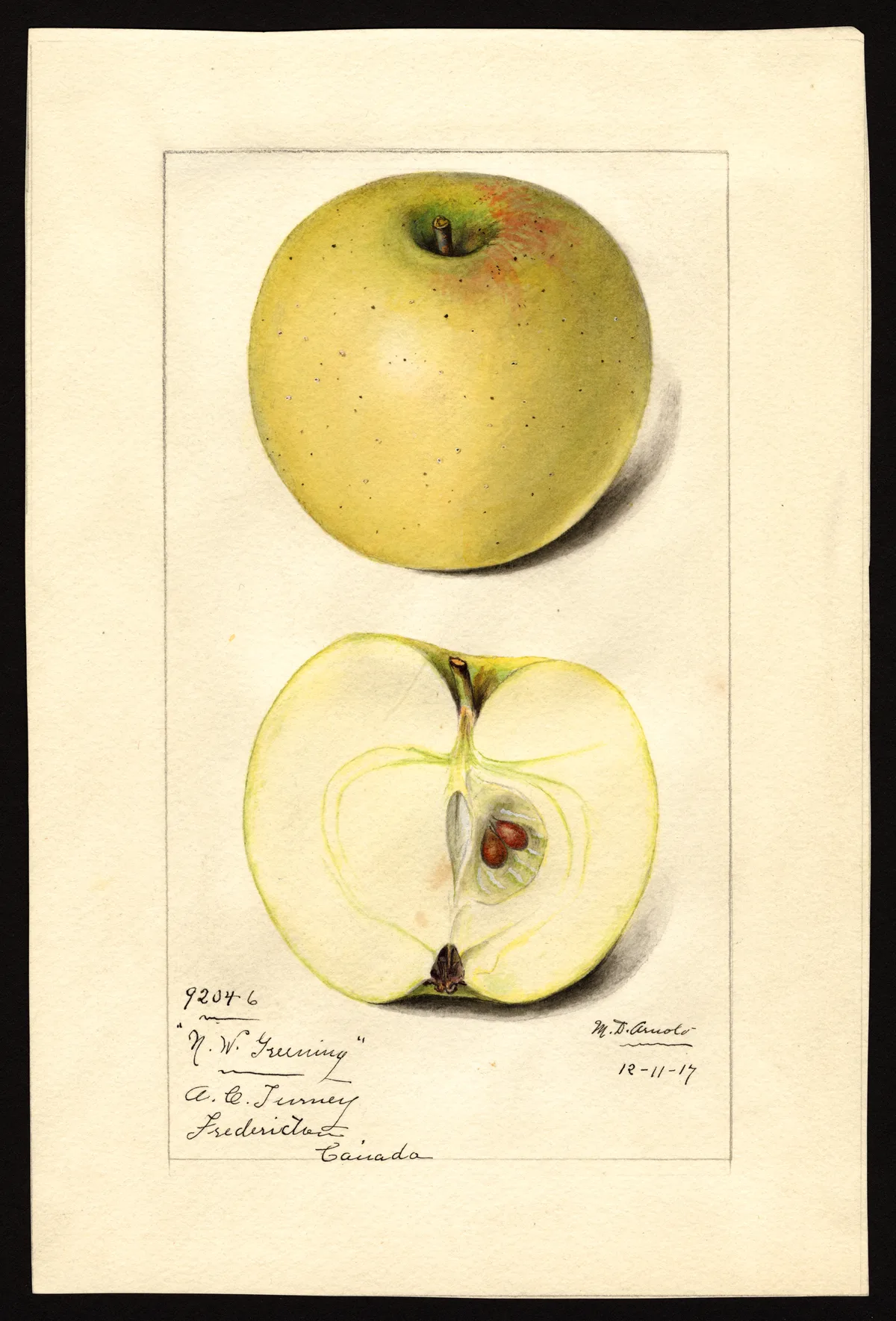
USDA Pomological Watercolor Collection
Northwestern Greening
Origin / History
Originated in Waupaca County, Wisconsin, and introduced in 1872 by E. W. Daniels (Hansen; Budd-Hansen; Beach). Beach notes it was first described in 1885 (citing Am. Pom. Soc. Rpt., 1885:27), while Hedrick states it "was first described in 1895." It has been widely disseminated throughout the northern portions of the apple belt where very hardy trees are desired (Beach), and plays an important part in the fruit-growing of Wisconsin and Minnesota (Hedrick). As of Beach's writing it had as yet been planted but very little in New York.
Tree
A free grower, spreading (Thomas). Tree vigorous, with moderately long, stout, crooked branches (Beach; Hedrick describes the branches as long, stout, and crooked). Form upright becoming quite roundish or spreading, inclined to droop, dense (Beach); Hedrick characterizes the form as upright-spreading and dense. The tree grows with rapidity and vigor (Hedrick), and is described as a fine erect grower in the nursery and a good strong grower in the orchard (Beach). Possessed of a constitution which enables it to endure as much cold as any other apple excepting, possibly, a few Russian sorts (Hedrick); it is hardier than Rhode Island Greening (Beach). Extremely hardy and one of the best apples for the north; a strong, vigorous grower, very productive (Stark Bros.).
It does not come into bearing very early but eventually becomes productive and is a reliable biennial cropper (Beach); Hedrick similarly notes that while it does not bear early, it eventually becomes a reliable and productive producer.
J. S. Harris, quoted by Hansen and by Budd-Hansen: "It does a little better top-worked on hardy stocks, i.e., crabs and hybrids." (Minn. Hort. Rep., 1895, p. 155.)
Twigs: Moderately long, curved, stout with large terminal buds; internodes medium to long (Beach).
Bark: Clear reddish-brown, lightly mottled with scarf-skin, lightly pubescent (Beach).
Lenticels: Quite numerous, medium to large, oval or elongated, raised, very conspicuous, pale and contrasting clearly with the bright smooth bark (Beach).
Buds: Large, broad, plump, obtuse, free, projecting, slightly pubescent (Beach).
Fruit
Size
Large to very large (Hansen; Budd-Hansen; Hedrick); medium to large or very large, variable in size (Beach); large (Thomas); large in size (Lowther). Beach and Hedrick both note the fruit is variable in size and form, and Beach observes it is "apt to be variable in size and not uniform in shape."
Form
Roundish oblong, slightly conical, truncated, regular (Hansen; Budd-Hansen). Oblate, inclined to conic (Thomas). Roundish conical (Lowther). Beach gives the fullest account: "Form commonly roundish but varying to oblong or to oblate and often inclined to conic, more or less irregular, sometimes elliptical, sometimes ribbed." Hedrick: "round, oblong or oblate, often conic, more or less irregular, sometimes elliptical, sometimes ribbed."
Stem
Rather short (Hansen; Budd-Hansen); short (Hedrick); medium to short (Beach).
Cavity
Hansen and Budd-Hansen: regular, deep, acute, sometimes slightly russeted. Beach: rather small to large, acute to acuminate, moderately narrow to wide, deep, often compressed or lipped, often with outspreading russet. Hedrick: small, acute, narrow, deep, often compressed or lipped, with outspreading russet.
Calyx
Open (Hansen; Budd-Hansen). Variable, small to large, closed or open (Beach). Variable, small, closed or open (Hedrick).
Basin
Regular, finely wrinkled around the eye (Hansen; Budd-Hansen). Small to large, narrow to wide, usually abrupt, moderately deep, furrowed and wrinkled (Beach). Small, narrow, abrupt, deep, furrowed and wrinkled (Hedrick).
Skin
Surface yellowish green, unctuous (Hansen; Budd-Hansen). Pale yellow when fully ripe (Thomas). Green in color (Lowther). Greenish-yellow, slightly mottled (Stark Bros.). Beach: smooth, somewhat waxy, clear pale yellow or greenish, sometimes faintly blushed; prevailing effect clear yellow or greenish. Hedrick: smooth, waxy, pale yellow, sometimes faintly blushed; prevailing effect yellow. Beach also remarks it is "attractive in color for a green or yellowish apple."
Dots
White, small, some with gray bases, a few large russet dots (Hansen; Budd-Hansen). Varying from small to large and irregular, usually whitish and submerged, sometimes gray with russet point (Beach). Small or large and irregular, usually white and submerged, sometimes gray with russet point (Hedrick).
Flesh / Flavor
Greenish yellow, firm, juicy, subacid, good (Hansen; Budd-Hansen). Coarse, juicy, mild, good (Thomas). Beach: tinged with yellow, medium in texture, crispness and firmness, juicy, with slight aroma, mild subacid, fair to good. Hedrick: yellow, crisp, firm, juicy, mild subacid; fair to good. Quality is "very good" (Lowther), while Beach and Hedrick consider it mediocre — Beach noting it is "not of high flavor or quality being much inferior in this respect to Rhode Island Greening," and as a dessert apple ranks fair to good in quality; Hedrick: "the apples are mediocre in quality." A serious fault noted by Beach and echoed by Hedrick: the flesh within the core lines is apt to be corky and discolored. Beach adds that it cooks evenly and quickly and when cooked has a fine yellow color.
Core / Seeds
Core closed, clasping; tube funnel-shaped, broad; stamens median (Hansen; Budd-Hansen). Beach: Calyx tube moderately wide, conical or approaching urn-shape; stamens median; core medium or above, usually axile or nearly so; cells usually symmetrical, closed or sometimes open; core lines meeting or somewhat clasping; carpels broadly roundish, truncate at base, narrowing toward the apex, mucronate, but slightly emarginate if at all; seeds very small, variable in shape, often some are abortive. Hedrick: calyx-tube wide, conical or urn-shaped; stamens median; core large, axile; cells symmetrical, closed or open; core-lines meeting; carpels broadly round, mucronate; seeds small, often abortive.
Season
All winter (Hansen; Budd-Hansen). December to April (Thomas). November to April (Hedrick). Winter (Lowther). A splendid keeper (Stark Bros.). Beach gives a detailed account of its keeping behavior at the New York Station: "it has not been a satisfactory keeper in common storage, the rate of loss being high in November and sometimes in December, moderate through the winter and gradually rising to high or very high in the closing weeks of its season. A large part of the fruit does not reach prime condition before January, a considerable portion of it remains sound at the close of the winter and some of it may keep till June."
Uses
Suited to both kitchen and market use (Lowther). Cooks evenly and quickly and when cooked has a fine yellow color (Beach). As a dessert apple it ranks fair to good in quality (Beach).
Subtypes / Variants
Not described in source.
Other
Lowther reports the variety from 2 stations in the Northern Division, 7 stations in the Central Division, and 1 station in the Southern Division, with an asterisk on each division count indicating the variety is reported as adapted to more than one division. Beach considers it worthy of cultivation in districts where the climate is too severe for the Rhode Island Greening, on account of its greater hardiness.
Book Sources
Described in 6 period pomological works
USDA Nomenclature (1905)
From W.H. Ragan, Nomenclature of the Apple, USDA Bulletin No. 56
Originated in Waupaca County
Nursery Catalog Sources
Found in 22 catalogs (1893–1932) from Illinois, Missouri, Oregon, Washington
- Milwaukie-Canby Nurseries , Canby, OR (and Milwaukie, OR) — 1893
- Multnomah Nurseries , Russellville , Oregon — 1894
- Cotta Nursery (J.V. Cotta) , Carroll County , Illinois — 1895
- Stark Bros. Nurseries & Orchards Co. , Louisiana , Missouri — 1896
- Stark Bros. Nurseries & Orchards Co. , Louisiana , Missouri — 1898
- Washington Nursery Co. , Toppenish , Washington — 1901
- Phoenix Nursery Company (W. E. Rossney , President; Sidney Tuttle, Vice-President), Bloomington , Illinois — 1904
- Stark Bros. Nurseries & Orchards Co. , Louisiana , Missouri — 1906
- Carlton Nursery Co. , Carlton , Oregon — 1909
- Washington Nursery Company , Toppenish , Washington — 1909
- Stark Bros. Nurseries & Orchards Co. , Louisiana , Missouri — 1910
- Stark Bros. Nurseries & Orchards Co. , Louisiana , Missouri — 1911
- Pacific Nursery Company , Portland , Oregon — 1912
- Stark Bros. Nurseries & Orchards Co. , Louisiana , Missouri — 1912
- Vineland Nurseries Company , Clarkston , Washington — 1912
- Washington Nursery Company , Toppenish , Washington — 1912
- Union Nurseries , J.B. Weaver & Sons, Union , Oregon — 1915
- Stark Bros. Nurseries & Orchards Co. , Louisiana , Missouri — 1918
- Oregon Nursery Co. , Orenco , Oregon — 1920
- Christopher Nurseries / John Stewart & Sons , Christopher , Washington — 1920
- Benedict Nursery Co. , Portland , Oregon — 1921
- Stark Bro's Nurseries , Louisiana , Missouri — 1932
View original book sources (7)
— N.E. Hansen, A Study of Northwestern Apples (1902)Northwestern Greening—Origin, Waupaca County, Wisconsin, introduced in 1872 by E. W. Daniels—Fruit large to very large, roundish oblong, slightly conical, truncated, regular; surface yellowish green, unctuous; dots white, small, some with gray bases, a few large russet dots; cavity regular, deep, acute, sometimes slightly russeted; stem rather short; basin regular, finely wrinkled around the eye; calyx open. Core closed, clasping; tube funnel-shaped, broad; stamens median; flesh greenish yellow, firm, juicy, subacid, good. All winter. J. S. Harris: "It does a little better top-worked on hardy stocks, i. e., crabs and hybrids." (Minn. Hort. Rep., 1895, p. 155.)
— John J. Thomas, The American Fruit Culturist (1903)Northwestern Greening. Tree a free grower, spreading; fruit large, oblate, inclined to conic; skin pale yellow when fully ripe; flesh coarse, juicy, mild, good. Season December to April. Wisconsin.
— S.A. Beach, The Apples of New York, Vol. 1 (1905)NORTHWESTERN GREENING.
REFERENCES. 1. Am. Pom. Soc. Rpt., 1885:27. 2. Rural N. Y., 44:150. 1885. figs. 3. Van Deman, U. S. Pom. Rpt., 1886:271. 4. Bailey, An. Hort., 1892:245. 5. Shepherd, Can. Hort., 16:205. 1893. 6. Ib., 17:84. 1894. 7. Beach, N. Y. Sta. An. Rpt. 14:254. 1895. 8. Hansen, S. D. Sta. Bul., 76:77. 1902. fig. 9. Munson, Me. Sta. An. Rpt., 18:84, 90. 1902. 10. Thomas, 1897:343. 11. Budd-Hansen, 1903:138. fig. 12. Macoun, Can. Dept. Agr. Rpt., 1903:95. 13. Powell and Fulton, U. S. B. P. I. Bul., 48:51. 1903. 14. Beach and Clark, N. Y. Sta. Bul., 248:135. 1904.
SYNONYMS. NORTH WEST GREENING (5, 6). NORTHWESTERN GREENING (1, 3, 4, 7, 8, 9, 10, 12, 13).
Attractive in color for a green or yellowish apple but apt to be variable in size and not uniform in shape. It is hardier than Rhode Island Greening and on that account some consider it worthy of cultivation in districts where the climate is too severe for the Rhode Island Greening. The fruit has a serious fault in that the flesh within the core lines is apt to be corky and discolored. It cooks evenly and quickly and when cooked has a fine yellow color but is not of high flavor or quality being much inferior in this respect to Rhode Island Greening. As a dessert apple it ranks fair to good in quality. At this Station it has not been a satisfactory keeper in common storage, the rate of loss being high in November and sometimes in December, moderate through the winter and gradually rising to high or very high in the closing weeks of its season. A large part of the fruit does not reach prime condition before January, a considerable portion of it remains sound at the close of the winter and some of it may keep till June. The tree is hardy, vigorous, a fine erect grower in the nursery, and a good strong grower in the orchard. It does not come into bearing very early but eventually becomes productive and is a reliable biennial cropper.
Historical. Originated in Waupaca county, Wisconsin. Introduced in 1872 by E. W. Daniels (1, 11). It has been pretty widely disseminated throughout the northern portions of the apple belt where very hardy trees are desired (1, 4, 5, 8, 11). It has as yet been planted but very little in New York.
TREE.
Tree vigorous with moderately long, stout, crooked branches. Form upright becoming quite roundish or spreading, inclined to droop, dense. Twigs moderately long, curved, stout with large terminal buds; internodes medium to long. Bark clear reddish-brown, lightly mottled with scarf-skin, lightly pubescent. Lenticels quite numerous, medium to large, oval or elongated, raised, very conspicuous, pale and contrasting clearly with the bright smooth bark. Buds large, broad, plump, obtuse, free, projecting, slightly pubescent.
FRUIT.
Fruit medium to large or very large, variable in size and form. Form commonly roundish but varying to oblong or to oblate and often inclined to conic, more or less irregular, sometimes elliptical, sometimes ribbed. Stem medium to short. Cavity rather small to large, acute to acuminate, moderately narrow to wide, deep, often compressed or lipped, often with outspreading russet. Calyx variable, small to large, closed or open. Basin small to large, narrow to wide, usually abrupt, moderately deep, furrowed and wrinkled. Skin smooth, somewhat waxy, clear pale yellow or greenish, sometimes faintly blushed. Dots varying from small to large and irregular, usually whitish and submerged, sometimes gray with russet point. Prevailing effect clear yellow or greenish. Calyx tube moderately wide, conical or approaching urn-shape. Stamens median. Core medium or above, usually axile or nearly so; cells usually symmetrical, closed or sometimes open; core lines meeting or somewhat clasping. Carpels broadly roundish, truncate at base, narrowing toward the apex, mucronate, but slightly emarginate if at all. Seeds very small, variable in shape; often some are abortive. Flesh tinged with yellow, medium in texture, crispness and firmness, juicy, with slight aroma, mild subacid, fair to good.
— J.L. Budd & N.E. Hansen, American Horticultural Manual, Part II: Systematic Pomology (1914)Northwestern Greening.—Origin, Waupaca Co., Wisconsin; introduced in 1872 by E. W. Daniels.
Fruit large to very large, roundish oblong, slightly conical, truncated, regular; surface yellowish green, unctuous; dots white, small, some with gray bases, a few large russet dots; cavity regular, deep, acute, sometimes slightly russeted; stem rather short; basin regular, finely wrinkled around the eye; calyx open. Core closed, clasping; tube funnel-shaped, broad; stamens median; flesh greenish yellow, firm, juicy, subacid, good. All winter.
J. S. Harris: "It does a little better top-worked on hardy stocks, i.e., crabs and hybrids." (Minn. Hort. Rep., 1895, p. 155.)
— Granville Lowther (ed.), Encyclopedia of Practical Horticulture (1914)Northwestern Greening is large in size, roundish conical in form, and green in color. Quality is very good. It is suited to both kitchen and market use. Season is winter. Reported by 2 stations in the Northern Division, 7 stations in the Central Division, and 1 station in the Southern Division; the asterisk on each division count indicates the variety is reported as adapted to more than one division.
— U.P. Hedrick, Cyclopedia of Hardy Fruits (1922)NORTHWESTERN GREENING. Fig. 38. Possessed of a constitution which enables it to endure as much cold as any other apple excepting, possibly, a few Russian sorts, Northwestern Greening has found a niche in the apple flora of the cold Northwest that it fills very well. The tree grows with rapidity and vigor, and while it does not bear early, eventually becomes a reliable and productive producer. The apples are mediocre in quality, and the flesh within the core-lines is often corky and discolored. Northwestern Greening originated in Waupaca County, Wisconsin, and was first described in 1895. It plays an important part in the fruit-growing of Wisconsin and Minnesota.
Tree vigorous, upright-spreading, dense, with long, stout, crooked branches. Fruit large or very large, variable in size and form, round, oblong or oblate, often conic, more or less irregular, sometimes elliptical, sometimes ribbed; stem short; cavity small, acute, narrow, deep, often compressed or lipped, with outspreading russet; calyx variable, small, closed or open; basin small, narrow, abrupt, deep, furrowed and wrinkled; skin smooth, waxy, pale yellow, sometimes faintly blushed; dots small or large and irregular, usually white and submerged, sometimes gray with russet point; prevailing effect yellow; calyx-tube wide, conical or urnshaped; stamens median; core large, axile; cells symmetrical, closed or open; core-lines meeting; carpels broadly round, mucronate; seeds small, often abortive; flesh yellow, crisp, firm, juicy, mild subacid; fair to good; November to April.
— Stark Bros. Nurseries & Orchards Co., Stark Bros. Year Book (1910) (1910)Greenish-yellow, slightly mottled, with a splendid keeper. This is extremely hardy and one of the best apples for the north. A strong, vigorous grower, very productive. NCS