Ogden
Apple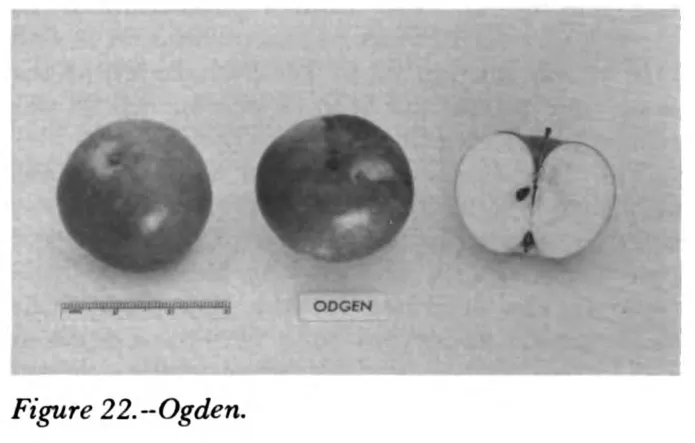
Ogden
Origin / History
Ogden originated from the cross Zusoff x McIntosh, made in 1912. It is a sister seedling of Kendall. The breeding record number was 12581, and the seedling number was Station 3609. It was selected in 1926 from a population of 24 seedlings. Without benefit of a second test, it was introduced in 1928. It was named for the township of Ogden in Monroe County, New York, and was briefly described in the Register of New Fruit and Nut Varieties.
Nursery trees of Ogden were sold by the New York State Fruit Testing Association for 27 years, 1929-55. In the 1960-68 period, it was sold by one commercial nursery. In 1954, Ogden was tested at experiment stations in Colorado, Massachusetts, and Nova Scotia. In 1963, a survey of apple clones in the United States showed that it was tested at stations in Michigan, New York, Pennsylvania, South Dakota, and Wyoming. In 1968, it was tested at stations in New York, North Carolina, and Pennsylvania.
Tree
Ogden trees are very large, vigorous, upright, tall, dense, and round-topped. They are productive but alternate in bearing. The trunks are stocky, and the trunk bark is shaggy. The bark of 2- or 3-year-old branches is darker in color than that of most other cultivars. Ogden trees bloom very late, more than 2 days after Delicious.
Fruit
Size: Ogden fruits are medium sized to large, mostly 2¾ to 3 inches in diameter.
Form: Round-oblate, somewhat irregular in shape, with a slight tendency to be five-sided.
Stem: Slender, short to medium in length.
Cavity: Somewhat obtuse, deep, medium in width, and somewhat furrowed. On most fruits, the cavity is slightly russeted, and on about 30 percent of the fruits, it is lipped.
Calyx: The calyx lobes are medium in length, narrow, and acute. The calyx tube is long, narrow, and conic. The stamens are located in a median position.
Basin: Medium in depth and width, abrupt, somewhat furrowed, and usually symmetrical.
Skin: Medium in thickness and toughness, smooth, glossy, and covered with heavy bloom. The skin color is 90 percent light, bright red, and 10 percent greenish ground. The color pattern is striped, sometimes with thin purple stripes radiating from the cavity. There sometimes is a slight scarfskin, and the general appearance is only medium attractive. Dayton found that in the skin of Ogden fruits, 85 percent of the cells in the epidermal layer and 99 percent of the cells in the outer hypodermal layer contained red pigment.
Dots: Small, white, and obscure.
Flesh and flavor: The flesh is nearly white, with a greenish tinge in slightly immature fruits, but with a distinctly pink tinge in some overripe fruits. The flesh is semifirm, fine grained, tender, slightly juicy, sweet, and aromatic. The eating quality is fair.
Core and seeds: The core is medium sized and somewhat open. The carpels are ovate. The seeds are numerous, large, wide, plump, long, and acute.
Season
Ogden averages a ripening date at Geneva of September 29, 11 days before Delicious. The average number of days from full bloom to harvest is 132, 13 fewer than Delicious. The fruits drop readily from the tree after they have ripened. The keeping quality is fair, about 80 days when held at 31°F.
Uses
The eating quality is fair, and the flesh is sweet and aromatic. Ogden is of no commercial value because there is very little commercial market for a sweet flavored cultivar. It is not recommended for planting. Its harvest season and fruit type are too similar to Delicious.
Subtypes / Variants
Not described in source.
Other
Ogden is illustrated in Figure 22 of the source. The variety is diploid, and the pollen is viable.
Book Sources
Described in 1 period pomological work
Nursery Catalog Sources
Found in 2 catalogs (1901–1913) from Illinois
- Benjamin Buckman (personal inventory) , Farmingdale , Illinois — 1901
- Benjamin Buckman (personal inventory) , Farmingdale , Illinois — 1913
View original book sources (1)
— Roger D. Way, Apple Cultivars Introduced by the New York State Agricultural Experiment Station, 1914–1968 (1971)Ogden
Origin. Ogden originated from the cross, Zusoff x McIntosh, made in 1912. It is a sister seedling of Kendall (see Kendall). The breeding record number was 12581, and the seedling number was Station 3609. It was selected in 1926 from a population of 24 seedlings. Without benefit of a second test, it was introduced in 1928 (Table 2). It was named for the township of Ogden in Monroe County, New York. It was briefly described in the Register of New Fruit and Nut Varieties (31).
Tree. Ogden trees are very large, vigorous, upright, tall, dense, and round-topped. They are productive but alternate in bearing (Table 5). The tree characteristics are summarized in Table 5. The trunks are stocky, and the trunk bark is shaggy. The bark of 2- or 3-year-old branches is darker in color than that of most other cultivars.
Pollination. Ogden trees bloom very late, more than 2 days after Delicious (Table 6). It is diploid (Table 4), and the pollen is viable.
Fruit. Ogden fruits are illustrated in Figure 22. The fruit characteristics are summarized in Table 8. The average ripening date at Geneva is September 29, 11 days before Delicious (Table 7). The average number of days from full bloom to harvest is 132, 13 fewer than Delicious. The fruits drop readily from the tree after they have ripened.
Ogden fruits are medium sized to large, mostly 2¾ to 3 inches in diameter. They are round-oblate, somewhat irregular in shape, and have a slight tendency to be five-sided. The stem is slender, and it is short to medium in length. The cavity is somewhat obtuse, deep, medium in width, and somewhat furrowed. On most fruits, the cavity is slightly russeted, and on about 30 per cent of the fruits, it is lipped. The calyx lobes are medium in length, narrow, and acute. The basin is medium in depth and width, abrupt, somewhat furrowed, and usually symmetrical.
Figure 22.--Ogden.
The skin is medium in thickness and toughness, smooth, glossy, and covered with heavy bloom. The skin color is 90 per cent light, bright red, and 10 per cent greenish ground. The color pattern is striped and sometimes with thin purple stripes radiating from the cavity. There sometimes is a slight scarfskin, and the general appearance is only medium attractive. Dayton (60) found that in the skin of Ogden fruits, 85 per cent of the cells in the epidermal layer and 99 per cent of the cells in the outer hypodermal layer contained red pigment.
The dots on Ogden fruits are small, white, and obscure. The calyx tube is long, narrow, and conic. The stamens are located in a median position. The core is medium sized and somewhat open. The carpels are ovate. The seeds are numerous, large, wide, plump, long, and acute.
The flesh of Ogden fruits is nearly white, with a greenish tinge in slightly immature fruits, but with a distinctly pink tinge in some overripe fruits. The flesh is semifirm, fine grained, tender, slightly juicy, sweet, and aromatic. The eating quality is fair. The keeping quality is fair, about 80 days when held at 31°F (Table 10).
Commercial Usefulness. Nursery trees of Ogden were sold by the New York State Fruit Testing Association for 27 years, 1929-55 (Table 2). In the 1960-68 period, it was sold by one commercial nursery (Table 3).
In 1954, Ogden was tested at experiment stations in Colorado, Massachusetts, and Nova Scotia. In 1963, a survey of apple clones in the United States (79) showed that it was tested at stations in Michigan, New York, Pennsylvania, South Dakota, and Wyoming. In 1968 (172), it was tested at stations in New York, North Carolina, and Pennsylvania.
In summary: Ogden is of no commercial value because there is very little commercial market for a sweet flavored cultivar. It is not recommended for planting. Its harvest season and fruit type are too similar to Delicious.