Zusoff
Apple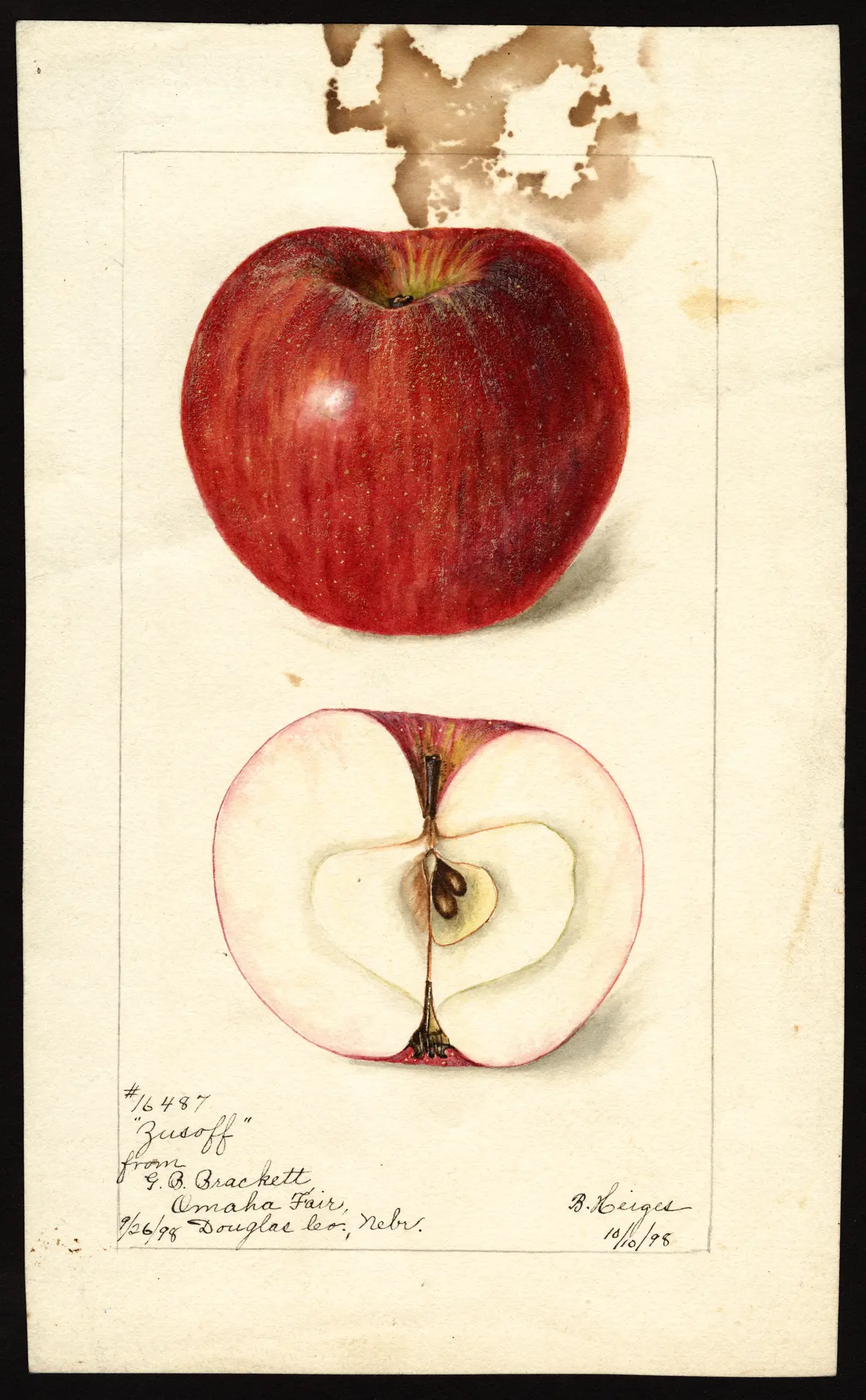
USDA Pomological Watercolor Collection
Zusoff
Origin / History
Of Russian origin (Russia, Hansen; "Russian," Thomas). For a time Anisim was mixed with Zusoff, but the two are very distinct (Hansen). The Russian Nomenclature Committee entry gives "Winter Zuzoff of Tuttle". Thomas (1903) lists it as "Zukoff's Winter", Russian.
Tree
Tree upright, a good grower, a tardy bearer.
Fruit
Size: Large, heavy. Size 8 to 9 (Russian Nomenclature Committee).
Form: Roundish oblate, round-oblate; regular or faintly angular (Hansen), rather angular (Russian Nomenclature Committee). Thomas alone gives irregular conical.
Stem: Very short (Hansen), short and stout (Russian Nomenclature Committee).
Cavity: Abrupt, very deep, regular, green and russet, the russet sometimes extending out in irregular rays (Hansen). Broad, medium, deep (Russian Nomenclature Committee). Thomas gives medium.
Calyx: Small, closed; segments small, erect convergent. Calyx tube conical; stamens median (Hansen).
Basin: Small, regular (Hansen); narrow, abrupt (Russian Nomenclature Committee). Thomas gives small.
Skin: Smooth, glossy, greenish yellow, almost or wholly covered with a peculiar dark brownish red; no stripes nor splashes. A showy fruit. Russian Nomenclature Committee and Thomas give greenish, nearly or quite overspread or covered with dark red.
Dots: Minute, numerous, whitish, distinct (Hansen); many, white (Russian Nomenclature Committee).
Flesh and flavor: Flesh white, with greenish tinge and veinings, juicy, firm, fine grained; subacid. Quality "good" (Hansen; Thomas).
Core and seeds: Core regular, clasping (Hansen); closed, small (Russian Nomenclature Committee). Seeds few, plump.
Season
Winter; Thomas gives mid-winter.
Uses
Not described in source.
Subtypes / Variants
Not described in source.
Other
Numbered 585 by Hansen and by Budd & Hansen. Thomas illustrates it as Fig. 462.
Book Sources
Described in 3 period pomological works
- Hansen, A Study of Northwestern Apples (1902) — listed as Zuzoff
- Budd & Hansen, Systematic Pomology (1914) — listed as Zusoff (No. 585)
- Thomas, The American Fruit Culturist (1903) — listed as Zukoff's Winter
Nursery Catalog Sources
Found in 3 catalogs (1900–1913) from Illinois
- Central Experimental Farm , Dominion Department of Agriculture, Agassiz, British Columbia (under test; Bulletin No. 3, Second Series) — 1900
- Benjamin Buckman (personal inventory) , Farmingdale , Illinois — 1901
- Benjamin Buckman (personal inventory) , Farmingdale , Illinois — 1913
View original book sources (3)
— N.E. Hansen, A Study of Northwestern Apples (1902)Zuzoff (No. 585)—Origin, Russia. For a time Anisim was mixed with this variety, but the two are very distinct—Fruit large, heavy, roundish oblate, regular or faintly angular; surface smooth, glossy, greenish yellow, almost or wholly covered with a peculiar dark brownish red, no stripes nor splashes, a showy fruit; dots minute, numerous, whitish, distinct; cavity abrupt, very deep, regular, green and russet, the russet sometimes extending out in irregular rays; stem very short; basin small, regular; calyx closed, segments small, erect convergent. Core regular, clasping; tube conical; stamens median; seeds few, plump; flesh white, with greenish tinge and veinings, juicy, firm, fine grained, subacid, good. Winter.
"ZUZOFF.
DESCRIPTION: Zuzoff—Winter Zuzoff of Tuttle—Size, 8 to 9; form, round-oblate, rather angular; color, greenish, nearly or quite overspread with dark red with many white dots; cavity, broad, medium, deep; stem short, stout; basin, narrow, abrupt; calyx, small, closed; core, closed, small; flavor subacid; season winter; tree upright, good grower, tardy bearer." (Rus. Nom. Com.)
— John J. Thomas, The American Fruit Culturist (1903)Zukoff's Winter. Large, irregular conical, greenish, nearly covered with dark red; cavity medium, basin small; flesh white, sub-acid, juicy, quality good. Mid-winter. Fig. 462. Russian.
[Additional entry in this volume: "Zusoff", pp. 372–372]
Zukoff's Winter. Large, irregular conical, greenish, nearly covered with dark red; cavity medium, basin small; flesh white, sub-acid, juicy, quality good. Mid-winter. Fig. 462. Russian.
— J.L. Budd & N.E. Hansen, American Horticultural Manual, Part II: Systematic Pomology (1914)Zusoff (No. 585). — Origin, Russia. For a time Anisim was mixed with this variety, but the two are very distinct.
Fruit large, heavy, roundish oblate, regular or faintly angular; surface smooth, glossy, greenish yellow, almost or wholly covered with a peculiar dark brownish red, no stripes nor splashes, a showy fruit; dots minute, numerous, whitish, distinct; cavity abrupt, very deep, regular, green and russet, the russet sometimes extending out in irregular rays; stem very short; basin small, regular; calyx closed; segments small, erect convergent. Core regular, clasping; tube conical; stamens median; seeds few, plump; flesh white, with greenish tinge and veinings, juicy, firm, fine-grained, subacid, good. Winter.