Oldfield
Pear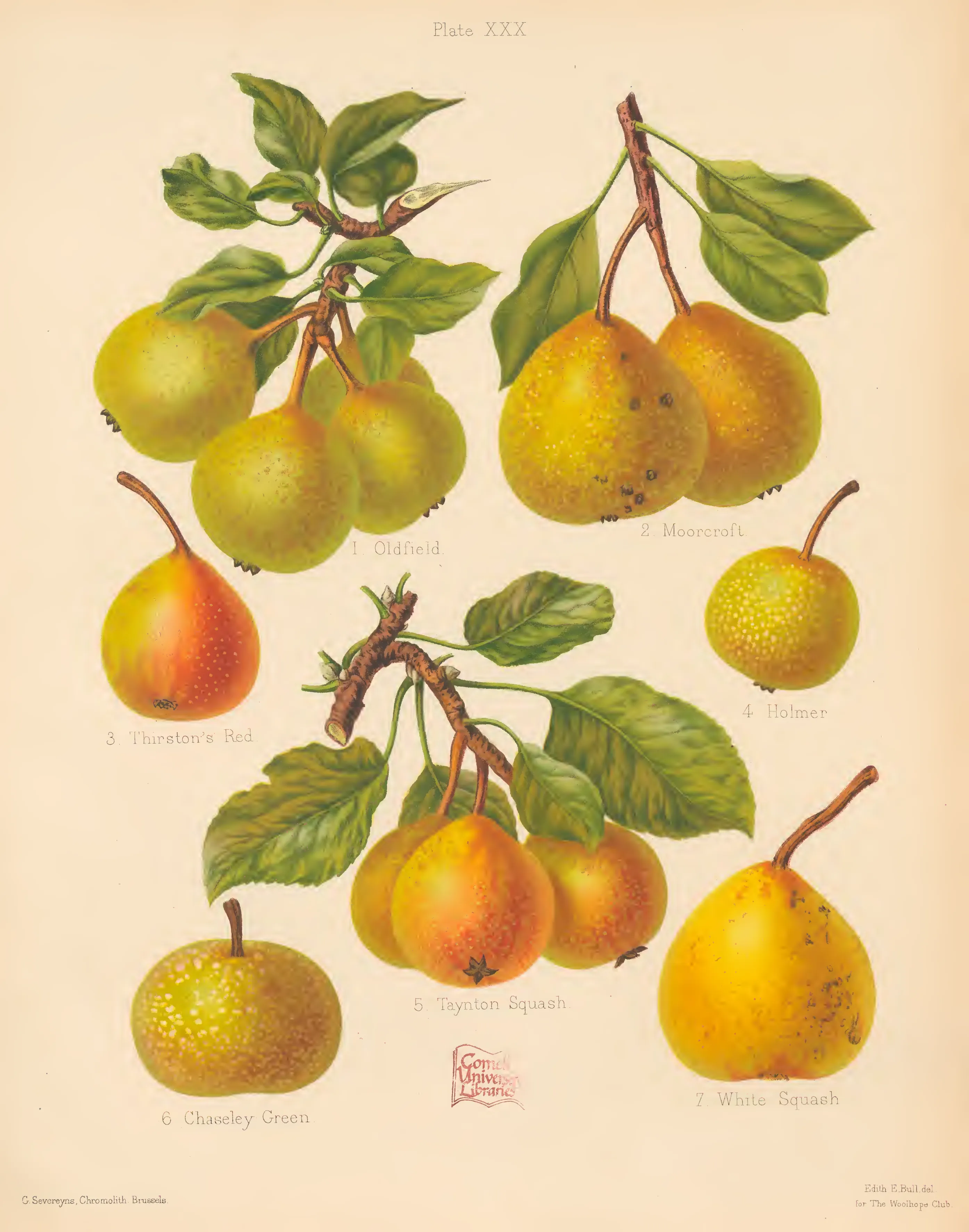
Oldfield Pear
Origin/History
The Oldfield pear takes its name from an enclosure called the "Oldfield" near Ledbury, in Herefordshire, England — Hedrick specifies it as the field where it was raised. There is no notice of it in any early catalogues of fruits; Philips does not mention it, nor does it appear to have been known until the early part of the eighteenth century. An excellent figure is given in the Pomona Herefordiensis, Pl. XI. By the time of the Herefordshire Pomona (1885), it was very generally distributed through Herefordshire and in full luxuriance. It is regarded as one of the most popular English perry pears. References: Prince, Pom. Man. 2:210, 1832; Hogg, Fruit Man. 624, 1884.
Tree
Very hardy and full blossoming. Very late in season. Generally bears abundantly. Trees are large. Very generally distributed through Herefordshire.
Fruit
Size and Form: Small, round (Herefordshire Pomona) / globular (Hedrick), even and regularly formed.
Stem: An inch long, slender; not depressed but tapering into the fruit at the base.
Cavity: Not depressed at base of stalk (stalk tapers directly into fruit).
Calyx/Eye: Open, with incurved segments, set in a shallow depression surrounded with plaits.
Basin: Shallow depression at the eye, with surrounding plaits.
Skin: Uniform greenish yellow when ripe (Herefordshire Pomona) / uniform yellow (Hedrick), covered with minute dots, and with a patch of russet around the stalk.
Flesh and Flavor: Yellowish, firm, and crisp (Herefordshire Pomona) / firm, breaking (Hedrick), and very astringent. Juice pale, plentiful, sweet, and very astringent.
Core/Seeds: Not described in source.
Chemical Analysis of Juice
Analysis of juice (season 1880) by Mr. G. H. With, F.C.S., F.R.A.S.:
- Density of the fresh juice: 1.057
- Density after 24 hours: 1.061
- Sugar: 13.06 parts per hundred by weight
- Tannin, Mucilage, Salts, &c.: 3.71 parts per hundred by weight
- Water: 83.23 parts per hundred by weight
Mr. Thomas Andrew Knight gives the density as 1.067, but states that it varies very much, like that of all other pears, according to the soil it grows on.
Season
Very late in season.
Uses
A perry pear of high repute — ranks next to the Taynton Squash in general estimation. The perry afforded by the Oldfield is rich and sweet with considerable strength. It fines readily in making, keeps well, and commands a high price in the market. It will keep and improve for 10 to 12 years in bottle.
Subtypes/Variants
Not described in source.
Other
Not described in source.
Book Sources
Described in 2 period pomological works
View original book sources (2)
— Woolhope Naturalists Field Club, The Herefordshire Pomona (1885)PLATE XXX.
- OLDFIELD.
This Pear is believed to have derived its name from an enclosure called the "Oldfield" near Ledbury, in Herefordshire. There is no notice of it in any early catalogues of fruits. Philips does not mention it, nor does it seem to have been known until the early part of the eighteenth century. An excellent figure is given of it in the Pomona Herefordiensis, Pl. XI.
Description.—Fruit : small, round, even and regularly formed. Skin : of a uniform greenish yellow when ripe, covered with minute dots and a patch of russet round the stalk. Eye : open with incurved segments, set in a shallow depression, surrounded with plaits. Stalk : an inch long, slender, not depressed but tapering into the fruit at the base. Flesh : yellowish, firm, and crisp. Juice : pale, plentiful, sweet, and very astringent.
The chemical analysis of the juice of the Oldfield Pear (season 1880), by Mr. G. H. With, F.C.S., F.R.A.S., is as follows :—
Density of the fresh juice ... ... ... 1·057 Ditto after 24 hours ... ... ... ... 1·061 One hundred parts by weight of the juice contain :— Sugar ... ... ... ... ... 13·06 Tannin, Mucilage, Salts, &c. ... ... ... 3·71 Water ... ... ... ... ... 83·23
Mr. Thos. Andrew Knight gives the density 1·067 but states that it varies very much, like that of all other pears, according to the soil it grows on.
The Perry afforded by the Oldfield pear is rich and sweet with considerable strength, and ranks next to the Taynton Squash in general estimation. It fines readily in making ; keeps well ; and commands a high price in the market. It will keep and improve for 10 or 12 years in bottle.
The tree is very hardy and full blossoming. It is very late in season, and generally bears abundantly. The trees are large. The variety is very generally distributed through Herefordshire and is at this time in full luxuriance.
— U.P. Hedrick, The Pears of New York (1921)Oldfield.
- Prince Pom. Man. 2:210. 1832. 2. Hogg Fruit Man. 624. 1884.
This is one of the most popular English perry pears, and took its name from the field where it was raised near Ledbury in Herefordshire. Fruit small, globular, even and regularly formed; skin uniform yellow, covered with minute dots, and with a patch of russet around the stalk; flesh yellowish, firm, breaking and very astringent.