Taynton Squash
Pear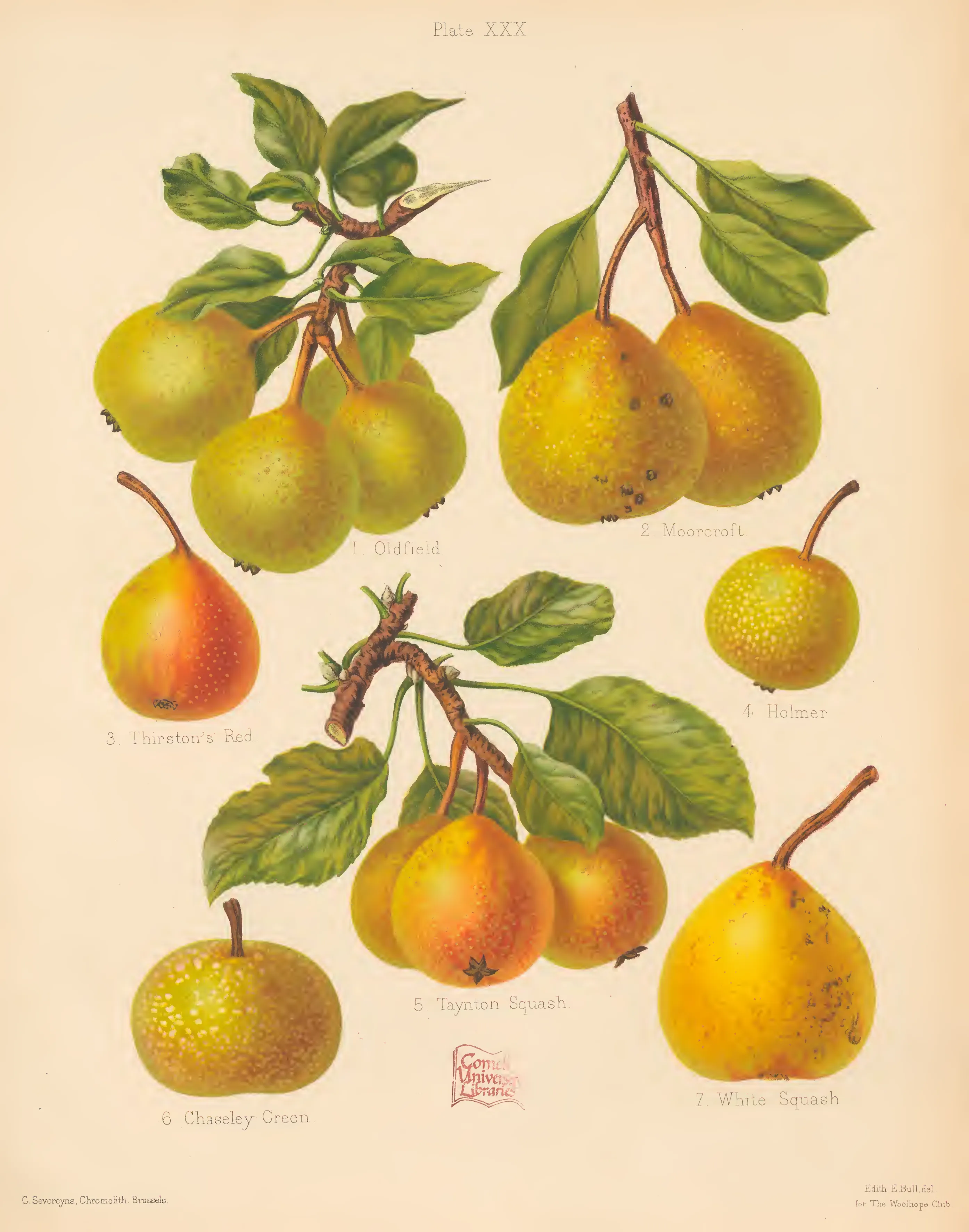
Origin/History
The Taynton Squash is one of the oldest and most celebrated perry pears of England, native to the parish of Taynton in Gloucestershire, approximately five miles beyond Gloucester. Its earliest known mention is by John Evelyn in his Pomona: "About Taynton (5 miles beyond Gloucester) Pears most abound, of which the best sort is that they name the Squash Pear, which makes the best Perry in those parts. These trees grow to be very large and exceedingly fruitful, bearing a fair round pear, red on one side and yellow on the other, when fully ripe, of a nature so harsh that Hogs will hardly eat them." No history of its origin is recorded beyond the suggestion, carried by name and tradition, that it was a native of Taynton parish. A Red Squash is mentioned by Worlidge, which may very possibly have been the same variety, the great size and age of many trees sufficiently proving its antiquity. Hedrick (1921) places its origin in Gloucestershire before the year 1805. The variety has long been widely known as a remarkably fine perry pear, much grown in Herefordshire. A coloured representation appears in the Pomona Herefordiensis, Pl. xiii.
Tree
The trees are hardy and grow large and lofty with spreading branches. They bear freely. At the time of the Herefordshire Pomona (1885) there was not a farm in Taynton parish without them, and they were scattered about widely, though nowhere in great abundance. Eleven trees stood on Aylstone Hill, Hereford; ten at Eggleton; but in most places the trees had already died from age.
Fruit
Size and Form: The Herefordshire Pomona describes the fruit as small, turbinate, even and regular in outline. Hedrick describes it as medium to below in size and turbinate in form. (Evelyn's earlier account describes "a fair round pear," which may reflect a difference in observation or in the particular trees he examined.)
Stem: Slender, three-quarters of an inch long.
Cavity: Inserted without depression; sometimes a fleshy lip on one side of the stem.
Calyx: Open, with stiff permanent recurved segments giving a star-like character, full of stamens.
Basin: Shallow, surrounded with plaits.
Skin: Dull greenish yellow on the shaded side. On the sun side, the Herefordshire Pomona describes a clear red with a few interrupted streaks of deeper colour; Hedrick describes the sun side as dull brownish-red. A thin light brown russet runs more or less over the fruit, often in thickly clustered dots — the Herefordshire Pomona notes it is not sufficiently deep to mar the bright colour, while Hedrick describes the russet dots as rough and covering the fruit.
Flesh and Flavor: The Herefordshire Pomona describes the flesh as yellowish, abounding in juice of a rich sweet flavour, brisk, and very astringent, but sometimes very disagreeably harsh and rough. Hedrick describes the flesh as white, with a brisk, sweet flavor. The flesh is notably tender; Coxe (1817) records that if the fruit drops ripe from the tree it bursts from the fall, which likely gives the variety its name — a detail Hedrick also records verbatim. Evelyn's observation that the fruit is "of a nature so harsh that Hogs will hardly eat them" speaks to the extreme astringency that, paradoxically, is the chief virtue prized in perry production.
Core/Seeds: Not described in sources.
Season
The earliest of all perry pears. Ripe about the beginning or middle of September.
Uses
Universally prized for perry. Coxe (1817) describes it as "the fruit of highest estimation in England for perry," producing a liquor that is pale, sweet, remarkably clear, and of strong body, bearing a price fourfold that of other perry. The Herefordshire Pomona concurs: the Taynton Squash affords a perry of the greatest excellence with a sweet, rich, distinctive flavour peculiarly its own, and is among perry pears what the Foxwhelp is among cider fruit — "the first and the best." It is always sought after and always commands a high price.
Mr. With's analysis of the juice (season 1880):
| Measurement | Value |
|---|---|
| Density of fresh juice | 1.055 |
| Density after 24 hours' exposure to air | 1.057 |
| Sugar (per 100 parts by weight) | 13.471 |
| Tannin, Mucilage, Salts, &c. (per 100 parts) | 3.033 |
| Water (per 100 parts) | 83.496 |
Subtypes/Variants
Not described in sources.
Book Sources
Described in 3 period pomological works
View original book sources (3)
— William Coxe, A View of the Cultivation of Fruit Trees (1817)1st, TAUNTON SQUASH.
The fruit of highest estimation in England for perry; it is an early pear, remarkable for the tenderness of its flesh—if it drops ripe from the tree it bursts from the fall, whence probably its name—the liquor made from it, is pale, sweet, remarkably clear and of strong body; it bears a price fourfold of other perry.
— Woolhope Naturalists Field Club, The Herefordshire Pomona (1885)PLATE XXX.
- TAYNTON SQUASH.
"About Taynton (5 miles beyond Gloucester) Pears most abound, of which the best sort is that they name the Squash Pear, which makes the best Perry in those parts. These trees grow to be very large and exceedingly fruitful, bearing a fair round pear, red on one side and yellow on the other, when fully ripe, of a nature so harsh that Hogs will hardly eat them."—Evelyn's "Pomona."
[Syn : Teinton Squash ; Red Squash.]
The earliest mention of this Pear is by Evelyn, in the paragraph above given. There is no history of its origin, but its name and tradition lead to the belief that it was a native of the parish of Taynton. A Red Squash is mentioned by Worlidge, which may very possibly have been the same variety, since the great size and age of many of the trees sufficiently prove its antiquity.
A coloured representation of this Pear is given in the "Pomona Herefordiensis," Pl. xiii.
Description.—Fruit : small, turbinate, even and regular in outline. Skin : dull, greenish yellow on the shaded side, and a clear red next the sun with a few interrupted streaks of deeper colour ; a thin light brown russet runs more or less over the fruit, often in thickly clustered dots, but not sufficiently deep to mar its bright colour. Eye : open, with stiff permanent recurved segments, giving it a star-like character, full of stamens set in a shallow depression, and surrounded with plaits. Stalk : slender, three quarters of an inch long, inserted without depression, with sometimes a fleshy lip on one side of it. Flesh : yellowish, abounding in juice of a rich sweet flavour, brisk, and very astringent, but sometimes very disagreeably harsh and rough.
Mr. With's analysis of the juice of the Taynton Squash Pear (season 1880), is as follows :—
Density of fresh juice ... ... ... ... 1·055 Ditto after 24 hours exposure to air ... ... 1·057 One hundred parts by weight of juice yield :— Sugar ... ... ... ... ... 13·471 Tannin, Mucilage, Salts, &c. ... ... ... 3·033 Water ... ... ... ... ... 83·496
The Taynton Squash is the earliest of all the Perry Pears and is ripe about the beginning or middle of September. It affords a Perry of the greatest excellence with a sweet rich distinctive flavour, peculiarly its own. The Taynton Squash is amongst Perry Pears what the Foxwhelp is amongst cider fruit, the first and the best. It is always sought after, and always commands a high price.
The trees are hardy and grow large and lofty with spreading branches. They bear freely. There is not a farm in Taynton parish without them, and they are scattered about widely, but nowhere in great abundance. There are eleven trees on Aylstone Hill, Hereford; ten trees at Eggleton; but usually they are less numerous; and indeed in most places the trees have died from age.
— U.P. Hedrick, The Pears of New York (1921)Taynton Squash, 1. Hogg Fruit Man. 654. 1884. Squash. 2. Thacher Am. Orch. 191. 1822. An old pear which originated in Gloucestershire, Eng., previous to the year 1805 and which is widely known as a remarkably fine perry pear much grown in Herefordshire. It is early, tender of flesh, and "if it drops ripe from the tree it bursts from the fall, whence probably the name." Fruit medium to below, turbinate, dull greenish-yellow on the shaded side and dull brownish-red next the sun, covered with rough, russet dots; calyx open; stem slender; flesh white, with a brisk, sweet flavor.