Moorcroft
Pear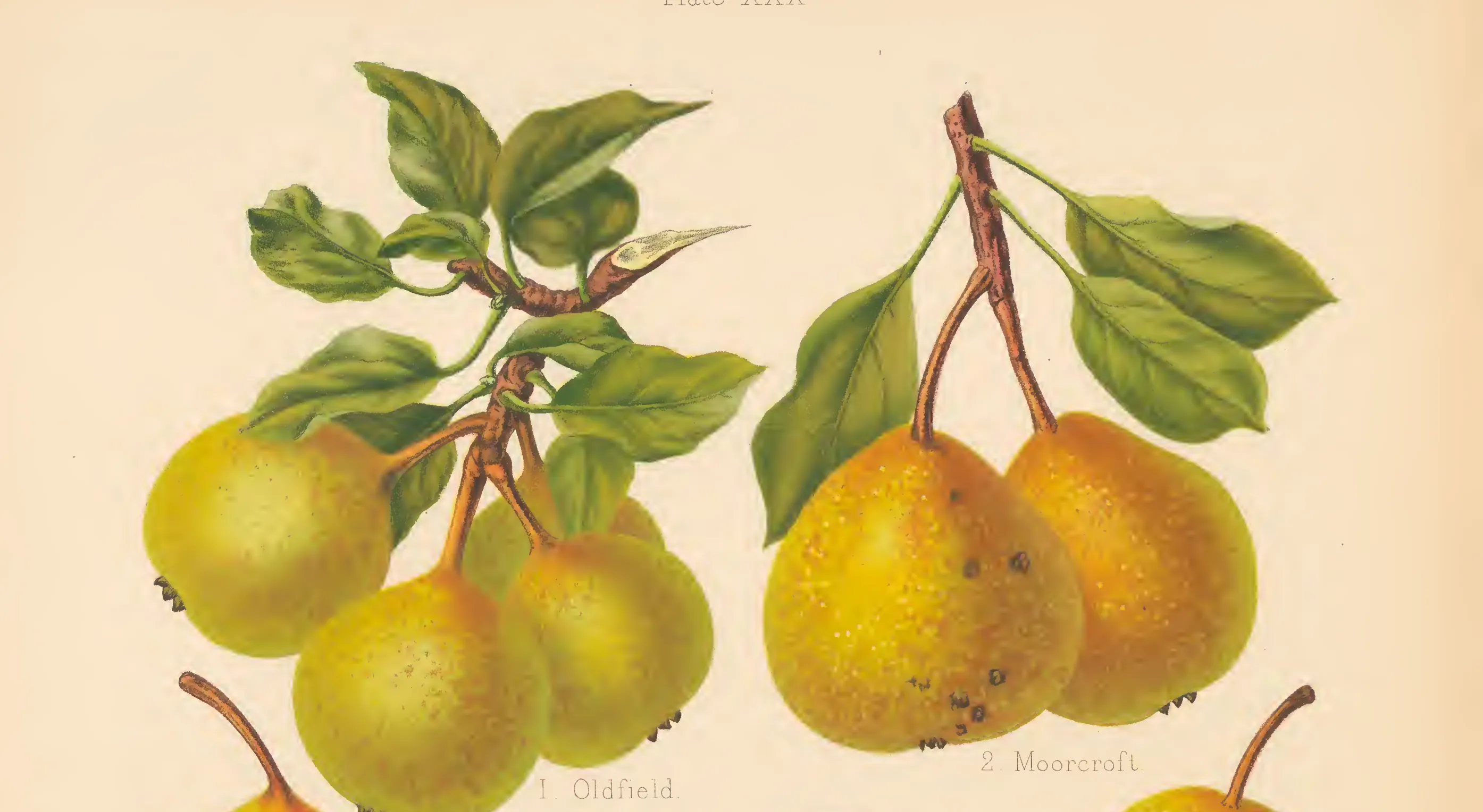
Moorcroft
Origin/History
This pear probably originated on the farm called "Moorcroft," in the parish of Colwall, near the western base of the Malvern Hills. There are many trees of considerable age there; it is chiefly cultivated in that district, and has thus obtained the name of Malvern Hill Pear. Nothing, however, is positively known with regard to its origin. It is often called in England the Malvern pear, being much grown about that place, and is esteemed for perry.
Tree
The tree takes a branching, spreading form of growth, attains a large size, and is very hardy, but it can scarcely be called a free bearer.
Fruit
Size and Form: The sources conflict on size and shape. The Herefordshire Pomona (1885) describes the fruit as large for a perry pear, pyriform, even and regular in its outline. Hedrick (1921), citing Hogg (1884), describes the fruit as small and globular, even and regular in outline.
Stem: Half to three-quarters of an inch long, rather stout, inserted without depression.
Cavity: Inserted without depression (no cavity described).
Calyx: Eye open.
Basin: Set in a saucer-like basin.
Skin: Greenish yellow on the shaded side, becoming quite yellow as it ripens, with a brownish tinge on the side next the sun; the whole surface strewed with large ash grey freckles of russet.
Flesh and Flavor: The sources conflict on flesh texture. The Herefordshire Pomona describes the flesh as crisp, with juice abundant, pale, having a sweet Jargonelle flavour and some astringency. Hedrick describes the flesh as breaking.
Core/Seeds: Not described in source.
Season
Ripens very early, about the same time as the Barland, following the Taynton Squash, and before the Red Pear and Oldfield. The pears are apt to decay soon, and care must be taken that they are used before this begins.
Uses
Esteemed for perry. It is usually mixed with other varieties to impart its excellent flavour and sweetness. Chemical analysis of the juice (Mr. Withy, season 1880) is as follows: density of the fresh juice, 1.049; after exposure for 24 hours, 1.050. One hundred parts by weight of the juice contain: sugar, 11.916; tannin, mucilage, salts, &c., 2.384; water, 85.700. This analysis proves that the Moorcroft Pear possesses a very rich juice, capable of making perry of considerable alcoholic strength.
Subtypes/Variants
Not described in source.
Other
Not described in source.
Book Sources
Described in 2 period pomological works
View original book sources (2)
— Woolhope Naturalists Field Club, The Herefordshire Pomona (1885)
- MOORCROFT. [Syn : Malvern Pear ; Malvern Hill Pear.] This Pear probably originated on the farm called “Moorcroft,” in the parish of Colwall, near the western base of the Malvern Hills. There are many trees of considerable age there ; it is chiefly cultivated in that district, and has thus obtained the name of Malvern Hill Pear. Nothing, however, is positively known with regard to its origin. Description.—Fruit : large for a Perry pear, pyriform, even and regular in its outline. Skin : greenish yellow on the shaded side, becoming quite yellow as it ripens, with a brownish tinge on the side next the sun ; the whole surface strewed with large ash grey freckles of russet. Eye : open, set in a saucer-like basin. Stalk : half to three-quarters of an inch long, rather stout inserted without depression. Flesh : crisp. Juice : abundant, pale, with a sweet Jargonelle flavour and some astringency. Mr. Withy’s analysis of the Moorcroft, (season 1880), is as follows :— Density of the fresh juice ... ... ... 1·049 Ditto after exposure for 24 hours ... ... ... 1·050 One hundred parts by weight of the juice contain :— Sugar ... ... ... ... ... 11·916 Tannin, Mucilage, Salts, &c. ... ... ... 2·384 Water ... ... ... ... ... 85·700 This analysis proves that the Moorcroft Pear possesses a very rich juice, capable of making Perry of considerable alcoholic strength. It ripens very early, about the same time as the Barland, following the Taynton Squash, and before the Red Pear and Oldfield. The pears are apt to decay soon, and care must be taken that they are used before this begins. It is usually mixed with other varieties to impart its excellent flavour and sweetness. The tree takes a branching spreading form of growth, attains a large size, and is very hardy, but it can scarcely be called a free bearer.
— U.P. Hedrick, The Pears of New York (1921)Moorcroft.
i. Hogg Fruit Man. 619. 1884.
Often called in England the Malvern pear, being much grown about that place; esteemed for perry. Fruit small, globular, even and regular in outline, greenish-yellow on the shaded side, and with a brownish tinge on the side next the sun, strewed all over with large ashy gray freckles of russet; flesh breaking.