Red Pear
Pear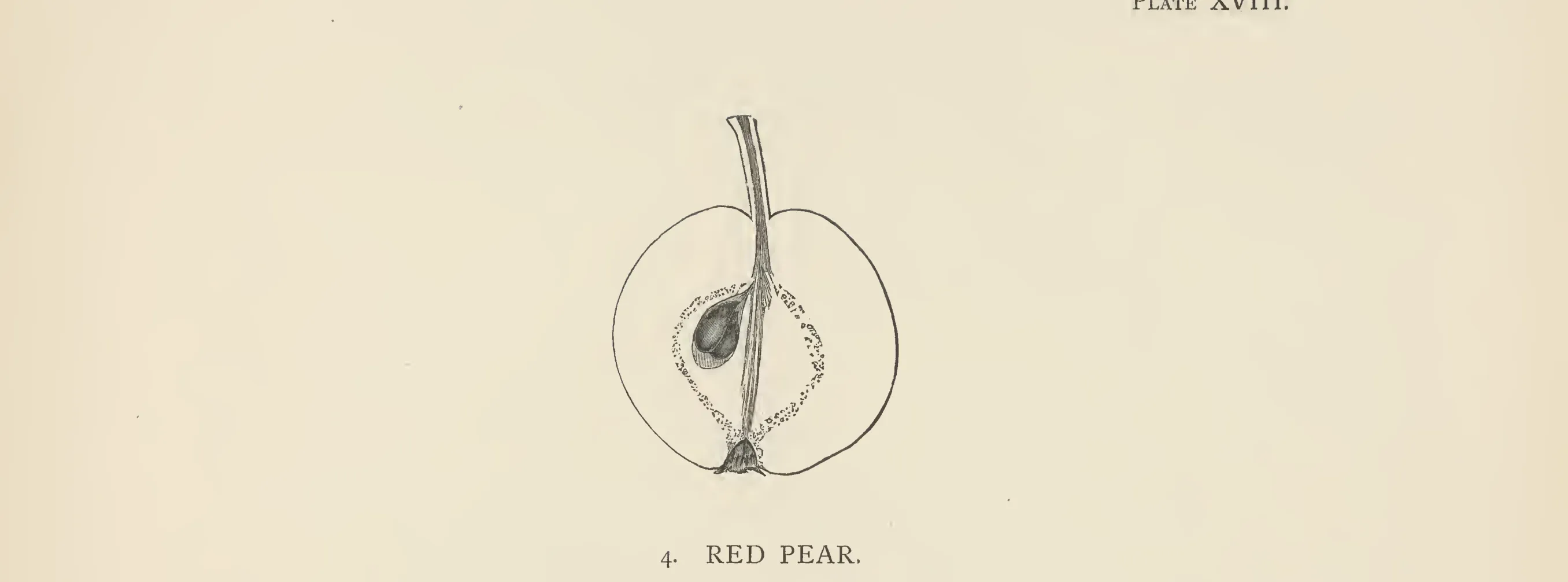
Red Pear
Origin / History
A perry pear grown largely in Herefordshire, England (Hedrick). Seems to have been well known in the 17th century, but its origin is involved in obscurity. Evelyn's Pomona lists it as "The Red Horse Pear next the Bosbury."
Tree
Very hardy, early, and an excellent bearer.
Fruit
Size: Small.
Form: Perfectly round, globular; even and regular in outline, sometimes inclining to turbinate.
Stem: Three quarters of an inch long, stout and straight with the axis of the fruit.
Cavity: Narrow, shallow.
Calyx: Eye open, with clove-like segments, set level with the surface.
Basin: Not described in source.
Skin: Almost entirely covered with rather bright red, except round the stalk and where shaded, which are yellow.
Dots: Pale gray russet dots, sprinkled over the whole surface.
Flesh and flavor: Pale yellow, firm, dry and gritty; Hedrick gives "quite yellow".
Core and seeds: Not described in source.
Season
Not described in source.
Uses
Perry pear. The perry is very good, with a strong cider-like character; it bottles well and in good seasons makes an excellent saleable beverage. Mr. With's 1879 analysis of the fresh juice: density 1·0398, unchanged after 24 hours' exposure to air; in one hundred parts by weight, sugar 8·742, tannin, mucilage, salts, etc. 3·202, water 88·056.
Subtypes / Variants
Not described in source.
Other
Not described in source.
Book Sources
Described in 2 period pomological works
View original book sources (2)
— Woolhope Naturalists Field Club, The Herefordshire Pomona (1885)
- RED PEAR.
[Syn: Red Horse Pear.]
"The Red Horse Pear next the Bosbury." (Evelyn's Pomona.)
This Pear seems to have been well-known in the 17th century, but its origin is involved in obscurity.
Description.—Fruit: small and perfectly round, even and regular in its outline, sometimes inclining to turbinate. Skin: almost entirely covered with a rather bright red colour, except round the stalk, and where it has been shaded, and there it is yellow; the whole surface is sprinkled with pale grey russet dots. Eye: open, having clove-like segments, and set level with the surface. Stalk: three quarters of an inch long, stout and straight with the axis of the fruit, set in a narrow shallow cavity. Flesh: pale yellow, firm, dry and gritty.
The tree is very hardy, early, and an excellent bearer.
The Perry is very good, and has a strong cider like character. It bottles well, and in good seasons makes an excellent saleable beverage.
Mr. With's analysis of the fresh juice (1879) is as follows:—
Density of fresh juice ... ... ... ... 1·0398 Ditto after 24 hours exposure to air... ... ... 1·0398 One hundred parts by weight contained:— Sugar ... ... ... ... 8·742 Tannin, Mucilage, Salts, &c., ... ... ... 3·202 Water ... ... ... ... 88·056 100
— U.P. Hedrick, The Pears of New York (1921)Red Pear.
i. Hogg Fruit Man. 636. 1884.
A perry pear grown largely in Herefordshire, Eng. Fruit small, globular, even and regular in outline, inclining to turbinate, almost entirely covered with rather bright red, yellow around the stalk where shaded, sprinkled all over with pale gray dots; flesh quite yellow, firm, dry and gritty.