Holmer
Pear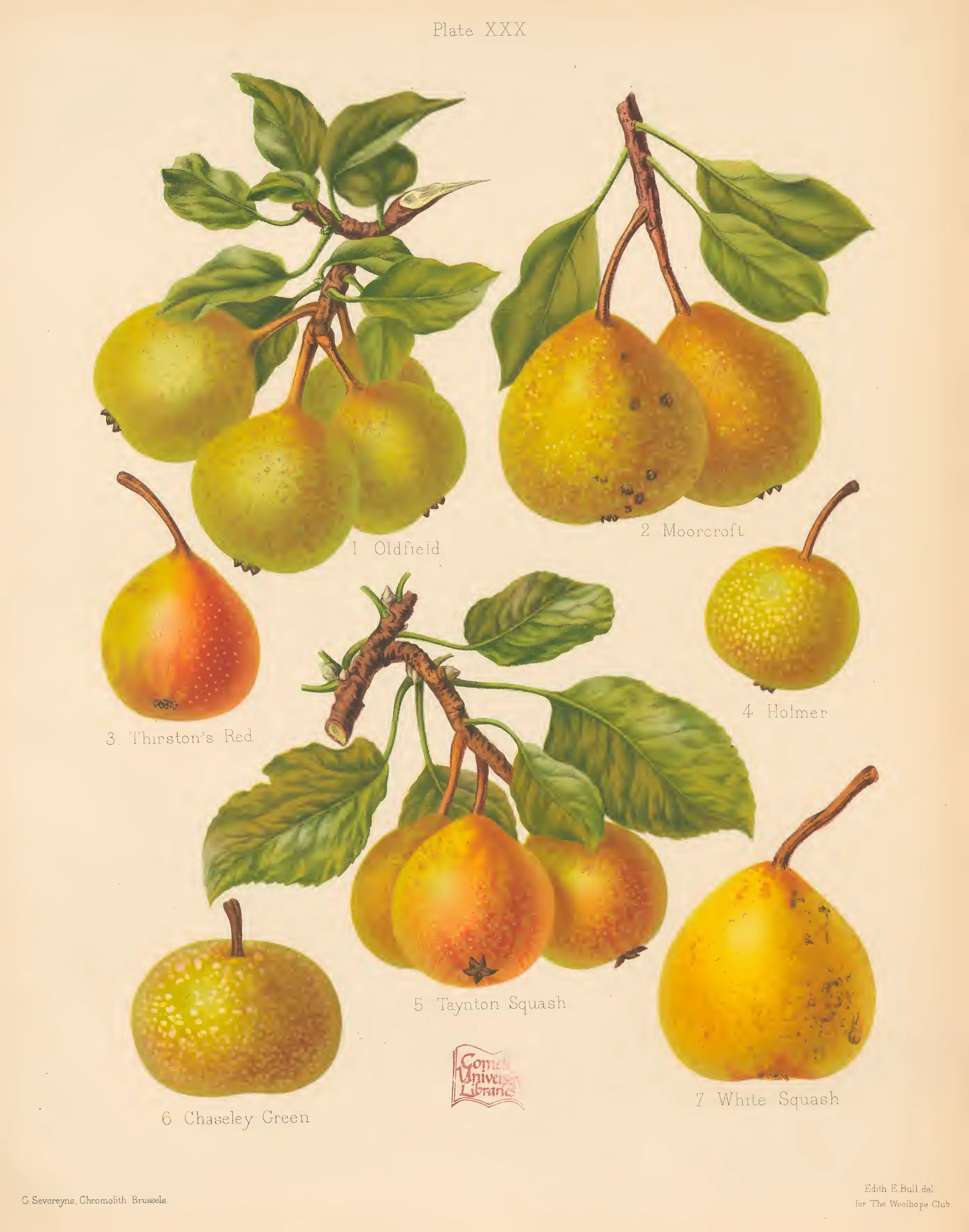
Holmer
Origin / History
The original tree was found in a hedgerow on the estate of the late Charles Cooke, Esq., of the Moor, in the parish of Holmer, near Hereford. Mr. Thomas Andrew Knight judged it to be about eighty years old (c. 1730); it was therefore about a hundred and fifty years old when the Woolhope Club wrote in 1885. A good figure is given in the Pomona Herefordiensis, Pl. XX; in that work the name was misprinted "Holmore". "Notwithstanding these grave faults" (ripening all together and perishing very quickly), "Mr. Knight thought very highly of the Holmer Pear, and consequently it has been widely propagated." Hedrick (1921), citing Hogg's Fruit Manual (1884), calls it a well-known perry pear in Herefordshire, England.
Tree
Tree strong and vigorous, grows tall, bears abundantly.
Fruit
Size: Small; Hedrick says very small.
Form: Roundish, turbinate (Hedrick: globular-turbinate); even and regular in outline.
Stem: From one-half to three-quarters of an inch long, slender.
Cavity: Stalk inserted in a small hole, occasionally with a slight swelling on one side.
Calyx: Eye open, full of stamens, with short divergent segments.
Basin: Very shallow, or scarcely any depression.
Skin: Pale green at first, dull greenish yellow when ripe; the russet dots are so thick as to form a kind of crust on the surface.
Dots: Russet, thickly covering the surface so as to form a kind of crust.
Flesh and flavor: Flesh yellowish, firm and crisp; Hedrick adds very astringent. Juice plentiful, pale in color, flavor sweet subacid and very astringent.
Core and seeds: Not described in source.
Season
Follows the Moorcroft and Barland in season. The pears ripen all together and perish very quickly, so that they must be sent at once to the mill.
Uses
Perry pear. The perry in a good season is of good flavor, very sweet and rich, and resembles that made from the Red Pear.
Mr. With's analysis (season 1880): density of fresh juice 1.051; after 24 hours' exposure to air 1.055. One hundred parts by weight of juice contain sugar 11.9, tannin, mucilage, salts, etc. 3.4, water 84.7. Mr. Thomas Andrew Knight found the density of the juice to be 1.066, so that the analysis is favorable for its spirit-producing power.
Subtypes / Variants
Not described in source.
Other
Not described in source.
Book Sources
Described in 2 period pomological works
View original book sources (2)
— Woolhope Naturalists Field Club, The Herefordshire Pomona (1885)
- HOLMER
[Syn: Holmore Pear—by printers error in the Pomona Herefordiensis.]
The original tree of this variety was found in a hedgerow on the estate of the late Charles Cooke, Esq., of the Moor, in the parish of Holmer, near Hereford. Mr. Thos. Andrew Knight judged it to be about eighty years old (c. 1730), and it is therefore now about a hundred and fifty years old.
A good figure is given of this Pear in the Pomona Herefordiensis, Pl. XX.
Description.—Fruit: small, roundish, turbinate, even and regular in its outline. Skin: pale green at first, but of a dull, greenish yellow when ripe; thickly covered with russet dots, so as to form a kind of crust on the surface. Eye: open, full of stamens, having short divergent segments, and set in a very shallow, or in scarcely any depression. Stalk: from half to three quarters of an inch long, slender; inserted in a small hole with occasionally a slight swelling on one side. Flesh: yellowish, firm and crisp. Juice: plentiful, pale in colour, with a sweet subacid and very astringent flavour.
Mr. With's analysis of the Holmer Pear (season 1880), is as follows:—
Density of fresh juice ... ... ... ... 1.051 Ditto after 24 hours exposure to air ... ... 1.055 One hundred parts by weight of juice contains:— Sugar ... ... ... ... ... 11.9 Tannin, Mucilage, Salts, &c. ... ... ... 3.4 Water ... ... ... ... ... 84.7
Mr. Thomas Andrew Knight found the density of the juice of this Pear to be 1.066—so that the analysis is favourable for its spirit-producing power.
The Perry from this variety in a good season is of good flavour, very sweet and rich, and resembles that made from the Red Pear.
The tree is strong and vigorous, grows tall and bears abundantly. The fruit follows the Moorcroft and Barland in season. The pears ripen all together and perish very quickly, so that they must be sent at once to the mill. Notwithstanding these grave faults, Mr. Knight thought very highly of the Holmer Pear, and consequently it has been widely propagated.
— U.P. Hedrick, The Pears of New York (1921)Holmer.
- Hogg Fruit Man. 594. 1884.
A well-known perry pear in Herefordshire, Eng. Fruit very small, globular-turbinate, even and regular in outline, dull greenish-yellow when ripe, and thickly covered with russet dots, so as to form a kind of crust on the surface; flesh yellowish, firm, crisp, and very astringent.