Paradise
Apple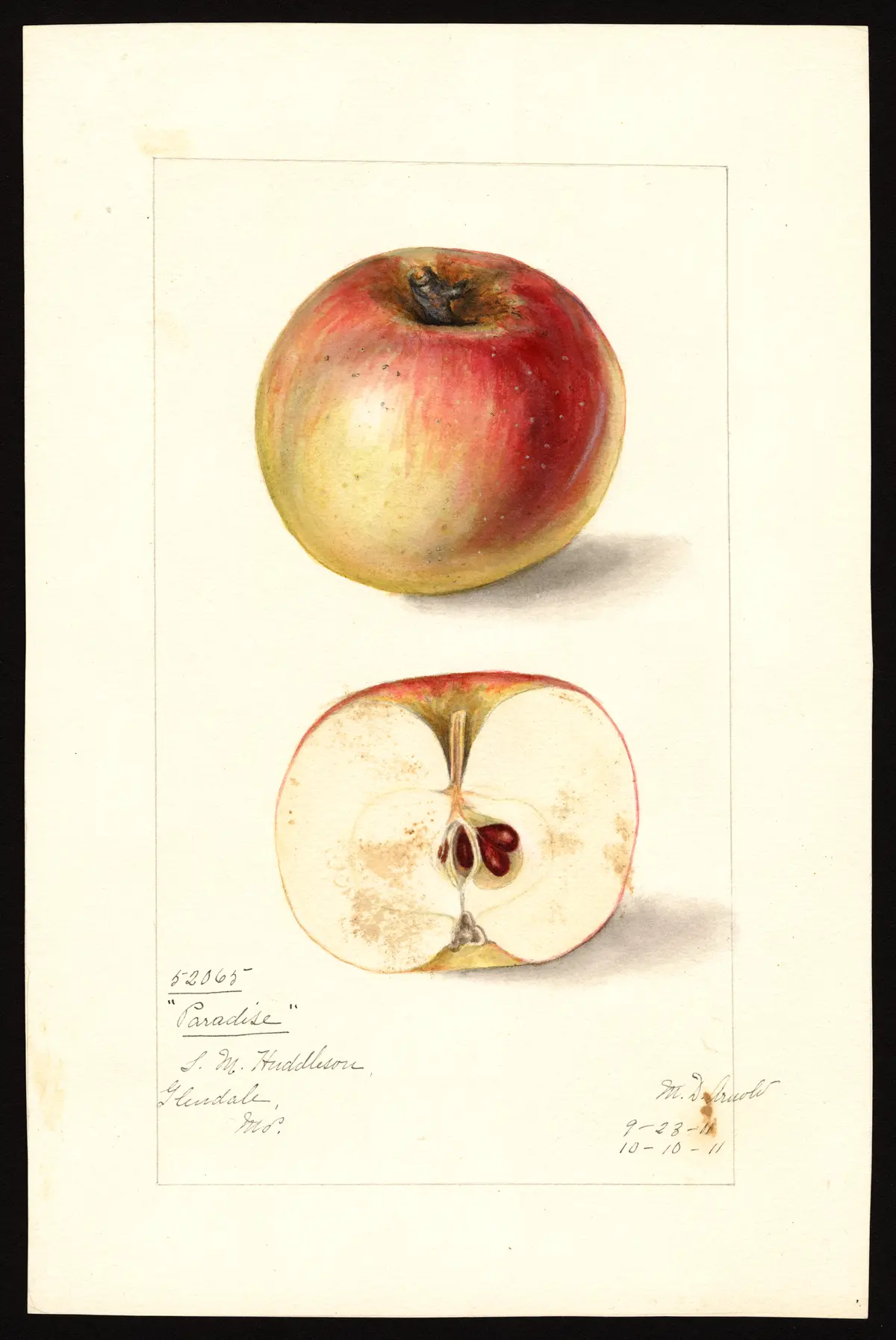
USDA Pomological Watercolor Collection
Paradise Apple
Origin/History
The Paradise Apple has long been cultivated primarily as a dwarfing rootstock rather than for its fruit. Coxe (1817) notes it is much used as a stock for grafting espaliers, on which it produces very large fruit. Bunyard (1920) observes that the name "Paradise" has been applied to a large number of different varieties all used for stocks, and that none of them possess any special value from the culinary or dessert standpoint; he refers readers to the Journal of the Royal Horticultural Society, Vol. XLII, parts II and III for full fruit descriptions. Bunyard also cross-references "Paradise: see Thorle," indicating that what he treats as the representative Paradise type is elsewhere known as the Thorle.
Tree
A dwarf — described by Coxe (1817) as "rather a shrub." Propagated by suckers, which frequently bear fruit as early as the second year after transplantation. If not kept trimmed in the manner of a currant bush, the plant shoots out large suckers that will exhaust the principal stock and cause fruit to be of diminutive size.
Fruit
Size: Rather small (Coxe). When grown on its own roots the fruit tends toward small or diminutive; when used as a grafting stock it produces very large fruit in the grafted variety (Coxe).
Skin: Yellow or yellowish ground (Coxe; Stark Bros.). Stark Bros. (1910) describes "deep set dots on yellowish ground."
Flesh: White, sometimes stained with red (Stark Bros.). Tender, juicy, and fine-grained (Stark Bros.).
Flavor: Sweet and pleasant (Coxe). Stark Bros. (1910) rates it as "Melleish and Wismer Dessert as best."
Stem, Cavity, Calyx, Basin, Core, Seeds: Not described in source.
Season
Ripens the latter part of July (Coxe).
Uses
Primarily valued as a dwarfing rootstock for espaliers (Coxe; Bunyard). Bunyard explicitly states it has no special culinary or dessert value. Coxe and Stark Bros. describe it as a dessert apple when grown on its own roots, contradicting Bunyard — likely reflecting the multi-variety problem Bunyard identifies: sources applying the "Paradise" name may be describing different underlying varieties.
Subtypes/Variants
Bunyard (1920) explicitly cautions that the name "Paradise" has been applied to a large number of distinct varieties, all used as stocks. He treats the Thorle as the representative type. This makes direct comparison across sources uncertain, as Coxe (1817) and Stark Bros. (1910) may be describing different forms than Bunyard's reference.
Other
Stark Bros. (1910) appends the notation "SNSS" following the variety description; this appears to be a table or catalog code abbreviation whose meaning is not defined in the source text.
Book Sources
Described in 2 period pomological works
Nursery Catalog Sources
Found in 1 catalog (1900)
- Central Experimental Farm , Dominion Department of Agriculture, Agassiz, British Columbia (under test; Bulletin No. 3, Second Series) — 1900
View original book sources (3)
— William Coxe, A View of the Cultivation of Fruit Trees (1817)NO. 5. PARADISE APPLE.
This is a dwarf, or rather a shrub; it is much used for stocks to ingraft for Espaliers, when it produces very large fruit—the usual mode of propagating it, is by suckers, which frequently bear the second year after transplantation—the fruit is rather small, of a yellow colour, and a sweet and pleasant taste; it ripens the latter part of July: if not kept trimmed, like a currant bush, it shoots out large suckers, which will exhaust the principal stock, and produce fruit of a diminutive size.
— Stark Bros. Nurseries & Orchards Co., Stark Bros. Year Book (1910) (1910)Handsome apple with deep set dots on yellowish ground. Flesh white, sometimes stained with red. Tender, juicy and fine-grained. Melleish and Wismer Dessert as best. SNSS
— E.A. Bunyard, A Handbook of Hardy Fruits (1920)PARADISE. The name Paradise has been applied to a large number of different varieties which are used for stocks. None of them, however, possess any special value from the culinary or dessert standpoint. For description of the fruits see Journal R.H.S., Vol. XLII., parts II. and III. Paradise : see Thorle.