Prairie Spy
Apple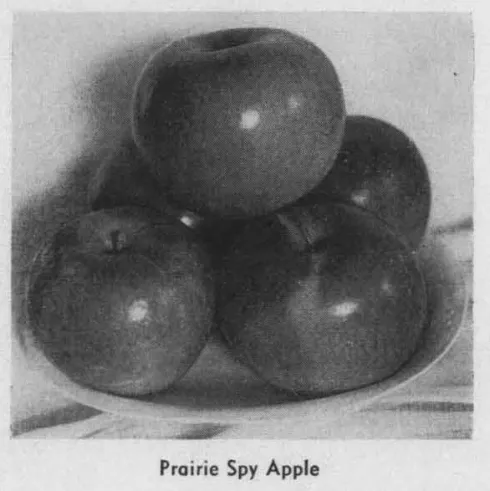
Prairie Spy
Origin / History
Prairie Spy, Minn. No. 1007, has unknown parentage and was introduced in 1940 by the University of Minnesota Fruit Breeding Farm. When introduced it attracted much attention as a high-quality winter apple adapted to both home and commercial orchards. In 1952 it ranked sixth in acres planted among varieties grown in Minnesota. Grower opinion as to its ultimate value has not yet crystallized.
Tree
The trees are vigorous with an upright habit when young and develop a round or spreading head at maturity. Tree type is good. Production is good, and the variety bears well enough to be counted among the favorable points of the cultivar. Maturity of the tree is late, which has led to winter injury under some conditions. Removal of weak wood by pruning, together with blossom thinning and stop-drop sprays, will correct some of these faults.
The variety is somewhat resistant to cedar rust and medium-susceptible to fire blight and scab.
Fruit
Size: Medium to large. Fruit size is variable, with a tendency to produce too many small fruits.
Form: Roundish conic.
Stem: Short.
Cavity: Wide and flaring, frequently marked with an outspreading patch of greenish russet.
Calyx: Closed. Calyx tube broad.
Basin: Medium.
Skin: Color about 50 percent bright attractive red over yellow. Fruit is large and attractive. The skin is scalding-prone in cold storage at temperatures below 35° F. or 36° F.
Dots: Not described in source.
Flesh and flavor: Flesh creamy white, medium fine-grained, crisp, medium tender. Flavor sprightly subacid, rich, pleasant. Quality is excellent for fresh and culinary purposes.
Core and seeds: Not described in source.
Season
Season of use is October to April. The variety keeps well in common storage.
Uses
The fruit is of excellent dessert and cooking quality and is quality excellent for fresh and culinary purposes. It was valued as a high-quality winter apple for both home and commercial orchards.
Subtypes / Variants
Not described in source.
Other
Not described in source.
Book Sources
Described in 1 period pomological work
View original book sources (1)
— W.H. Alderman, A.N. Wilcox & T.S. Weir, Fruit Varieties Developed at the University of Minnesota Fruit Breeding Farm (1957)Prairie Spy. Minn. No. 1007. Parentage unknown. Introduced 1940.
When this variety was introduced it attracted much attention as a high-quality winter apple adapted to both home and commercial orchards. In acres planted it ranked sixth among varieties grown in Minnesota in 1952. Grower opinion as to its ultimate value has not yet crystallized. Points in its favor are good production, good keeping quality in common storage, good tree type and large attractive fruits of excellent dessert and cooking quality.
Unfavorable points are late tree maturity, which has led to winter injury under some conditions; a lack of good adherence at harvest time; a tendency to produce fruit of variable size with too many small ones; and a tendency to scald in cold storage at temperatures below 35° F. or 36° F. Removal of "weak wood" by pruning and the use of blossom thinning and stop-drop sprays will correct some of these faults. The variety is somewhat resistant to cedar rust and medium-susceptible to fire blight and scab.
The trees are vigorous with an upright habit when young but develop a round or spreading head at maturity. The fruit is medium to large, roundish conic; color about 50 percent bright attractive red over yellow; stem short; cavity wide, flaring, and frequently marked with an outspreading patch of greenish russet; basin medium; calyx closed; calyx tube broad; flesh creamy white, medium fine-grained, crisp, medium tender; flavor sprightly subacid, rich, pleasant; quality is excellent for fresh and culinary purposes; season of use October to April.