Prince Albert
Apple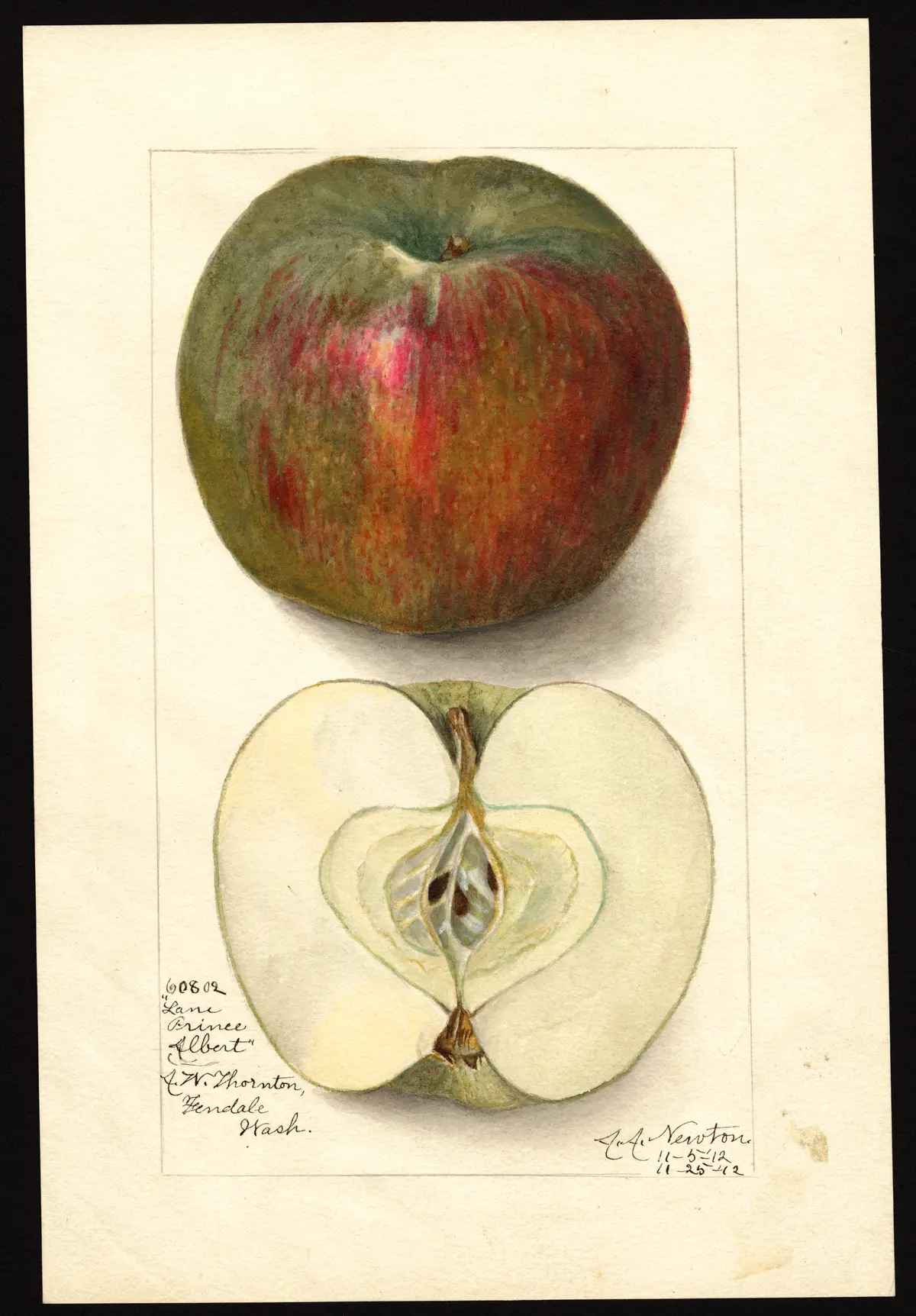
USDA Pomological Watercolor Collection
Prince Albert
Origin / History
Found in a garden at Berkhampstead, England. Introduced in 1857 by H. Lane & Son of that town (Messrs. Lane & Sons in the 1914 Bunyard catalog). They exhibited it at a meeting of the British Pomological Society on October 26, 1857. The original tree was still in existence in a Berkhampstead garden in 1903. In 1881 Prince Albert received a first-class certificate from the Royal Horticultural Society.
Beach (1905) says it is in common cultivation in some parts of England, where it is usually called the Lane Prince Albert. Bunyard's 1898 article lists it first as Prince Albert (Lane) and afterwards as Lane Prince Albert, and Ragan abbreviated the name to Lane Albert. Beach followed Bunyard's 1898 listing in calling it Prince Albert, as that name appeared to approach more closely the one by which it is commonly known in England.
That 1898 article, "Progress in Fruit Culture in Queen Victoria's Reign 1837-1897," gives a list of fruits introduced into English cultivation in the previous sixty years that were likely to prove permanent additions. The list includes but ten apples, and Prince Albert is one of them.
E. A. Bunyard (1920) calls it "perhaps the most reliable cropper of all cooking apples." Veitch (1911) calls it "a variety which no garden should be without." The George Bunyard catalogs call it "most desirable for garden culture" and "indispensable for cultivation in small villa gardens" (1901). The 1914 catalog calls it "quite indispensable for garden and market culture as bushes on account of its regularity in fruiting."
In America, Beach (1905) found it "but little known as yet." He judged that further testing was required to determine whether it was a desirable variety for his region.
Tree
Habit spreading. Beach calls the tree very vigorous, with a rather dense form. The 1914 Bunyard catalog calls it dwarf in growth, with a weeping habit, and E. A. Bunyard (1920) likewise gives the growth as dwarf, spreading.
Twigs stocky, moderately long. Bark dark greenish-brown. Lenticels numerous, roundish, medium in size, conspicuous. Buds large, plump, obtuse, pubescent. Leaves large and broad; foliage dense (Beach). E. A. Bunyard describes the leaf as rather large, pale, lax, nearly flat, very coarsely serrate.
Very to extremely fertile, very prolific. Comes into bearing young and is a reliable, regular, and very productive cropper. So far as tested at his Station, Beach found that the tree sustained the reputation it had gained in England for these traits. The 1901 Bunyard catalog calls its fertility "remarkable." The same catalog judges it not suitable for orchard culture, "as the weight of crop brings it into the reach of cattle."
Veitch says it forms a medium-sized pyramid or standard. The 1914 Bunyard catalog calls it not suitable for standards on account of its weeping habit and recommends it as bushes.
Fruit
Size: Large, pretty uniformly so, sometimes very large (Beach). E. A. Bunyard gives 3½ by 3.
Form: Round conical. Beach describes it as roundish, somewhat flattened at the base, inclined to conic, with broad obtuse ribs toward the basin, somewhat irregular. The 1914 Bunyard catalog calls it evenly shaped.
Stem: Short to medium, moderately thick.
Cavity: Acute, varying from slightly obtuse to slightly acuminate. Medium in depth to deep. Rather broad to wide, somewhat furrowed, frequently compressed. Beach finds it sometimes faintly russeted; E. A. Bunyard calls it russet free.
Calyx: Below medium to above in size, closed or slightly open, generally closed. Lobes rather short and wide, inclined to acute. Calyx tube rather short, moderately wide, cone-shaped or approaching funnel-shaped; stamens median to basal (Beach).
Basin: Medium in depth to deep. Beach describes it as usually below medium in size, often oblique, rather narrow to medium in width, abrupt, irregular, deeply furrowed and wrinkled. E. A. Bunyard calls it wide and slightly ribbed.
Skin: Remarkably smooth, moderately thick, tough. Grass-green or pale green, changing to yellowish-green and pale yellow. Part of the exposed cheek bears a thin red blush or slight pinkish flush, and the cheek is striped and splashed with red to bright carmine. The stripes are "distinct" to E. A. Bunyard and "sparsely" striped in the 1914 Bunyard catalog. Mottled and streaked with scarf-skin (Beach). Handsome, "extremely handsome" in the 1901 Bunyard catalog. Beach calls the general appearance "rather attractive for a green apple."
Dots: Small, often submerged, whitish or sometimes with a russet point. Numerous toward the basin, larger and more scattering toward the cavity (Beach).
Flesh and flavor: Greenish-white, or tinged with yellow or green. Firm, moderately fine, crisp, tender, very juicy. Acid, briskly subacid, or sour. Beach finds it "too briskly subacid in flavor for a dessert apple" and says it "has too much acidity for a good dessert apple."
Core and seeds: Core large to very large, abaxile. Cells usually symmetrical, open or sometimes closed. Core lines meeting or slightly clasping. Carpels elongated or broadly roundish, obtusely emarginate, often tufted. Seeds numerous, medium or above, moderately narrow to rather wide, obtuse to acute, rather dark (Beach).
Season
The recorded season runs from October to March. The listed seasons all end in March, but they begin anywhere from October to January; Hogg, cited by Beach, gives December to March. Its season was not proved at Beach's Station, but he judged it to extend from midautumn to midwinter. The 1901 Bunyard catalog says it keeps sound for six months.
Uses
Culinary; valued for cooking, too acid for dessert. Highly recommended for market and plantation work (1901 Bunyard catalog). Cordons or pyramids on the Paradise stock produce grand exhibition fruit (1901 Bunyard catalog).
Subtypes / Variants
Not described in source.
Other
Veitch calls it somewhat like Cellini, but later. Beach reports that Sharpe lists a Prince Albert of Prussia, distinct from Prince Albert.
Book Sources
Described in 2 period pomological works
- Beach, The Apples of New York Vol. 1 (1905)
- Bunyard, A Handbook of Hardy Fruits (1920) — listed as Lane's Prince Albert
Nursery Catalog Sources
Found in 8 catalogs (1897–1917) from England, Illinois
- Kelway & Son , Langport, Somerset , England — 1897 — listed as Lane's Prince Albert
- George Bunyard & Co. , Royal Nurseries, Maidstone, Kent , England — 1900 — listed as Lane's Prince Albert
- Benjamin Buckman (personal inventory) , Farmingdale , Illinois — 1901 — listed as Lane Prince Albert
- James Veitch & Sons , Ltd., Royal Exotic Nursery, Chelsea, London (also Coombe Wood, Langley, and Feltham) , England — 1911 — listed as Lane's Prince Albert
- Thomas Rivers & Son , Sawbridgeworth, Hertfordshire , England — 1913 — listed as Lane's Prince Albert
- Benjamin Buckman (personal inventory) , Farmingdale , Illinois — 1913 — listed as Lane Prince Albert
- George Bunyard & Co. , Royal Nurseries, Maidstone, Kent , England — 1914 — listed as Lane's Prince Albert
- George Bunyard & Co. , Royal Nurseries, Maidstone, Kent , England — 1917 — listed as Lane's Prince Albert
View original book sources (5)
— S.A. Beach, The Apples of New York, Vol. 1 (1905)PRINCE ALBERT.
REFERENCES. 1. Hogg, 1884:128. 2. Bunyard, Jour. Roy. Hort. Soc., 1898: 356, 359. 3. Can. Hort., 12:10. 1889. 4. Garden, 64:322. 1903. fig. 5. Ragan, U. S. B. P. I. Bul., 56:172. 1905.
SYNONYMS. LANE ALBERT (5). LANE'S PRINCE ALBERT (1, 2, 3). Lane Prince Albert (5). PRINCE ALBERT (LANE) (2).
Fruit large, grass-green eventually becoming yellowish with part of the exposed cheek covered with a thin blush and splashed with bright carmine. The general appearance is rather attractive for a green apple. It is too briskly subacid in flavor for a dessert apple but is valued for culinary uses. So far as tested at this Station the tree sustains the reputation which it has gained in England of coming into bearing young and being a reliable cropper and very productive (1, 4). Its season has not been proved here but it evidently extends from midautumn to midwinter. Hogg gives its season as December to March. Further testing is required to determine whether it is a desirable variety for this region.
This variety is found in common cultivation in some parts of England and it is there usually called the Lane Prince Albert (4). Bunyard lists it first as Prince Albert (Lane) and afterwards as Lane Prince Albert (2). Ragan has abbreviated the name to Lane Albert (5). We prefer to follow Bunyard in calling it Prince Albert as that appears to approach more closely to the name by which it is commonly known in England.
Sharpe lists a Prince Albert of Prussia which is distinct from Prince Albert.¹
Historical. Introduced by H. Lane & Son, Berkhampstead, England, and exhibited by them at a meeting of the British Pomological Society, October 26, 1857 (1, 4). The original tree was still in existence in a Berkhampstead garden in 1903 (4). In 1881 Prince Albert received a first-class certificate from the Royal Horticultural Society (2). In an article on "Progress in Fruit Culture in Queen Victoria's Reign 1837-1897," Bunyard presents a list of fruits introduced into cultivation in England in the last sixty years likely to prove permanent additions which includes but ten varieties of apples and one of them is Prince Albert (2). This variety is but little known as yet in America.
TREE. Tree very vigorous. Form spreading, rather dense. Twigs stocky, moderately long. Bark dark greenish-brown. Lenticels numerous, roundish, medium in size, conspicuous. Buds large, plump, obtuse, pubescent. Leaves large, broad; foliage dense.
FRUIT. Fruit pretty uniformly large, sometimes very large. Form roundish somewhat flattened at the base and inclined to conic with broad obtuse ribs toward the basin, somewhat irregular. Stem medium to short, moderately thick. Cavity acute, varying from slightly obtuse to slightly acuminate, medium in depth or sometimes deep, rather broad, somewhat furrowed, frequently compressed, sometimes faintly russeted. Calyx below medium to above, closed or slightly open; lobes rather short and wide, inclined to acute. Basin usually below medium in size, often oblique, medium in depth to rather deep, rather narrow to medium in width, abrupt, irregular, deeply furrowed and wrinkled. Skin smooth, moderately thick, tough, grass-green becoming yellowish with part of the exposed cheek shaded with red and striped with carmine, mottled and streaked with scarf-skin. Dots small, often submerged, whitish or sometimes with russet point, numerous toward the basin, larger and more scattering toward the cavity. Calyx tube rather short, moderately wide, cone-shape or approaching funnel-shape. Stamens median to basal. Core large to very large, abaxile; cells usually symmetrical, open or sometimes closed; core lines meeting or slightly clasping. Carpels elongated or broadly roundish, obtusely emarginate, often tufted. Seeds numerous, medium or above, moderately narrow to rather wide, obtuse to acute, rather dark. Flesh tinged with yellow or green, firm, moderately fine, crisp, tender, very juicy, briskly subacid or sour; suitable for culinary uses but has too much acidity for a good dessert apple.
¹Can. Dept. Agr. Rpt., 1900:437 and letter, 1905.
— E.A. Bunyard, A Handbook of Hardy Fruits (1920)LANE'S PRINCE ALBERT. Her. Pom. 52. G., Prinz Albert. (Prince Albert, Lane's.) Culinary, January to March, large, 3½ by 3, round conical. Colour, yellowish-green with distinct red stripes and slight pinkish flush. Skin, remarkably smooth. Flesh, tender, greenish-white, acid. Eye, generally closed in a deep wide slightly ribbed basin. Stem, short in a wide deep, russet free cavity. Growth, dwarf, spreading; very fertile. Leaf, rather large, pale, lax, nearly flat, very coarsely serrate. Origin, found in a garden at Berkhampstead, and introduced by Messrs. Lane, of that town in 1857. Perhaps the most reliable cropper of all cooking apples.
— George Bunyard & Co., George Bunyard Fruit Catalogue (1901) (1901)Large, extremely handsome striped fruit, very prolific; most desirable for garden culture, keeping sound for six months; its fertility is remarkable; not suitable for orchard culture, as the weight of crop brings it into the reach of cattle; highly recommended for market and plantation work, and indispensable for cultivation in small villa gardens, while Cordons or Pyramids, on the Paradise stock, produce grand exhibition fruit. F.C., R.H.S.
— James Veitch & Sons, Veitch's Fruit Trees (1911) (1911)large and handsome, pale green striped and flushed with red, somewhat like Cellini but later, a variety which no garden should be without, it forms a medium-sized pyramid or standard ... Oct. to Mar.
— George Bunyard & Co., George Bunyard Catalog of Fruit Trees (1914) (1914)Culinary; Nov.-March. Large, evenly shaped, grass-green changing pale yellow, sparsely striped and flushed; dwarf in growth and extremely fertile; quite indispensable for garden and market culture as bushes on account of its regularity in fruiting; not suitable for standards on account of its weeping habit. Found in a garden at Berkhampstead, and introduced by Messrs. Lane & Sons in 1857.