Redfield
Apple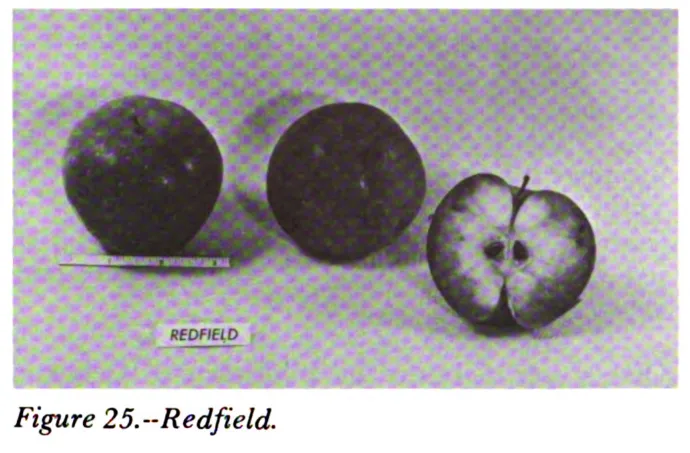
Redfield
Origin / History
Redfield originated from the 1924 cross Wolf River × Malus niedzwetzkyana. It is a sister seedling of Redford. The breeding record number was 2468, and the seedling number was Station 4840. It was selected in 1935 from a population of 46 seedlings. Without a thorough second test, it was introduced in 1938. It was named for the village of Redfield in Oswego County, New York. Redfield was briefly described in the Register of New Fruit and Nut Varieties (31), and it was again briefly described by Way (221).
Nursery trees of Redfield were sold by the New York State Fruit Testing Association for 31 years, 1938–68. In the 1960–68 period, it was not sold by any commercial nursery. In 1963, a survey of apple clones in the United States (70) showed that Redfield was tested at experiment stations in New York, South Dakota, and Wyoming.
Tree
Redfield trees are medium sized and vigorous. They are upright, tall, dense, and round-topped. Trees are not highly productive and are annual croppers. Tree trunks are medium in stockiness. The trunk bark is grayish, tinged red, and only slightly shaggy. The twigs are medium in thickness, long, and very slightly pubescent. The leaves are dark green with a reddish green tinge early in the spring, and the reddish foliage soon turns almost fully green.
Redfield trees bloom very early, almost 4 days before Delicious. It is one of the earliest blooming cultivars introduced at Geneva. The flowers are very dark pink. The variety is diploid, and the pollen is viable.
Fruit
Size: Fruit medium sized (2½ inches) to large, up to 3 inches in diameter, and variable in size.
Form: Fruit round-conic in shape, somewhat irregular, with unequal halves.
Stem: Stem short and slender.
Cavity: Cavity acuminate, medium in depth, very narrow, russeted, and usually slightly compressed.
Calyx: Calyx small and open. Calyx lobes short, narrow, and acute, dried and disintegrated. Calyx tube very long (13 mm), narrow (5 mm), and funnel shaped. Stamens basal.
Basin: Basin medium in depth, rather narrow, abrupt, and generally furrowed.
Skin: Skin thick, tender, slightly rough, and dull, covered with a light bloom but no scarfskin. The skin is sometimes somewhat russeted. Skin color is 90 per cent dark red blush with no striping, and has a very attractive appearance. Ground color is pinkish yellow.
Dots: Dots light brown russet, few, small, and conspicuous.
Flesh and flavor: Flesh red in its outer half and cream colored in its inner half. Flesh semifirm, coarse, tender, and almost dry. Flavor sour and lacking in aroma. Eating quality poor. Fruit not edible out of hand and useful only for cooking. Exposed flesh oxidizes slowly.
Core and seeds: Core medium sized (22 mm wide) and closed. Carpels round and tufted. Seeds large, wide, plump, and acute, dark brown with a pinkish tinge.
Season
Average ripening date at Geneva is October 19, 9 days after Delicious. The average number of days from full bloom to harvest is 158, 13 more than Delicious. Fruits adhere well to the tree after they have ripened. Fruits store poorly; the approximate storage life at 31° F is 100 days. Shelf life after storage is fair.
Uses
Redfield fruit is useful only for cooking and is not edible out of hand. The variety is useful as an ornamental tree and is recommended only for that purpose. It is more useful as an ornamental in the spring than for its fruits in the fall.
Subtypes / Variants
Not described in source.
Other
The fruits of Redfield and Redford are practically indistinguishable. Redfield fruits are possibly somewhat less symmetrical in shape. Redfield ground color is generally more yellowish than Redford. The basin of Redfield is generally more abrupt and deeper than Redford. Redfield is slightly darker in color than Redford. In 1950, Mrs. G. H. Howe and Mrs. R. Wellington each cooked both cultivars into sauce. They both stated that "Redfield had smaller, brighter colored fruits than Redford. Redfield made a juicier, sweeter, but less attractively colored sauce than Redford." Although the fruits are practically indistinguishable, the flowers are different. The Fruit Testing Association's catalog for 1938–39 states that "Redfield flowers are large and very dark pink, perhaps the darkest and handsomest of any Malus species. Redford flowers are perhaps the largest and showiest flowers of any pink-flowered Malus species. The petals are deep pink but not so dark as Redfield." The very close similarity between these two cultivars raises the possibility that they could be the same clone.
Book Sources
Described in 1 period pomological work
View original book sources (1)
— Roger D. Way, Apple Cultivars Introduced by the New York State Agricultural Experiment Station, 1914–1968 (1971)Redfield
Origin. Redfield originated from the 1924 cross, Wolf River x Malus niedzwetzkyana. It is a sister seedling of Redford (see Redford). The breeding record number was 2468, and the seedling number was Station 4840. It was selected in 1935 from a population of 46 seedlings. Without a thorough second test, it was introduced in 1938 (Table 2). It was named for the village of Redfield in Oswego County, New York. Redfield was briefly described in the Register of New Fruit and Nut Varieties (31), and it was again briefly described by Way (221).
Tree. Tree characteristics are summarized in Table 5. Redfield trees are medium sized and vigorous. They are upright, tall, dense, and round-topped. Trees are not highly productive and are annual croppers (Table 5). Tree trunks are medium in stockiness. The trunk bark is grayish, tinged red, and is only slightly shaggy. The twigs are medium in thickness, long, and very slightly pubescent. The leaves are dark green with a reddish green tinge early in the spring.
Blossoms. Redfield is more useful as an ornamental in the spring than it is for its fruits in the fall. In addition to its attractive reddish early spring foliage (which soon turns almost fully green), the flowers are also attractively very dark pink. Redfield trees bloom very early, almost 4 days before Delicious (Table 6). It is one of the earliest blooming cultivars introduced at Geneva. It is diploid (Table 4), and the pollen is viable.
Fruit. Redfield fruits are illustrated in Figure 25. Their characteristics are summarized in Table 8. The average ripening date at Geneva is October 19, 9 days after Delicious (Table 7). The average number of days from full bloom to harvest is 158, 13 more than Delicious. The fruits adhere well to the tree after they have ripened.
Redfield fruits are medium sized (2½ inches) to large, up to 3 inches in diameter, and they are variable in size. They are round-conic in shape and are somewhat irregular in shape with unequal halves. The stem is short and slender. The cavity is acuminate, medium in depth, very narrow, russeted, and usually slightly compressed. The calyx is small and open. The calyx lobes are short, narrow, and acute. The calyx lobes are dried and disintegrated. The basin is medium in depth, rather narrow, abrupt, and generally furrowed. The skin is thick, tender, slightly rough, dull, and covered with a light bloom but no scarfskin. The skin is sometimes somewhat russeted. The skin color is 90 per cent dark red blush, with no striping, and has a very attractive appearance. The ground color is pinkish yellow. The dots are light brown russet, few, small, and conspicuous. The calyx tube is very long (13 mm), narrow (5 mm), and funnel shaped. The stamens are basal. The core is medium sized (22 mm wide) and closed. The carpels are round and tufted. The seeds are large, wide, plump, acute, and dark brown, with a pinkish tinge. The fruit flesh is red in its outer half and cream colored in its inner half. The flesh is semifirm, coarse, tender, almost dry, sour, lacking in aroma, and poor in eating quality. It is not edible out of hand and is useful only for cooking. Exposed flesh oxidizes slowly. The fruits store poorly; the approximate storage life at 31° F is 100 days (Table 10). The shelf life after storage is fair.
Commercial Usefulness. Redfield is useful as an ornamental tree and is recommended only for that purpose. Nursery trees of Redfield were sold by the New York State Fruit Testing Association for 31 years, 1938-68 (Table 2). In the 1960-68 period, it was not sold by any commercial nursery. In 1963, a survey of apple clones in the United States (70) showed that Redfield was tested at experiment stations in New York, South Dakota, and Wyoming.
Distinguishing Features of Redfield and Redford. The fruits of Redfield and Redford are practically indistinguishable. Redfield fruits are possibly somewhat less symmetrical in shape. Redfield ground color is generally more yellowish than Redford. The basin of Redfield is generally more abrupt and deeper than Redford. Redfield is slightly darker in color than Redford. In 1950, Mrs. G. H. Howe and Mrs. R. Wellington each cooked both cultivars into sauce. They both stated that "Redfield had smaller, brighter colored fruits than Redford. Redfield made a juicier, sweeter, but less attractively colored sauce than Redford." Although Redfield and Redford fruits are practically indistinguishable, their flowers are different. The Fruit Testing Association's catalog for 1938-39 states that "Redfield flowers are large and very dark pink, perhaps the darkest and handsomest of any Malus species. Redford flowers are perhaps the largest and showiest flowers of any pink-flowered Malus species. The petals are deep pink but not so dark as Redfield." The very close similarity between these two cultivars raises the possibility that they could be the same clone.