Rutledge
Apple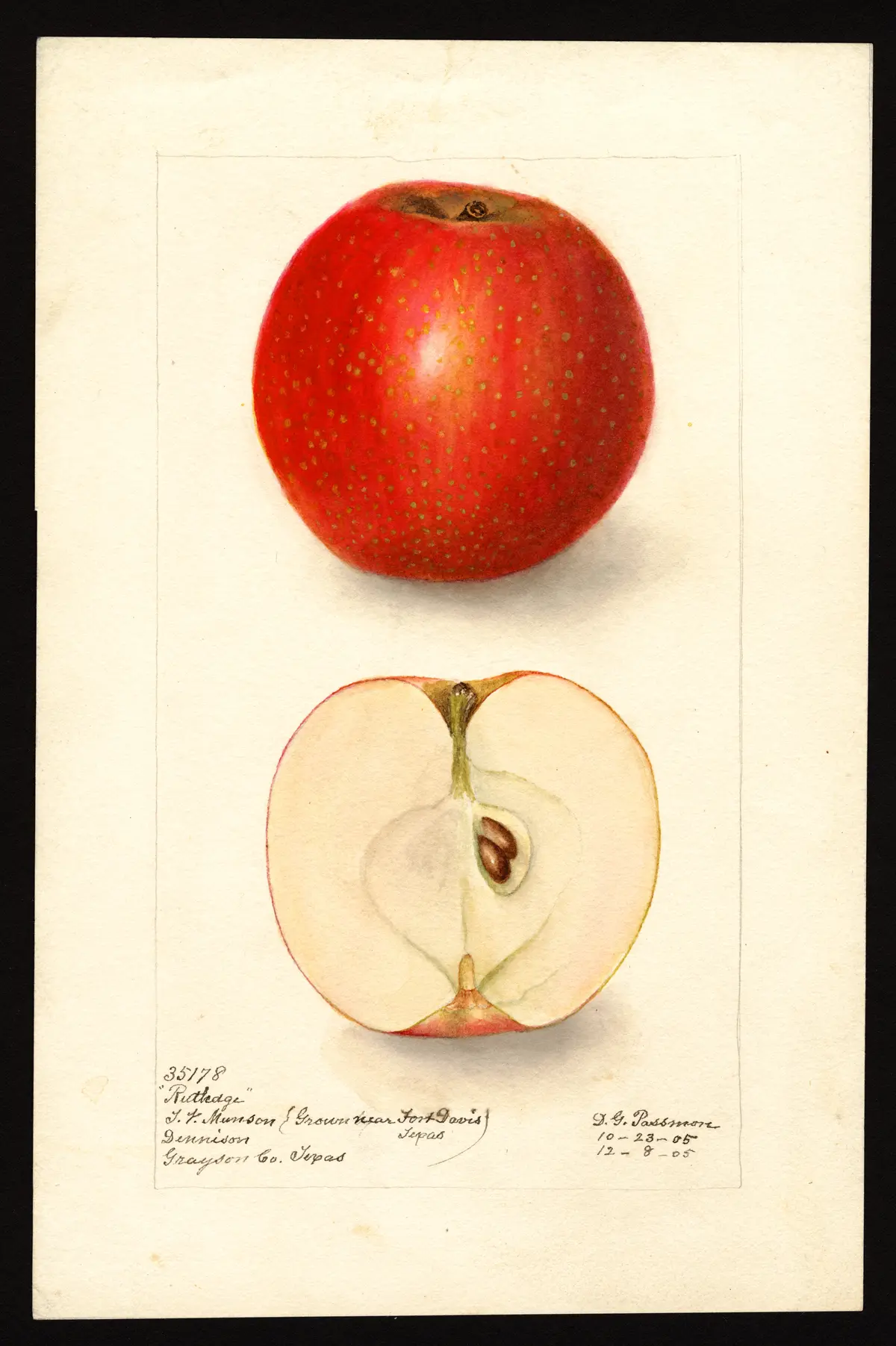
USDA Pomological Watercolor Collection
Rutledge
Origin and History
References: 1. Bailey, An. Hort., 1892:248. 2. N. Y. Sta. An. Rpt., 11:223. 1892. 3. Ragan, U. S. B. P. I. Bul., 56:272. 1905.
Received for testing at this Station from T. V. Munson, Denison, Texas, in 1892. This evidently belongs in the same group as the Bethel and Blue Pearmain varieties. Its affinity to the Blue Pearmain group is shown by the texture, flavor and quality of the flesh and by the bloom, conspicuous dots and characteristic yellow and red colors of the skin. It is less highly colored than either Blue Pearmain or Bethel but is a better keeper than either.
Tree
Tree vigorous with very long and moderately stout branches; laterals characteristically covered with numerous small spurs. Form upright spreading or roundish, dense. Twigs short to rather long, curved or nearly straight, moderately stout; terminal buds large; internodes medium to long. Bark olive-green washed with reddish-brown, lightly streaked with scarf-skin; heavily pubescent. Lenticels numerous, small to medium, round or slightly elongated, slightly raised. Buds medium in size, plump, acute, free, pubescent.
Fruit
Size and Form: Fruit above medium, pretty uniform in size and shape. Form nearly globular varying to roundish oblate or to slightly oblong, regular or somewhat ribbed, usually symmetrical.
Stem: Stem short to medium, moderately slender to thick, sometimes inserted under a lip.
Cavity: Cavity medium in size, acute to slightly acuminate, deep, rather broad or somewhat compressed, often slightly furrowed, sometimes partly russeted.
Calyx: Calyx small to medium, closed or partly open; lobes moderately narrow, acute to acuminate.
Basin: Basin small to medium, often oblique, very shallow and obtuse to moderately shallow and somewhat abrupt, narrow to moderately wide, somewhat furrowed, wrinkled.
Skin: Skin rather thick, tough, smooth about the cavity but somewhat roughened toward the basin with russet dots and fine capillary russet lines, yellow or greenish largely overspread with orange-red; in well colored specimens becoming rather dull deep red, mottled and narrowly striped with purplish-carmine, often faintly marked with grayish scarf-skin toward the cavity and covered with a thin bloom which gives the fruit a dull appearance. Dots scattering, conspicuous, large, areolar, pale gray or russet toward the cavity but numerous and smaller about the basin. Prevailing effect red and yellow.
Calyx Tube and Stamens: Calyx tube urn-shaped. Stamens median to marginal.
Core and Seeds: Core small to medium, abaxile; cells not uniform in size, usually symmetrical, closed or partly open; core lines clasping. Carpels broadly roundish or sometimes inclined to ovate, usually smooth. Seeds small to nearly medium, obtuse to somewhat acute, plump, sometimes slightly tufted, light and dark brown.
Flesh and Flavor: Flesh tinged with yellow, firm, a little coarse, not very crisp, rather tender, moderately juicy, somewhat aromatic, mild subacid becoming nearly sweet; fair to good in quality.
Season
January to May.
Uses
Not described in source.
Subtypes and Variants
Not described in source.
Other
The fruit is pretty uniformly of good size and desirable form. The tree is a good strong grower, does not come into bearing very young, but is an annual cropper, yielding moderately heavy to good crops. It does not appear to be of sufficient value for New York state to be worthy of testing except perhaps in those regions where Bethel and Blue Pearmain are most valued.
Book Sources
Described in 1 period pomological work
Nursery Catalog Sources
Found in 1 catalog (1913) from Illinois
- Benjamin Buckman (personal inventory) , Farmingdale , Illinois — 1913
View original book sources (1)
— S.A. Beach, The Apples of New York, Vol. 1 (1905)RUTLEDGE.
REFERENCES. 1. Bailey, An. Hort., 1892:248. 2. N. Y. Sta. An. Rpt., 11:223. 1892. 3. Ragan, U. S. B. P. I. Bul., 56:272. 1905.
This evidently belongs in the same group as the Bethel and Blue Pearmain. Its affinity to the Blue Pearmain group is shown by the texture, flavor and quality of the flesh and by the bloom, conspicuous dots and characteristic yellow and red colors of the skin. It is less highly colored than either Blue Pearmain or Bethel but is a better keeper than either. The fruit is pretty uniformly of good size and desirable form. The tree is a good strong grower, does not come into bearing very young, but is an annual cropper, yielding moderately heavy to good crops. It does not appear to be of sufficient value for New York state to be worthy of testing except perhaps in those regions where Bethel and Blue Pearmain are most valued.
Historical. Received for testing at this Station from T. V. Munson, Denison, Texas, in 1892 (2).
TREE.
Tree vigorous with very long and moderately stout branches; laterals characteristically covered with numerous small spurs. Form upright spreading or roundish, dense. Twigs short to rather long, curved or nearly straight, moderately stout; terminal buds large; internodes medium to long. Bark olive-green washed with reddish-brown, lightly streaked with scarf-skin; heavily pubescent. Lenticels numerous, small to medium, round or slightly elongated, slightly raised. Buds medium in size, plump, acute, free, pubescent.
FRUIT.
Fruit above medium, pretty uniform in size and shape. Form nearly globular varying to roundish oblate or to slightly oblong, regular or somewhat ribbed, usually symmetrical. Stem short to medium, moderately slender to thick, sometimes inserted under a lip. Cavity medium in size, acute to slightly acuminate, deep, rather broad or somewhat compressed, often slightly furrowed, sometimes partly russeted. Calyx small to medium, closed or partly open; lobes moderately narrow, acute to acuminate. Basin small to medium, often oblique, very shallow and obtuse to moderately shallow and somewhat abrupt, narrow to moderately wide, somewhat furrowed, wrinkled.
Skin rather thick, tough, smooth about the cavity but somewhat roughened toward the basin with russet dots and fine capillary russet lines, yellow or greenish largely overspread with orange-red, in well colored specimens becoming rather dull deep red, mottled and narrowly striped with purplish-carmine, often faintly marked with grayish scarf-skin toward the cavity and covered with a thin bloom which gives the fruit a dull appearance. Dots scattering, conspicuous, large, areolar, pale gray or russet toward the cavity but numerous and smaller about the basin. Prevailing effect red and yellow.
Calyx tube urn-shape. Stamens median to marginal.
Core small to medium, abaxile; cells not uniform in size, usually symmetrical, closed or partly open; core lines clasping. Carpels broadly roundish or sometimes inclined to ovate, usually smooth. Seeds small to nearly medium, obtuse to somewhat acute, plump, sometimes slightly tufted, light and dark brown.
Flesh tinged with yellow, firm, a little coarse, not very crisp, rather tender, moderately juicy, somewhat aromatic, mild subacid becoming nearly sweet, fair to good in quality.
Season January to May.