Saint Ghislain
Pear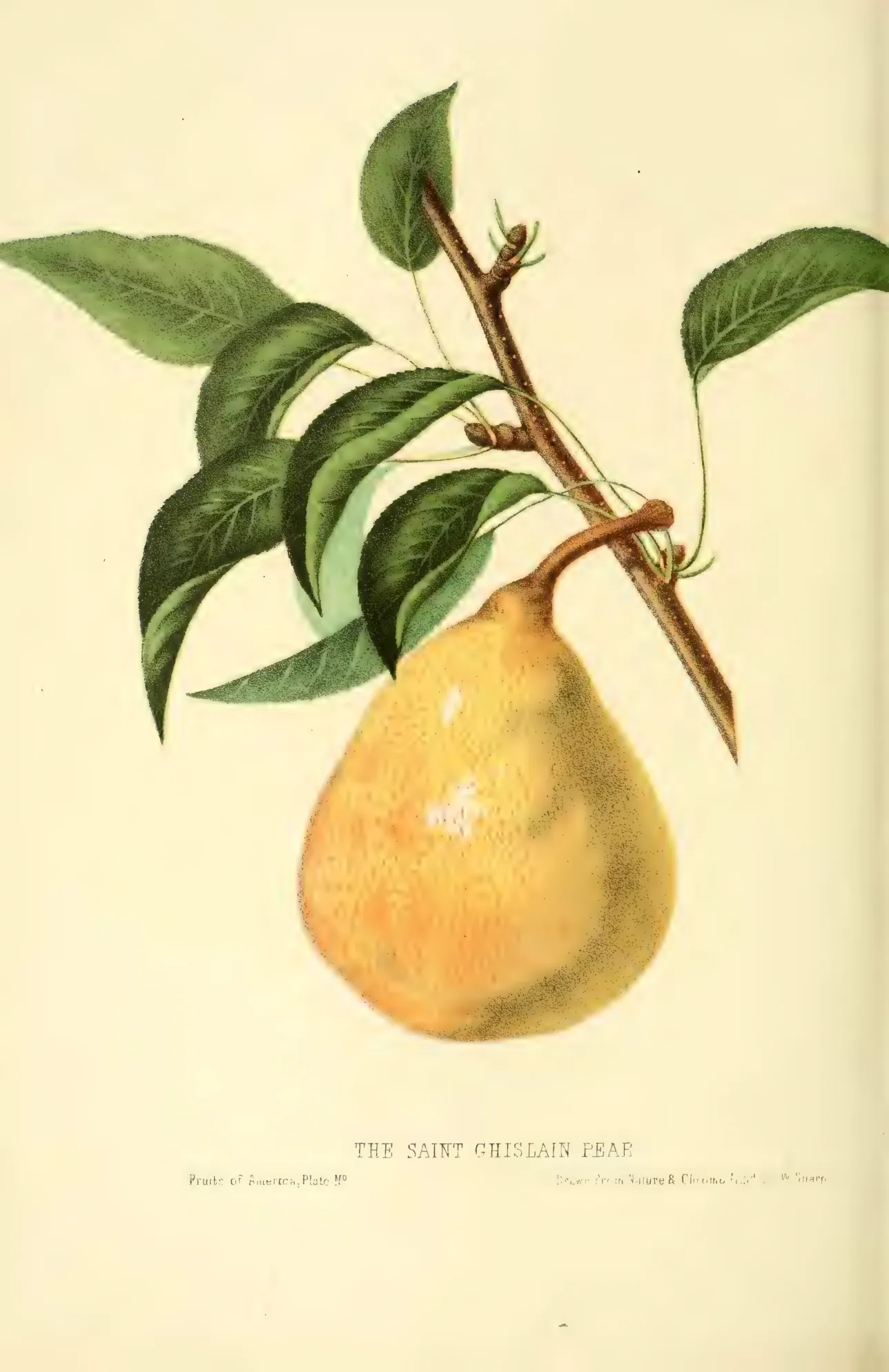
Saint Ghislain
Origin/History
Saint Ghislain is a Belgian pear (Elliott; Downing; Thomas; Budd & Hansen). Elliott describes it simply as "Foreign." Downing characterizes it as "A most excellent Belgian Pear." Budd & Hansen note it is grown for dessert use in the southeastern States and in Utah.
Tree
The tree is upright in growth habit, with vigorous growth (Elliott; Thomas). Downing emphasizes that "the tree is remarkable for its uprightness, and the great beauty and vigor of its growth." Young shoots are light brown (Elliott; Thomas), described by Downing more specifically as "olive brown, with oblong white specks." The variety requires warm, rich soil, otherwise it is "a little insipid" (Elliott); Thomas similarly notes it "requires high cultivation."
Fruit
Size
Below medium (Elliott); medium (Downing; Thomas; Budd & Hansen).
Form
Generally pyriform, but varying (Elliott); pyriform, tapering to the stalk (Downing); pyriform, with the neck narrow, acute, and tapering (Thomas); obtuse pyriform or turbinate (Budd & Hansen). Downing notes the fruit joins the stalk by fleshy rings.
Stem
Generally curved (Elliott). Downing specifies the stalk is "an inch and a half long, curved," and Thomas concurs: "an inch and a half long, curved with fleshy rings at insertion." Budd & Hansen give the length as "one to one and one-half inches long, curved, with rings at insertion in cavity."
Cavity
Not described in source by Elliott, Downing, or Thomas as a distinct feature; Budd & Hansen note rings at the insertion of the stalk in the cavity.
Calyx
Open (Elliott); "rather small, open, set in a shallow basin" (Downing).
Basin
Shallow (Elliott; Downing); very shallow (Thomas).
Skin
Pale yellow, or yellowish green, with dots of green underneath, and marblings of russet on the surface (Elliott); pale clear yellow, with a few gray specks (Downing); pale yellow, sometimes with a faint blush (Thomas); bright yellow, with greenish tinge in spots, and a blushed cheek (Budd & Hansen). Sources thus disagree on intensity of yellow (pale vs. bright) and on the presence of a blush — Elliott and Downing describe only yellow/green with russet or gray specks, while Thomas notes an occasional faint blush and Budd & Hansen describe a blushed cheek.
Flesh and Flavor
White, buttery, juicy, and sprightly (Elliott); white, buttery, and juicy, with a rich sprightly flavor (Downing); white, buttery, juicy, with a fine flavor (Thomas); white, juicy, melting, rich, vinous (Budd & Hansen). Quality is "Good to very good" (Downing), "very good" (Budd & Hansen), but "somewhat variable in quality" (Thomas), and Downing similarly cautions that "on some soils it is a little variable."
Core and Seeds
Core small (Elliott; Downing). Seeds obovate, pointed (Elliott).
Season
September (Elliott); September, October (Downing); early autumn (Thomas). Not described in source by Budd & Hansen.
Uses
Dessert use, particularly in the southeastern States and in Utah (Budd & Hansen).
Subtypes/Variants
Not described in source.
Other
Downing references Fig. 660 in association with the entry as given by Thomas.
Book Sources
Described in 4 period pomological works
- Downing, Fruits and Fruit Trees of America (1900)
- Budd & Hansen, Systematic Pomology (1914) — listed as Ghislain (St. Ghislain)
- Elliott, The Western Fruit Book (1865) — listed as St. Ghislain
- Thomas, The American Fruit Culturist (1903) — listed as Quinnipiac
View original book sources (4)
— F.R. Elliott, The Western Fruit Book (1865)St. Ghislain.
St. Galen.
Foreign. Tree, upright, vigorous growth; young shoots, light brown; requires warm rich soil, otherwise a little insipid.
Fruit, below medium; generally pyriform, but varying; color, pale yellow, or yellowish green, with dots of green underneath, and marblings of russet on surface: stem, generally curved; calyx, open; basin, shallow; core, small; seeds, obovate pointed; flesh, white, buttery, juicy, and sprightly. September.
— A.J. Downing, The Fruits and Fruit Trees of America (1900)Saint Ghislain.
Quinnipiac.
A most excellent Belgian Pear. When in perfection it is of the highest quality, but on some soils it is a little variable. The tree is remarkable for its uprightness, and the great beauty and vigor of its growth. Young shoots olive brown, with oblong white specks.
Fruit of medium size, pyriform, tapering to the stalk, to which it joins by fleshy rings. Skin pale clear yellow, with a few gray specks. Stalk an inch and a half long, curved. Calyx rather small, open, set in a shallow basin. Core small. Flesh white, buttery, and juicy, with a rich sprightly flavor. Good to very good. September, October.
— John J. Thomas, The American Fruit Culturist (1903)Quinnipiac, See St. Ghislain.
[Additional entry in this volume: "St. Ghislain", pp. 548–548]
St. Ghislain. Size medium, pyriform, neck narrow, acute, tapering; surface pale yellow, sometimes a faint blush; stalk an inch and a half long, curved with fleshy rings at insertion; basin very shallow; flesh white, buttery, juicy, with a fine flavor. Growth upright, vigorous, shoots light brown. Somewhat variable in quality. Belgian. Early autumn. Requires high cultivation. Fig. 660.
— J.L. Budd & N.E. Hansen, American Horticultural Manual, Part II: Systematic Pomology (1914)Ghislain (St. Ghislain).—Medium, obtuse pyriform or turbinate; color bright yellow, with greenish tinge in spots, and blushed cheek; stalk one to one and one-half inches long, curved, with rings at insertion in cavity. Flesh white, juicy, melting, rich, vinous, very good. Grown for dessert use in the southeastern States, and in Utah. Belgium.