Sharp
Apple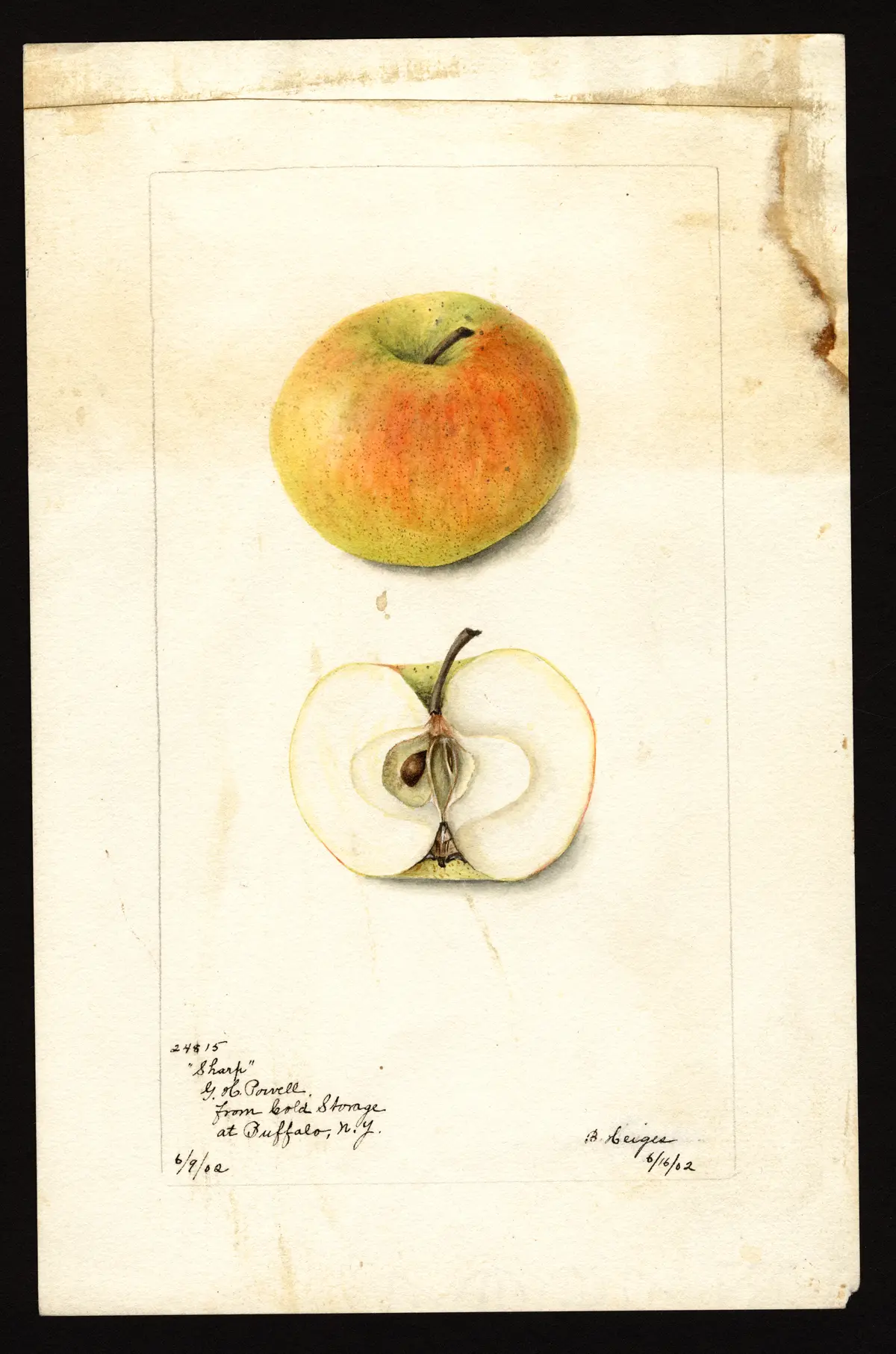
USDA Pomological Watercolor Collection
Sharp
Origin/History
Sharp is a little-known variety that can be traced to Halliday and Son, Baltimore, Maryland, about 1880 (Hedrick). It was received from Benjamin Buckman, Farmingdale, Illinois, in 1889 for testing at the New York Station; Buckman had obtained his stock from the Illinois Experiment Station, which in turn secured the variety from A. N. Lawver, who received it from Halliday and Son (Beach). The variety is more generally grown in Illinois than elsewhere (Hedrick). It is distinct from both Sharp Greening and Sharp Russet. Buckman believes it to be the same as the Butler or Butler Sweet of Pennsylvania (Beach).
Sharp is often confused with Maiden Blush, which it resembles somewhat in shape and color (Beach), but it does not equal Maiden Blush in tree or fruit, and a comparison of their descriptions enables one at once to distinguish between the two (Hedrick).
Tree
Tree small (Hedrick) to below medium size (Beach), a slow grower (Beach). Form upright spreading or roundish, open (Beach; Hedrick: upright, spreading, open). Branches short, stout to moderately stout (Beach and Hedrick). The tree comes into bearing young and yields full crops biennially (Beach).
Twigs: Short to below medium in length, stout to rather slender, straight; internodes medium (Beach).
Bark: Dull brown or brownish-red with some olive-green, streaked with thin scarf-skin; slightly pubescent (Beach).
Lenticels: Quite numerous, medium to small, oblong, slightly raised (Beach).
Buds: Medium size or below medium, prominent, plump, obtuse, free or nearly so, pubescent (Beach).
Fruit
Size and Uniformity: Often below medium, sometimes above medium (Beach); Hedrick characterizes the fruit as medium in size. Uniform in shape and size (both sources).
Form: Roundish oblate to roundish conic, sometimes approaching oblong conic, regular or very faintly ribbed, symmetrical (Beach; Hedrick: round-oblate or round-conic, sometimes oblong-conic, regular or very faintly ribbed, symmetrical).
Stem: Often very short and not exserted (Beach; Hedrick: short, not exserted).
Cavity: Usually rather large, acute to acuminate (Beach; Hedrick: large, acute), moderately deep to deep (Beach; Hedrick: deep), moderately wide to wide (Beach; Hedrick: wide), sometimes very slightly furrowed and often russeted (both sources).
Calyx: Small to medium (Beach; Hedrick: small), closed or partly open; lobes long (both sources).
Basin: Moderately shallow to rather deep (Beach; Hedrick renders this as "shallow, deep"), moderately wide (Beach; Hedrick: wide), abrupt, smooth or sometimes slightly ridged or wrinkled (Beach; Hedrick: smooth or sometimes ridged or wrinkled).
Skin: Attractive pale yellow, partly covered with a bright blush (Beach; Hedrick: pale yellow with a bright blush). Dots minute, pale or brown (both sources).
Internal structure: Calyx tube funnel-form. Stamens median to basal (both sources).
Core: Medium in size, somewhat abaxile (Beach; Hedrick: abaxile); cells open or closed; core lines clasping (both sources). Carpels broadly roundish or somewhat elliptical, emarginate (Beach; Hedrick: elliptical, emarginate).
Seeds: Beach: medium or above, moderately long, rather flat, obtuse, dark. Hedrick: large, long, flat, obtuse, dark. [The two sources differ slightly on seed size — Beach gives medium or above; Hedrick gives large.]
Flesh/Flavor: Whitish (Beach; Hedrick: white), moderately firm (Beach; Hedrick: firm), fine-grained, tender, crisp, juicy, mild subacid (both sources); nearly sweet (Beach). Quality rated very good (both sources).
Season
Late September into October (both sources). In this region (New York) it comes in season early in October or late in September (Beach).
Uses
At its best an excellent dessert fruit of very attractive appearance. Less suitable for most culinary uses because it is mildly subacid or nearly sweet. Not a good market variety because very often it is below medium size and not highly colored (Beach). In ordinary storage it commonly reaches its commercial limit in November, but sometimes a portion of the fruit keeps until March (Beach).
Other
Not described in source.
Book Sources
Described in 2 period pomological works
Nursery Catalog Sources
Found in 1 catalog (1901) from Illinois
- Benjamin Buckman (personal inventory) , Farmingdale , Illinois — 1901
View original book sources (2)
— S.A. Beach, The Apples of New York, Vol. 2 (1905)SHARP.
REFERENCES. 1. Beach, N. Y. Sta. An. Rpt., 11:602. 1893. 2. Ib., Gard. and For., 8:428. 1895. 3. Burrill and McCluer, Ill. Sta. Bul., 45:311. 1896. 4. Powell and Fulton, U. S. B. P. I. Bul., 48:56. 1903. 5. Beach and Clark, N. Y. Sta. Bul., 248:144. 1904.
SYNONYMS. None.
This at its best is an excellent dessert fruit of very attractive appearance and very good quality. It is less suitable for most culinary uses because it is mildly subacid or nearly sweet, and it is not a good market variety because very often it is below medium size and not highly colored. It resembles Maiden Blush somewhat in shape and color. In this region it comes in season early in October or late in September. In ordinary storage it commonly reaches its commercial limit in November, but sometimes a portion of the fruit keeps till March. The tree is not a strong grower, but it comes into bearing young and yields full crops biennially.
It is distinct from both Sharp Greening and Sharp Russet. Buckman believes that it is the same as the Butler or Butler Sweet of Pennsylvania.
Historical. Received from Benjamin Buckman, Farmingdale, Illinois, in 1889 for testing at this Station. Mr. Buckman obtained his stock from the Illinois Experiment Station. That Station secured the variety from A. N. Lawver, who received it from Halliday and Son, Baltimore, Maryland.
TREE.
Tree below medium size, a slow grower with short, moderately stout branches. Form upright spreading or roundish, open. Twigs short to below medium, stout to rather slender, straight; internodes medium. Bark dull brown or brownish-red with some olive-green, streaked with thin scarf-skin; slightly pubescent. Lenticels quite numerous, medium to small, oblong, slightly raised. Buds medium size or below medium, prominent, plump, obtuse, free or nearly so, pubescent.
FRUIT.
Fruit often below medium, sometimes above medium, uniform in shape and size. Form roundish oblate to roundish conic, sometimes approaching oblong conic, regular or very faintly ribbed, symmetrical. Stem often very short and not exserted. Cavity usually rather large, acute to acuminate, moderately deep to deep, moderately wide to wide, sometimes very slightly furrowed and often russeted. Calyx small to medium, closed or partly open; lobes long. Basin moderately shallow to rather deep, moderately wide, abrupt, smooth or sometimes slightly ridged or wrinkled.
Skin attractive pale yellow partly covered with a bright blush. Dots minute, pale or brown.
Calyx tube funnel-form. Stamens median to basal.
Core medium in size, somewhat abaxile; cells open or closed; core lines clasping. Carpels broadly roundish or somewhat elliptical, emarginate. Seeds medium or above, moderately long, rather flat, obtuse, dark.
Flesh whitish, moderately firm, fine-grained, tender, crisp, juicy, mild subacid, nearly sweet, very good.
Season late September into October.
— U.P. Hedrick, Cyclopedia of Hardy Fruits (1922)SHARP. Sharp is a little known variety, often confused with Maiden Blush, which it does not equal in tree or fruit. A comparison of the descriptions enables one at once to distinguish between the two. The variety can be traced to Halliday and Son, Baltimore, Maryland, about 1880. It is more generally grown in Illinois than elsewhere.
Tree small, upright, spreading, open; branches short, stout. Fruit of medium size, uniform in shape and size, round-oblate or round-conic, sometimes oblong-conic, regular or very faintly ribbed, symmetrical; stem short, not exserted; cavity large, acute, deep, wide, sometimes furrowed and often russeted; calyx small, closed or partly open; lobes long; basin shallow, deep, wide, abrupt, smooth or sometimes ridged or wrinkled; skin pale yellow with a bright blush; dots minute, pale or brown; calyx-tube funnel-form; stamens median to basal; core medium in size, abaxile; cells open or closed; core-lines clasping; carpels elliptical, emarginate; seeds large, long, flat, obtuse, dark; flesh white, firm, fine-grained, tender, crisp, juicy, mild subacid; very good; late September into October.