Sheldon
Pear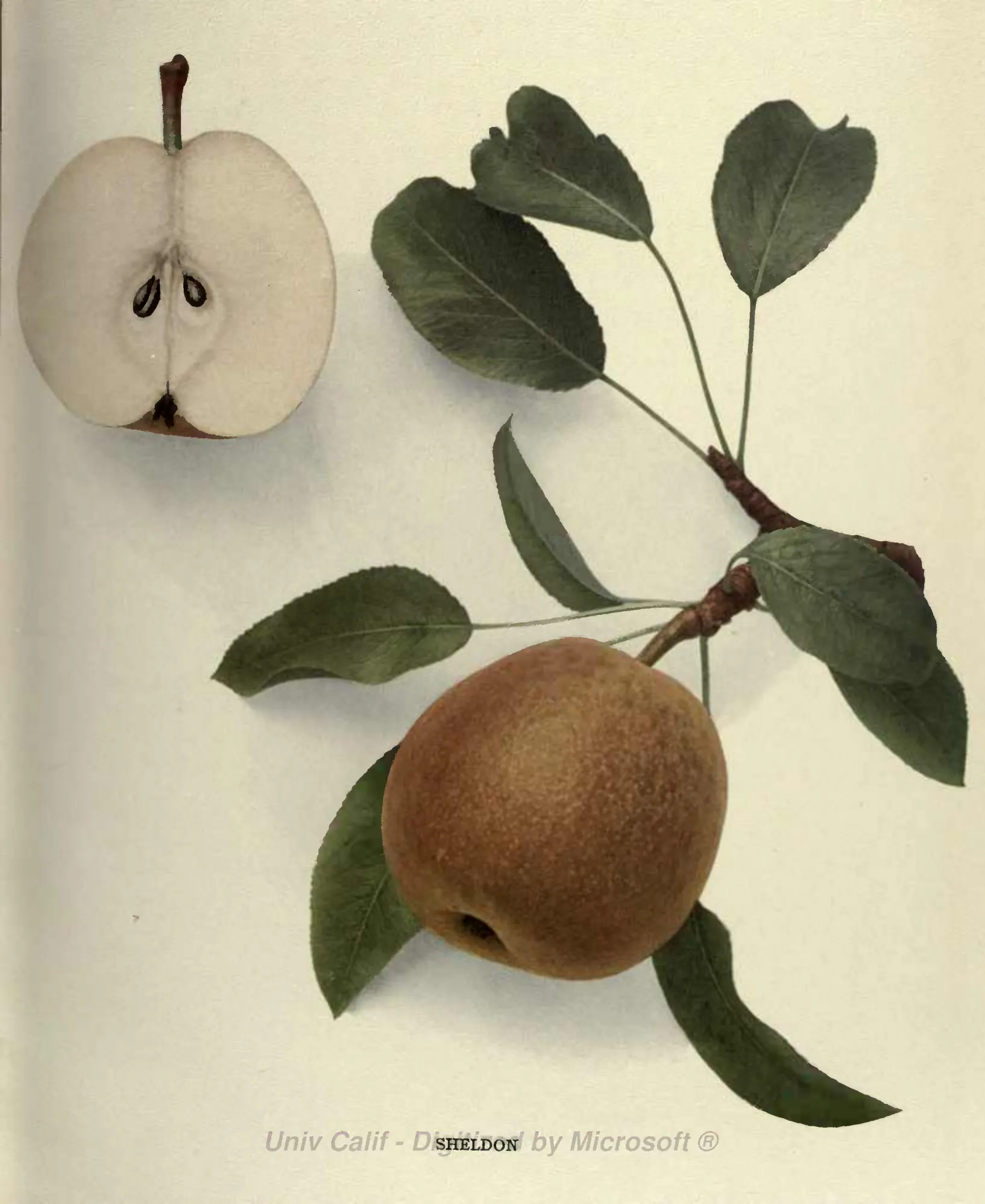
Sheldon
Origin / History
Sheldon is an American pear, native of the town of Huron, Wayne County, New York, in the region Elliott calls western Central New York. It was first brought to the notice of cultivators by Mr. E. L. Leavenworth of Wolcott, Wayne County. Hovey printed the substance of Leavenworth's history of its origin, which had appeared in the Magazine of Horticulture.
According to that history, Major Sheldon's father brought pear seeds from Washington, Dutchess County, New York, "between thirty and forty years since," as stated by Leavenworth in 1850. He planted them on the place where Major Sheldon lived, in the town of Huron, then Wolcott. Hedrick dates the seed to about 1815 and places the original tree on the premises of Major Sheldon. Downing instead calls Sheldon an accidental seedling on the farm of Norman Sheldon in the town of Huron.
The seeds came from pears grown on a grafted tree, name not known. In Hovey's words, these "were introduced there by an Englishman of the name of Johnson." Major Sheldon thought Johnson "brought them with him from England"; Norman Sheldon, an older brother, thought they were procured in Boston. Desportes says the seeds were brought by Mr. Sheldon to Wayne County from the farm of Judge Johnson of Dutchess County.
Several trees were raised. Desportes describes them as all seedlings, "bearing the strongest resemblance to each other." Hovey reports that in 1850 they were of large size and bore several bushels of fruit. Desportes found the form and size much like the Doyenne or Virgalieu, "which was probably the parent," with more of the flavor of the Brown Beurre.
Leavenworth first exhibited the fruit at the Pomological Convention in 1849. Hovey places that convention at Buffalo; Hedrick places it at Syracuse, in the autumn of 1849. The variety was published in the Magazine of Horticulture, vol. xvii, 1851. Through Leavenworth, Hovey obtained scions from the original tree, and his drawing was made from "specimens the produce of these scions, inserted in 1851." The American Pomological Society mentioned Sheldon as promising well in 1854 and gave it a place in its fruit catalog in 1856. Desportes, writing in 1856, reports receiving a box of samples of these "new seedling pears" from Mr. W. S. Verplanck of Geneva, New York. The Central Experimental Farm at Agassiz, British Columbia, planted it in spring 1890.
Hovey wrote that among American pears introduced during the previous twenty years "few, if any, will take a higher rank." He held that it "possesses all the characteristics of a fine variety" and "must be considered one of the very finest of our native pears." Budd and Hansen call it "very extensively grown across the continent." Hedrick says that, were the fruits alone considered, Sheldon "would take rank as one of the best of all pears." He adds that the fruits "please both the eye and the palate" and that "those of no rival in season surpass them either in appearance or in characters that satisfy taste." He also wrote that "the list of faults in the trees is as long as the list of virtues in the fruits." In his judgment the variety grows better in New York, possibly, than in any other part of the United States.
Tree
Large, vigorous, rapid-growing, hardy. Hovey calls it a vigorous grower and elsewhere moderately vigorous; the Agassiz station reports a strong grower. Habit erect and upright, symmetrical, branching rather symmetrically with regular diverging branches; Hedrick calls it upright-spreading. Hovey likens the habit to the White Doyenne, and Desportes was told the growth resembles the Virgalieu. Annual growth rather slender and nearly straight (Hovey). Trunk stocky (Hedrick).
Branches thick, reddish-brown, overlaid with dull gray scarf-skin, marked with large lenticels. Branchlets thick, dull brown, glabrous, with numerous slightly raised, conspicuous lenticels (Hedrick). Young wood yellowish, light yellowish, yellow brown, or yellowish-brown. Shoots ascending (Thomas), short-jointed, rather slender, dotted with small whitish specks. Old wood yellowish olive (Hovey).
Leaf-buds medium size, ovate, regularly pointed, slightly diverging, with prominent shoulders (Hovey). Hedrick gives them as large, above medium in length, obtuse or somewhat pointed, appressed. Flower-buds medium size, long, sharply pointed (Hovey); conical or pointed, free (Hedrick).
Leaves medium size. Hovey describes them as ovate, long, narrow, tapering to each end, thin, light yellowish green, glossy, nearly flat, slightly recurved on the midrib, somewhat wavy, finely and sharply serrated; petioles long, 1½ to 2 in., moderately stout. Hedrick describes them as oval and leathery, apex taper-pointed, margin finely serrate. He measures them 2½ in. long and 1¼ in. wide with petiole 1½ in. in 1921, and 1¾ in. wide with petiole 1¾ in. in his 1922 Cyclopedia.
Flowers small; petals small, roundish, cupped; clusters compact (Hovey). Hedrick gives the flowers as 1⅛ in. across, in dense clusters of 13 or 14 buds, with pedicels ⅝ in. long, thick, pubescent, and greenish; his Cyclopedia gives 1¼ in. and 7 or 8 buds.
Hovey says the tree bears freely when not more than four or five years old and produces regular and abundant crops; Elliott and Downing call it a good bearer, Elliott on pear stock. Hedrick reports the reverse. In his view the trees are reluctant in coming into bearing, "niggardly in production" (1921) or "not productive" (1922), and seldom hold their crop well, so that in exposed positions the wind takes great toll. His technical descriptions nonetheless call the tree moderately productive (1921) and productive (1922). They "blight as badly as any pear-tree in the orchard" (Hedrick).
Hovey believed it does not succeed well upon the quince, though it had not then had sufficient trial. Thomas says it requires double working on the quince.
Fruit
Size: Medium to large. The sources divide about evenly between medium or above medium and large, and Thomas gives medium or large. Hovey says it frequently weighs nearly a pound and measures about 3 in. long by 3 in. in diameter. Hedrick measures it 2⅝ in. long by 2⅜ in. wide (2⅞ by 2⅝ in. in his Cyclopedia), uniform in size. His introductory remarks call the fruits "not large," though of sufficient size to meet the demands of a good dessert pear.
Form: Roundish obtuse obovate, regular, full at the crown, tapering little to the stem end, which is very obtuse. Sometimes a little angular (Elliott); sometimes approaching broad obovate (Thomas). Hedrick calls it a perfect turbinate, truncated at the base, usually very symmetrical, often with a tendency to oblateness, uniform in shape.
Stem: Short, stout to rather stout, thick, about ½ to ¾ in. long (Hovey about ½ in., Hedrick ⅝ in., Budd and Hansen ¾ in.). Hovey calls it curved and Elliott slightly curved; Hedrick calls it nearly straight.
Cavity: Deep to quite deep. Hedrick describes it as obtuse, slightly furrowed (furrowed in his Cyclopedia), and occasionally lipped; Thomas calls it narrow. Hovey, against these, has the stem inserted "with scarcely any depression" on the obtuse end.
Calyx: Medium to large, open. Segments broad and short; projecting (Hovey); partly recurved (Downing). Hedrick describes the lobes as very broad and obtuse, and the calyx-tube as short, wide, conical.
Basin: Smooth, round, broad, wide, large, obtuse, symmetrical. Depth from not very deep, with the eye moderately sunk (Hovey), to rather deep (Thomas) or quite deep (Budd and Hansen).
Skin: Thick. Hovey calls it fair and nearly smooth; Hedrick calls it granular, tender, roughish, and Budd and Hansen rather harsh.
Pale greenish russet, greenish yellow, or dull greenish-yellow, mostly or nearly wholly covered with thin light russet in nettings and streaks; Hedrick says the whole fruit is more or less russeted. Becoming yellowish when mature (Hovey); becoming cinnamon brown (Thomas). Desportes likens the russety greenish yellow skin to that of the Brown Beurre.
A ruddy cheek on the sunny side: bronzy red, light red, or bronzed; a little brownish crimson, or some show of crimson; a brownish-red blush, faint in Hedrick's Cyclopedia. Handsome, prepossessing, and very distinctive in its russeted skin with ruddy cheek.
Dots: Numerous, small, russet. Hovey describes the skin as regularly dotted with small dark russet specks; Elliott calls it only a little specked with dark russet.
Flesh and flavor: Flesh whitish; yellowish (Hovey). Rather coarse, somewhat granular, a little coarse and gritty at the core (Elliott); otherwise tender, very to exceedingly melting, buttery (Agassiz), very juicy. Hedrick says the flesh deserves, "more than that of almost any other pear, the adjective luscious."
Flavor sweet and sugary, vinous, sprightly, very brisk (Thomas). Rich, "exceedingly rich" (Hovey), aromatic. Hovey calls it "highly aromatized, and luscious" with "a delicious aroma." Hedrick calls it "highly perfumed" and "pleasantly aromatic," with "a pleasant musky aroma" in his Cyclopedia. Desportes places the flavor between the Doyenne or Virgalieu and the Brown Beurre, with more of the Brown Beurre's flavor.
Quality "very good" to "best." Most ratings stand at "very good," Desportes so judging from a single season's fruit. Elliott rates it nearly "best" and Hedrick "very good to best"; Thomas calls the flavor "excellent."
Core and seeds: Core rather large to large; closed, with clasping core-lines (Hedrick). Seeds medium size, flat, dark (Hovey); dark brown (Elliott); acute (Hedrick).
Season
October. Hovey says it keeps three or four weeks. Hedrick says the fruits keep well.
Uses
A dessert pear; Hedrick says it is esteemed both for dessert and for culinary purposes. He adds that the fruits ship well and sell well during their season. In his judgment the faults of the tree keep Sheldon from being a commercial variety of high rank. Even so, the splendid fruits make it worth growing by the pear-fancier, in the home orchard, or for markets where the faults of the trees are not too marked.
Subtypes / Variants
Not described in source.
Other
Hedrick states that his color-plate does not do justice to the fruit in illustrating size, shape, or color. The fruit is figured in the Magazine of Horticulture (fig. 25), Thomas (Fig. 721), and Hedrick's Cyclopedia (Fig. 95). Hedrick's references include accounts in Downing (1857, 1869), Elliott (1859), Hoffy's North American Pomologist (1860, plate), Mas's Le Verger (1866–73, fig. 156), and Leroy's Dictionnaire de Pomologie (1869).
Book Sources
Described in 8 period pomological works
- Hedrick, The Pears of New York (1921)
- Hedrick, Cyclopedia of Hardy Fruits (1922)
- Thomas, The American Fruit Culturist (1903)
- Budd & Hansen, Systematic Pomology (1914)
- Downing, Fruits and Fruit Trees of America (1900)
- Elliott, The Western Fruit Book (1865)
- The Horticulturist (1855) — listed as The Sheldon Pear
- Hovey, The Fruits of America (1852) — listed as THE SHELDON PEAR
Nursery Catalog Sources
Found in 42 catalogs (1850–1918) from Alabama, California, Florida, Illinois, Maryland, Massachusetts, Missouri, New Jersey, New York, Oregon, Pennsylvania, Washington
- Azell Bowditch (Nursery / Fruit Catalog) , Boston , Massachusetts — 1850
- Hutchison Nursery , James Hutchison, Oakland , California — 1881
- Felix Gillet , Barren Hill Nursery, Nevada City , California — 1884
- Huntsville Wholesale Nurseries (Jessie S. Moss , Proprietor; W.F. Heikes, Manager), Huntsville , Alabama — 1886
- Felix Gillet , Barren Hill Nursery, Nevada City , California — 1888
- California Nursery Co. , Niles , California — 1889
- Felix Gillet , Barren Hill Nursery, Nevada City , California — 1889
- Felix Gillet , Barren Hill Nursery, Nevada City , California — 1890
- William H. Moon Co. , Morrisville, Bucks County , Pennsylvania — 1890
- Felix Gillet , Barren Hill Nursery, Nevada City , California — 1891
- Missouri Nursery Co. , Louisiana , Missouri — 1891
- Puyallup & Yakima Nurseries , Puyallup, Washington (Lock Box 191) and North Yakima , Washington — 1892
- Glen St. Mary Nurseries (G.L. Taber , Proprietor), Glen St. Mary , Florida — 1893
- Rogers Nursery Co. , Moorestown , New Jersey — 1893
- Sherwood Hall Nursery Co. , Timothy Hopkins (Menlo Park Nurseries), San Francisco / Menlo Park , California — 1893
- Milwaukie-Canby Nurseries , Canby, OR (and Milwaukie, OR) — 1893
- Green's Nursery Co. (Charles A. Green) , Rochester , New York — 1894
- The Vineland Nurseries (Kelsey & Co. , Proprietors), St. Joseph, Missouri (Office: 13th and Atchison Sts., 2 Blocks East of the Citizens St. Car Line) — 1894
- Woodburn Nurseries , Woodburn, Marion Co. , Oregon — 1894
- Felix Gillet , Barren Hill Nursery, Nevada City , California — 1895
- The Lovett Company , Little Silver , New Jersey — 1896
- Felix Gillet , Barren Hill Nursery, Nevada City , California — 1897
- Arthur J. Collins & Sons , Moorestown , New Jersey — 1898
- Reading Nursery , Jacob W. Manning, Proprietor, Reading , Massachusetts — 1898
- Stark Bros. Nurseries & Orchards Co. , Louisiana , Missouri — 1898
- Brown Brothers Co. , Continental Nurseries, Rochester, NY (also operated from Toronto, Canada) — 1899
- Alabama Nursery Co. , Huntsville , Alabama — 1900
- Central Experimental Farm , Dominion Department of Agriculture, Agassiz, British Columbia (under test; Bulletin No. 3, Second Series) — 1900
- Brown Brothers Co. , Continental Nurseries, Rochester, NY (also operated from Toronto, Canada) — 1901
- Mountain Grove Nurseries (Tippin & Moore , Proprietors; Geo. T. Tippin, J. W. Tippin, J. C. Moore), Mountain Grove , Missouri — 1901
- S.L. Watkins , Grizzly Flats, El Dorado County , California — 1901
- Phoenix Nursery Company (W. E. Rossney , President; Sidney Tuttle, Vice-President), Bloomington , Illinois — 1904
- Carlton Nursery Co. , Carlton , Oregon — 1909
- Wm. J. Corse (successor to Robert Sinclair / Sinclair Nurseries) , Baltimore , Maryland — 1909
- Island Nurseries & Fruit Farm , Vashon (Vashon Island) , Washington — 1910
- Island Nurseries & Fruit Farm , Vashon (Vashon Island) , Washington — 1911
- Samuel Fraser , Geneseo , New York — 1913
- Island Nurseries & Fruit Farm , Vashon (Vashon Island) , Washington — 1914
- Island Nurseries & Fruit Farm , Vashon (Vashon Island) , Washington — 1915
- Island Nurseries & Fruit Farm , Vashon (Vashon Island) , Washington — 1916
- Island Nurseries & Fruit Farm , Vashon (Vashon Island) , Washington — 1917
- Fancher Creek Nurseries , George C. Roeding, Fresno , California — 1918
View original book sources (9)
— C.M. Hovey, The Fruits of America (1852)THE SHELDON PEAR.
Sheldon. Magazine of Horticulture, vol. xvii. 1851.
Among all the American pears that have been introduced to notice, during the last twenty years, few, if any, will take a higher rank than the Sheldon. It possesses all the characteristics of a fine variety; the fruit is of large size, frequently weighing nearly a pound each, and is prepossessing in its appearance, having a handsome russety skin, with a ruddy cheek: its flesh is exceedingly melting and juicy, and its flavor rich, highly aromatized, and luscious: the tree is a vigorous grower, with an erect and symmetrical habit, and produces regular and abundant crops. Altogether it, must be considered one of the very finest of our native pears.
The Sheldon was first brought to the notice of cultivators by Mr. E. L. Leavenworth, of Wolcott, Wayne Co., N. Y., who first exhibited specimens of the fruit at the Pomological Convention in Buffalo, in 1849; and to that gentleman the public are indebted for a full history of its origin, which appeared in the Magazine of Horticulture, the substance of which is as follows:—
Major Sheldon's father brought pear seeds from Washington, Dutchess Co., New York, between thirty and forty years since, and planted them on the place where Maj. Sheldon now lives, in the town of Huron, (then Wolcott), N. Y.; from these seeds the trees were raised which bear the pears known as the Sheldon. The seeds brought from Dutchess County were from pears which grew on a grafted tree, (name not known,) but were introduced there by an Englishman of the name of Johnson, and Maj. Sheldon thinks he brought them with him from England; but Norman Sheldon, an older brother, thinks they were procured in Boston. The trees, of which there are several, were in 1850, when Mr. Leavenworth sent us this statement, of large size, and bore several bushels of fruit. Through the kindness of Mr. Leavenworth, we obtained scions from the original tree, and our beautiful drawing is made from specimens the produce of these scions, inserted in 1851.
The Sheldon is a moderately vigorous tree, with an erect habit, branching rather symmetrically, somewhat resembling the White Doyenne. It bears freely on trees not more than four or five years old. We believe it does not succeed well upon the quince, though there has not been sufficient time to give it a trial.
Tree. — Vigorous, upright, erect, symmetrical in shape, with regular diverging branches; annual growth rather slender, and nearly straight.
Wood. — Yellowish, dotted with small whitish specks, short-jointed, rather slender; old wood, yellowish olive; buds, medium size, ovate, regularly pointed, slightly diverging, with prominent shoulders: Flower-buds, medium size, long, sharply pointed.
Leaves. — Medium size, ovate, long, narrow, tapering to each end, thin, light yellowish green, glossy, nearly flat, slightly recurved on the midrib, somewhat wavy, and finely and sharply serrated; petioles, long, one and a half to two inches in length, moderately stout.
Flowers. — Small; petals, small, roundish, cupped; clusters compact.
Fruit. — Large, about three inches long, and three inches in diameter: Form, roundish obovate, regular, full at the crown, tapering little to the stem end, which is very obtuse: Skin, fair, nearly smooth, of a pale greenish russet, becoming yellowish when mature, bronzy red on the sunny side, and regularly dotted with small dark russet specks: Stem, short, about half an inch long, stout, curved, and inserted, with scarcely any depression, on the obtuse end: Eye, medium size, open, and moderately sunk in a smooth, round, not very deep basin; segments of the calyx, broad, short, projecting: Flesh, yellowish, rather coarse, melting, and very juicy: Flavor, exceedingly rich, sprightly, and sugary, with a delicious aroma: Core, rather large: Seeds, medium size, flat, dark.
Ripe in October, and keeps three or four weeks.
— B. Desportes, The Horticulturist (1856)The Sheldon Pear.—We received from Mr. W. S. Verplanck, of Geneva, N. Y., a box containing some samples of new seedling pears under this name. They were, as we learn, the product of several trees, all seedlings, bearing the strongest resemblance to each other, and all raised from seeds brought by Mr. Sheldon to Wayne co., from the farm of Judge Johnson, of Dutchess county, N. Y. The form and size is much like that of the Doyenne or Virgalieu, (which was probably the parent,) but with more of the flavor of the Brown Beurre, and a good deal of the russety greenish yellow skin of the latter pear. The flavor is something between the two first—and so far as we could judge from the product of a single season, is likely to take rank as a "very good" pear. The tree is said to resemble the Virgalieu in its growth. We shall hope to examine this variety next year, and report more fully upon it.
— F.R. Elliott, The Western Fruit Book (1865)Sheldon.
Penfield, | Wayne.
American. Native of western Central New York. Tree, vigorous, erect, hardy, good bearer on pear, young shoots short-jointed, light yellowish. Fruit, medium or above, roundish, a little angular, sometimes obovate, pale greenish russet, light red or bronzed in sun, little specked with dark russet; stem, short, rather stout, slightly curved; calyx, medium, open, broad short segments; core, rather large; seeds, dark brown: flesh, a little coarse, and gritty, at core, otherwise melting, juicy, sugary, sprightly, aromatic; nearly "best." October.
— A.J. Downing, The Fruits and Fruit Trees of America (1900)Sheldon.
Wayne. Bland. Huron. Wisner.
An accidental seedling on the farm of Norman Sheldon, in the town of Huron, Wayne Co., N. Y. Tree vigorous, erect, hardy, and a good bearer. Young wood yellow brown.
Fruit medium, roundish obtuse obovate. Skin greenish yellow mostly covered with thin light russet, a little brownish crimson in the sun, dotted with russet. Stalk short, stout. Cavity deep. Calyx open. Segments partly recurved. Basin broad, large. Flesh whitish, very juicy, melting, sweet, vinous, rich aromatic. Very good. October.
— John J. Thomas, The American Fruit Culturist (1903)Sheldon.* Medium or large, roundish, sometimes approaching broad obovate; greenish-russet becoming cinnamon brown; stalk short, cavity narrow; basin smooth, rather deep; flesh a little coarse, very melting, juicy, with a very brisk, vinous, excellent flavor. October. Tree vigorous, shoots ascending, yellowish-brown. It requires double working on the quince. New York. Fig. 721.
— J.L. Budd & N.E. Hansen, American Horticultural Manual, Part II: Systematic Pomology (1914)Sheldon.—Large, roundish, obtuse obovate; color greenish yellow, covered largely with thin russet; some show of crimson where exposed, and numerous russet dots; skin thick and rather harsh; stalk three-quarters of an inch long, inserted in quite a deep cavity; basin broad and quite deep. Flesh whitish, juicy, melting, sweet, vinous, and aromatic, very good. Very extensively grown across the continent. New York.
— U.P. Hedrick, The Pears of New York (1921)SHELDON
- Mag. Hort. 17:252, fig. 25. 1851. 2. Am. Pom. Soc. Rpt. 151. 1854. 3. Ibid. 210. 1856. 4. Downing Fr. Trees Am. 444, fig. 1857. 5. Elliott Fr. Book 347. 1859. 6. Hoffy N. Am. Pom. 1: Pl. 1860. 7. Mas Le Verger 3: Pt. 2, 119, fig. 156. 1866-73. 8. Downing Fr. Trees Am. 855, fig. 1869. 9. Leroy Dict. Pom. 2:662, fig. 1869.
Were the fruits alone to be considered, Sheldon would take rank as one of the best of all pears. The fruits please both the eye and the palate. Those of no rival in season surpass them either in appearance or in characters that satisfy taste. While not large, the fruits are of sufficient size to meet the demands of a good dessert pear. The shape is a perfect turbinate, truncated at the base of the fruit, usually very symmetrical, and the fruits run uniform in shape. In color, the pears are distinctive in their russeted skin, with a handsome ruddy cheek. The accompanying color-plate does not do justice to the fruit in illustrating size, shape, or color. The flesh is melting and juicy, and deserves, more than that of almost any other pear, the adjective luscious. The flavor is sweet, vinous, and highly perfumed. The fruits keep well, ship well, and sell well during their season, and are esteemed both for dessert and for culinary purposes. The list of faults in the trees is as long as the list of virtues in the fruits. The trees, while large, vigorous, and hardy, blight as badly as any pear-tree in the orchard, are reluctant in coming in bearing, niggardly in production, and seldom hold their crop well. With these faults of the tree, Sheldon is not a commercial variety of high rank, but the splendid fruits make it worth growing by the pear-fancier, in the home orchard, or for the markets where the faults of the trees are not too marked. The variety grows better in New York, possibly, than in any other part of the United States.
This pear is a native of the town of Huron, New York. The original tree stood on the premises of Major Sheldon, having sprung from seed brought by his father from Washington, New York, about 1815. The fruit was first exhibited at the Pomological Convention in Syracuse in the autumn of 1849. In 1854, Sheldon was mentioned by the American Pomological Society as promising well, and in 1856 it was given a place in the Society's fruit-catalog.
Tree large, vigorous, upright-spreading, rapid-growing, hardy, moderately productive; trunk stocky; branches thick, reddish-brown, overlaid with dull gray scarf-skin, marked with large lenticels; branchlets thick, dull brown, glabrous, with numerous slightly raised, conspicuous lenticels.
Leaf-buds large, above medium in length, obtuse or somewhat pointed, appressed.
Leaves 2½ in. long, 1¼ in. wide, oval, leathery; apex taper-pointed; margin finely serrate; petiole 1½ in. long. Flower-buds conical or pointed, free; flowers 1⅛ in. across, in dense clusters, 13 or 14 buds in a cluster; pedicels ⅝ in. long, thick, pubescent, greenish.
Fruit matures in October; large, 2⅝ in. long, 2⅜ in. wide, uniform in size and shape, turbinate, often with a tendency to oblateness, symmetrical; stem ⅝ in. long, thick, nearly straight; cavity obtuse, deep, slightly furrowed, occasionally lipped; calyx large, open; lobes very broad, obtuse; basin wide, obtuse, symmetrical; skin thick, granular, tender, roughish; color dull greenish-yellow, with a brownish-red blush, overspread with russet nettings and streaks; dots numerous, small, russet; flesh whitish, somewhat granular, tender and melting, very juicy, sweet, and vinous, with a rich and pleasantly aromatic flavor; quality very good to best. Core large, closed, with clasping core-lines; calyx-tube short, wide, conical; seeds acute.
— U.P. Hedrick, Cyclopedia of Hardy Fruits (1922)SHELDON. Fig. 95. The fruits of Sheldon satisfy both the eye and the palate; no rival in season surpasses them in either appearance or quality. While not large, they are of sufficient size to meet the demands of a good dessert fruit. The shape is a perfect turbinate, truncated at the base, and is usually symmetrical and uniform. In color the pears are very distinctive, the whole fruit being more or less russeted, with a handsome ruddy cheek. The flesh is melting and juicy, and deserves more than almost any other pear the adjective luscious; it is sweet, vinous, and highly perfumed with a pleasant musky aroma. The fruits keep and ship well, and are esteemed both for dessert and culinary purposes. The trees, while large, vigorous, and hardy, are not productive; blight as badly as any pear in the orchard; are reluctant in coming in bearing, and seldom hold their crop well, so that in exposed positions the wind takes great toll. These faults of the tree keep Sheldon from being a commercial variety of high rank, but the fine fruits make it worth growing in the home orchard or for the markets where the faults of the trees are not too marked. This pear is a native of the town of Huron, Wayne County, New York. The original tree stood on the premises of Major Sheldon, having sprung from seed planted about 1815.
Tree large, vigorous, upright-spreading, rapid-growing, hardy, productive; trunk stocky; branches thick, reddish-brown, marked with large lenticels. Leaves 2½ inches long, 1¾ inches wide, oval, leathery; apex taper-pointed; margin finely serrate; petiole 1¾ inches long. Flowers 1¼ inches across, in dense clusters, 7 or 8 buds in a cluster. Fruit matures in October; large, 2⅞ inches long, 2⅝ inches wide, uniform in size and shape, turbinate, symmetrical; stem ¾ inch long, thick, nearly straight; cavity obtuse, deep, furrowed, occasionally lipped; calyx large, open; lobes very broad, obtuse; basin wide, obtuse, symmetrical; skin thick, granular, tender, roughish; color dull greenish-yellow with a faint brownish-red blush overspread with russet nettings and streaks; dots numerous, small, russet; flesh whitish, somewhat granular, tender and melting, very juicy, sweet and vinous, with a rich and pleasantly aromatic flavor; quality very good to best; core large, closed, with clasping core-lines; calyx-tube short, wide, conical; seeds acute.
— Central Experimental Farm, Central Experimental Farm, Agassiz BC — Catalogue of Fruit Trees under Test (Bulletin No. 3, 1900) (1900)Planted Spring 1890. Tree a strong grower. Fruit above medium size, roundish, obtuse, obovate. Skin greenish yellow, with a thin russet, nearly over the whole surface. Flesh whitish, juicy, buttery, sweet and rich. Season October.