Shockley
Apple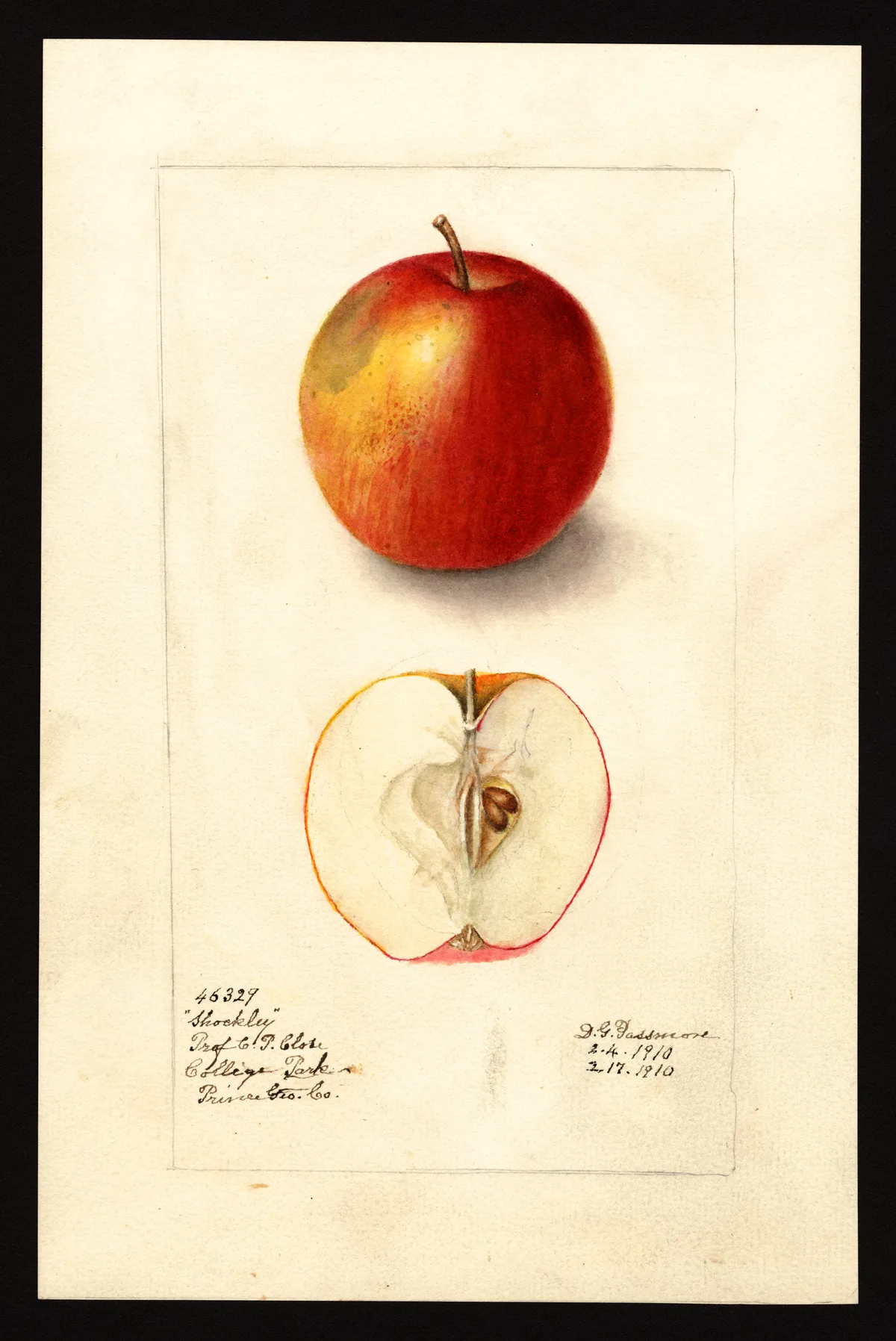
USDA Pomological Watercolor Collection
Shockley
Origin / History
Sources disagree on the precise origin. Warder (1867) and Budd & Hansen (1914) give the origin as Jackson County, Georgia. Thomas (1903) attributes it simply to Georgia, citing Wm. N. White. Downing (1900) gives the origin as Georgia. Hedrick (1922) states the origin is not known, but reports it as having been long grown in Maryland, calling it an old southern sort widely grown under several names. Downing (1900) lists a separate entry for "Waddell Hall" as a Southern apple of unknown origin, while Elliott (1865) and Thomas (1903) treat "Waddel's Hall" as a synonym of Shockley.
Warder (1867) describes it as a long-keeper from the South that promises to be an acquisition of value for market orchards, unless its small size may make an objection. Downing (1900) calls it one of the most profitable varieties at the South, where it not only bears abundantly but keeps and sells remarkably well. Budd & Hansen (1914) describe it as a popular variety at the South. Hedrick (1922) notes that before cold storage became common, Shockley was a favorite variety because of the long season of the fruits.
Tree
Vigorous (Warder; Budd & Hansen), or moderately vigorous (Downing; and Downing for "Waddell Hall"); upright (Downing; Budd & Hansen); very productive (Warder; Downing); bearing young and regularly (Downing); an early and very abundant bearer (Budd & Hansen); erect, vigorous, coming into bearing early and very productive (Hedrick, citing catalogs).
Young wood reddish, grayish on under side (Downing). For "Waddell Hall," Downing gives young wood as brownish.
Fruit
Size
Sources vary slightly: medium (Elliott; Thomas); medium to small (Warder); below medium (Downing); small to medium (Budd & Hansen); small (Downing, for "Waddell Hall"); medium size, uniform in size and shape (Hedrick, citing catalogs).
Form
Roundish conical (Elliott; Downing; Downing for "Waddell Hall"); roundish-oblong, narrowing to the eye (Thomas); conic, truncated, regular (Warder); conical, truncated, regular (Budd & Hansen); round-conical (Lowther; Hedrick).
Stem / Stalk
Long, slender (Elliott; Thomas; Downing; Downing for "Waddell Hall"; Warder describes the stem as slender, long; Budd & Hansen describe it as slender, long).
Cavity
Deep, narrow (Elliott); narrow, deep (Thomas); deep, acute, regular (Warder); deep, acute (Downing); deep, acute, regular, slightly russeted (Budd & Hansen).
Calyx / Eye
Closed (Elliott; Thomas; Downing for "Waddell Hall"); small, closed (Warder); partially closed (Downing); small, half open (Budd & Hansen).
Basin
Shallow (Elliott); shallow, plaited (Warder); shallow, corrugated (Downing); shallow, corrugated, narrow (Budd & Hansen).
Skin / Surface
Yellow, clouded and striped with red, little russet (Elliott); yellow striped and clouded with red, with dark greenish russet blotches (Thomas); surface very smooth, waxen yellow, marbled or blushed scarlet and crimson (Warder); pale yellow overspread with red (Downing); pale yellow, shaded, striped, and splashed with light red (Downing for "Waddell Hall"); surface very smooth, pale waxen yellow, mostly covered with marbled and blushed bright red and crimson (Budd & Hansen); yellow-red (Lowther); yellow, with a bright crimson cheek (Hedrick, citing catalogs).
Dots
Inconspicuous minute dots (Downing); dots scattered, minute, gray (Warder); dots few, obscure, minute, gray (Budd & Hansen).
Flesh / Flavor
Firm, juicy, saccharine; "very good" (Elliott); firm, of good but not high flavor (Thomas); yellow, fine grained; flavor mildly sub-acid, rich, saccharine, agreeable; quality very good (Warder); crisp, juicy, rich, saccharine, slightly vinous, and pleasant; good (Downing); whitish, juicy, tender, pleasant subacid; good (Downing for "Waddell Hall"); yellow, fine-grained, juicy, crisp, rich, saccharine subacid, very good (Budd & Hansen); quality good (Lowther); firm, subacid or almost sweet, with a distinctive flavor; quality fair to good (Hedrick, citing catalogs).
Core / Seeds
Core long heart-shaped, closed, meeting the eye; seeds numerous, plump, dark (Warder). Core closed, meeting; tube conical; stamens median; seeds many, plump (Budd & Hansen).
Season
Elliott: October to March. Warder: March to June; a good keeper. Downing: April, May. Downing for "Waddell Hall": December to March. Thomas: ripens October to March. Budd & Hansen: March, June. Lowther: winter. Hedrick: ripen in October and keep until the following summer; October to May or June. Hedrick emphasizes the long season of the fruits as a reason for its historical popularity before cold storage became common.
Uses
Dessert (Warder); both kitchen and market (Lowther). Widely grown as a market apple in the South, valued for its bearing, keeping, and selling qualities (Downing).
Subtypes / Variants
Not described in source.
Other
Lowther (1914) reports distribution across stations: Northern Division (no entry); Central Division marked with an asterisk indicating cross-division reporting; Southern Division with 13 stations reporting.
Hedrick (1922) notes it has been widely grown under several names.
Book Sources
Described in 7 period pomological works
- Budd & Hansen, Systematic Pomology (1914)
- Downing, Fruits and Fruit Trees of America (1900)
- Warder, American Pomology: Apples (1867)
- Lowther (ed.), Encyclopedia of Practical Horticulture (1914)
- Hedrick, Cyclopedia of Hardy Fruits (1922)
- Thomas, The American Fruit Culturist (1903)
- Elliott, The Western Fruit Book (1865) — listed as Waddel's Hall
Nursery Catalog Sources
Found in 15 catalogs (1886–1913) from Alabama, Arkansas, Illinois, Missouri, Oregon, Washington
- Huntsville Wholesale Nurseries (Jessie S. Moss , Proprietor; W.F. Heikes, Manager), Huntsville , Alabama — 1886
- Woodburn Nurseries , Woodburn, Marion Co. , Oregon — 1894
- The Vineland Nurseries (Kelsey & Co. , Proprietors), St. Joseph, Missouri (Office: 13th and Atchison Sts., 2 Blocks East of the Citizens St. Car Line) — 1894
- Stark Bros. Nurseries & Orchards Co. , Louisiana , Missouri — 1898
- Alabama Nursery Co. , Huntsville , Alabama — 1900
- Central Experimental Farm , Dominion Department of Agriculture, Agassiz, British Columbia (under test; Bulletin No. 3, Second Series) — 1900
- Yarbrough Bros. , Stephens , Arkansas — 1901
- Benjamin Buckman (personal inventory) , Farmingdale , Illinois — 1901
- Phoenix Nursery Company (W. E. Rossney , President; Sidney Tuttle, Vice-President), Bloomington , Illinois — 1904
- Stark Bros. Nurseries & Orchards Co. , Louisiana , Missouri — 1906
- Stark Bros. Nurseries & Orchards Co. , Louisiana , Missouri — 1910
- Stark Bros. Nurseries & Orchards Co. , Louisiana , Missouri — 1911
- Stark Bros. Nurseries & Orchards Co. , Louisiana , Missouri — 1912
- Vineland Nurseries Company , Clarkston , Washington — 1912
- Benjamin Buckman (personal inventory) , Farmingdale , Illinois — 1913
View original book sources (7)
— F.R. Elliott, The Western Fruit Book (1865)Waddel's Hall. Shockley. Southern. Fruit, medium, roundish conical, yellow, clouded and striped with red, little russet ; stem, long, slender ; cavity, deep, narrow ; calyx, closed ; basin, shallow; flesh, firm, juicy, saccharine ; "very good." October to March.
— John A. Warder, American Pomology: Apples (1867)Shockley.
Origin Jackson County, Georgia. This long-keeper from the South promises to be an acquisition of value for market orchards, unless its small size may make an objection.
Tree vigorous, very productive.
Fruit medium to small, conic, truncated, regular; Surface very smooth, waxen yellow, marbled or blushed scarlet and crimson; Dots scattered, minute, gray.
Basin shallow, plaited; Eye small, closed.
Cavity acute, deep, regular; Stem slender, long.
Core long heart-shaped, closed, meeting the eye; Seeds numerous, plump, dark; Flesh yellow, fine grained; Flavor mildly sub-acid, rich, saccharine, agreeable; Quality very good; Use, dessert; Season, March to June; a good keeper.
— A.J. Downing, The Fruits and Fruit Trees of America (1900)Shockley.
Origin, Georgia. Tree moderately vigorous, upright, very productive, bearing young and regularly. Young wood reddish, grayish on under side.
Shockley.
Fruit below medium, roundish conical, pale yellow overspread with red, inconspicuous minute dots. Stalk long, slender inserted in a deep acute cavity. Calyx partially closed, set in a shallow corrugated basin. Flesh crisp, juicy, rich, saccharine, slightly vinous, and pleasant. Good. April, May.
This is one of the most profitable varieties at the South, where it not only bears abundantly, but keeps and sells remarkably well.
[Additional entry in this volume: "Waddell Hall", pp. 419–419]
Waddell Hall.
A Southern Apple of unknown origin. Tree moderately vigorous. Young wood brownish.
Fruit small, roundish conical, pale yellow, shaded, striped, and splashed with light red. Stalk long, slender. Calyx closed. Flesh whitish, juicy, tender, pleasant subacid. Good. December to March.
— John J. Thomas, The American Fruit Culturist (1903)Shockley. (Waddel's Hall.) Medium, roundish-oblong, narrowing to the eye; yellow striped and clouded with red, with dark greenish russet blotches; stalk long, slender; cavity narrow, deep; flesh firm, of good but not high flavor. Georgia. Ripens from October to March. Wm. N. White.
— J.L. Budd & N.E. Hansen, American Horticultural Manual, Part II: Systematic Pomology (1914)Shockley.— Origin, Jackson Co., Georgia, a popular variety at the South; tree vigorous, upright, an early and very abundant bearer. Fruit small to medium, conical, truncated, regular; surface very smooth, pale waxen yellow, mostly covered with marbled and blushed bright red and crimson; dots few, obscure, minute, gray; cavity deep, acute, regular, slightly russeted; stem slender, long; basin shallow, corrugated, narrow; calyx small, half open. Core closed, meeting; tube conical; stamens median; seeds many, plump; flesh yellow, fine-grained, juicy, crisp, rich, saccharine subacid, very good. March, June.
— Granville Lowther (ed.), Encyclopedia of Practical Horticulture (1914)Shockley. Form: round-conical. Color: yellow-red. Quality: good. Use: both kitchen and market. Season: winter. Northern Division: . Central Division: *. Southern Division: 13 stations reporting, with cross-division reporting indicated by the asterisk.
— U.P. Hedrick, Cyclopedia of Hardy Fruits (1922)SHOCKLEY. Sweet Romanite.
This is an old southern sort widely grown under several names. Before cold storage became common, Shockley was a favorite variety because of the long season of the fruits, which ripen in October and keep until the following summer. Its origin is not known, but it is reported as having been long grown in Maryland. Catalogs describe it as follows:
Tree erect, vigorous, coming into bearing early and very productive ; fruit of medium size, round-conical, uniform in size and shape, yellow, with a bright crimson cheek ; flesh firm, subacid or almost sweet, with a distinctive flavor ; quality fair to good ; October to May or June.