Souvenir D'Espéren
Pear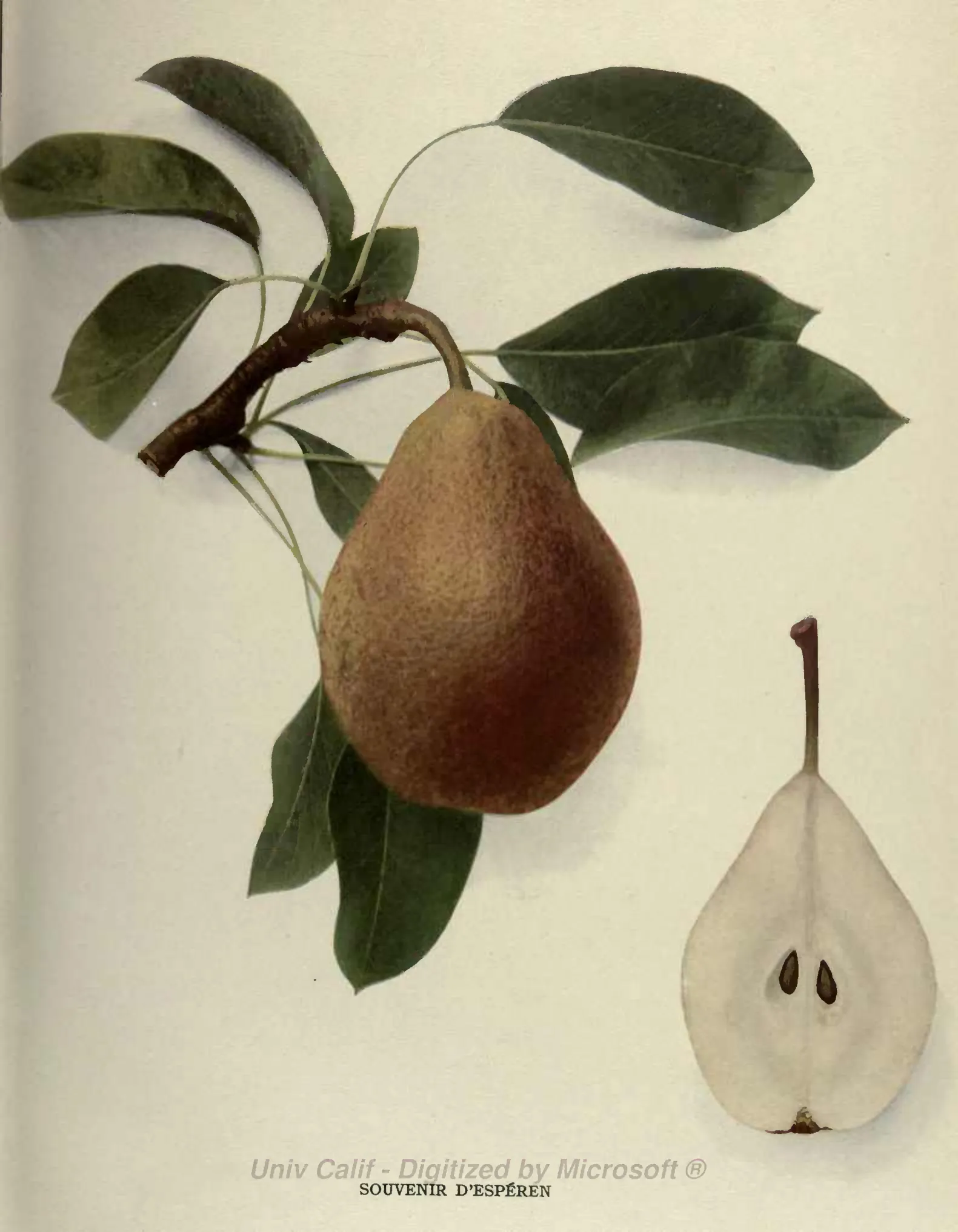
Souvenir D'Espéren
Origin / History
Souvenir D'Espéren is an old French pear raised from seed by Major Espéren of Mechlin, Belgium, about the middle of the nineteenth century. The pear reached America about 1850. Downing, in 1869, noted it as one of the best pears for either amateur or commercial grower, and at that time it was rather widely planted. By the early twentieth century, however, growers seldom set it; Hedrick judged that neither tree nor fruit rose much above mediocrity, and that the variety had no outstanding character to give it individuality, being worth planting only for the sake of diversity. Thomas (1903) classes it as Belgian. The name Souvenir d'Espéren was at one time applied to Fondante de Noël, in consequence of which confusion has existed as to the identity of the two sorts. Early references include Barry's Fruit Garden (1851), Downing's Fruits and Fruit Trees of America (1869), and Tilton's Journal of Horticulture (1869). At the Central Experimental Farm, Agassiz BC, a tree was planted in spring 1890 as part of their fruit trees under test.
Tree
Vigorous, healthy, hardy, and productive (Downing); medium in size, upright and slightly spreading (Hedrick, Pears of New York) or upright-spreading and slow-growing (Hedrick, Cyclopedia of Hardy Fruits), dense-topped, productive; the trunk and branches medium in thickness and smoothness. The tree holds its foliage well and late (Downing). At Agassiz BC the tree was noted as a vigorous grower.
Branches reddish-brown overlaid with thin scarf-skin, marked with very conspicuous but scattering lenticels. Branchlets very thick and long, with long internodes, light brown mingled with green, dull, glabrous, sprinkled with small, conspicuous, raised lenticels. Young wood olive reddish yellow brown (Downing); shoots yellow and erect (Thomas).
Leaf-buds very small, short, pointed, plump, free. Leaves 3 in. long (Hedrick, Pears of New York; length given only as "inches long" in the Cyclopedia), 1¾ in. wide; apex abruptly pointed; margin uneven, finely serrate; petiole 2½ in. long (Pears of New York) or 2¼ in. long (Cyclopedia), tinged red.
Flower-buds small, short, conical, plump, free, borne singly on very short spurs. Flowers open late, showy; 1½ in. across with an average of 7 buds in a cluster (Pears of New York), or 1¾ in. across (Cyclopedia); pedicels 1⅛ in. long, slender.
Fruit
Size: Large (Downing, Thomas, Pears of New York); above medium to large in the Cyclopedia, measured at 3¼ in. long and 2¾ in. wide; measured in Pears of New York at 3½ in. long and 2½ in. wide; above medium size at Agassiz BC.
Form: Oblong-pyriform (Downing); pyriform, obovate, tapering to crown (Thomas); oblong-obovate-pyriform (Hedrick); oblong, pyriform (Agassiz BC). Surface uneven.
Stem: Long, inclined (Downing); 1½ in. long, slender (Pears of New York); 1¼ in. long, slender (Cyclopedia).
Cavity: Slight, surrounded by a lip (Downing); very obtuse and shallow or lacking, the flesh drawn up about the base of the stem in a lip (Hedrick).
Calyx: Open (Downing); partly open, small (Hedrick). Segments/lobes medium, erect, sometimes a little recurved (Downing); lobes separated at the base, short, narrow, acute (Hedrick).
Basin: Small, narrow, uneven (Downing); shallow, narrow, obtuse, wrinkled (Hedrick).
Skin: Thick, roughened with russet. Color greenish yellow, mostly covered with dull rough russet, especially around the stalk and calyx (Downing); greenish-yellow, mottled and patched with russet, sprinkled with many russet dots and often with russet overspreading nearly the entire surface (Hedrick); dull yellow, with a mottled red cheek (Thomas).
Dots: Numerous, russet, small.
Flesh and Flavor: Yellowish, juicy, melting, aromatic; "very good" (Downing); melting, vinous (Thomas); yellowish, very granular near the center, firm, crisp but tender, juicy, with a pleasant, aromatic, vinous flavor; quality good to very good (Hedrick); yellowish, juicy, aromatic (Agassiz BC).
Core and Seeds: Core large, closed, with clasping core-lines; calyx-tube short, wide, conical; seeds small, short, plump, acute, light brown (Hedrick).
Season
October, November (Downing); November (Thomas); season October (Agassiz BC). Hedrick gives fruit ripe the last of November and December, with the crop coming in season in December; the pears keep well until ripe, after which they quickly decay.
Uses
Suitable for either amateur or market/commercial cultivation (Downing, Hedrick). Hedrick later concluded the variety was worth planting only for the sake of diversity.
Subtypes / Variants
Not described in source.
Other
The name Souvenir d'Espéren was at one time applied to Fondante de Noël, causing historical confusion between the two sorts.
Book Sources
Described in 4 period pomological works
Nursery Catalog Sources
Found in 1 catalog (1900)
- Central Experimental Farm , Dominion Department of Agriculture, Agassiz, British Columbia (under test; Bulletin No. 3, Second Series) — 1900
View original book sources (5)
— A.J. Downing, The Fruits and Fruit Trees of America (1900)SOUVENIR D'ESPEREN.
This seedling Pear of Major Esperen's proves one of the very best, either for amateur or market cultivation. Tree vigorous, healthy, hardy, and productive, and holds its foliage well and late. Young wood olive reddish yellow brown.
Fruit large, oblong pyriform. Surface uneven. Skin greenish yellow, mostly covered with dull rough russet, especially around the stalk and calyx. Stalk long, inclined, set in a slight cavity, surrounded by a lip. Calyx open. Segments medium, erect, sometimes a little recurved. Basin small, narrow, uneven. Flesh yellowish, juicy, melting, aromatic. Very good. October, November.
— John J. Thomas, The American Fruit Culturist (1903)Souvenir Esperen. Large, pyriform, obovate, tapering to crown, dull yellow, with a mottled red cheek; melting, vinous. Shoots yellow, erect. November. Belgian.
— U.P. Hedrick, The Pears of New York (1921)SOUVENIR D'ESPÉREN
- Barry Fr. Garden 318. 1851. 2. Downing Fr. Trees Am. 857. 1869. 3. Tilton Jour. Hort. 6:14, fig. 1869.
Downing, in 1869, noted this old French pear as one of the best for either amateur or commercial grower, and at that time it was rather widely planted. Now, however, growers seldom set it. The trees are vigorous, hardy, healthy, and productive, and the fruits are attractive in appearance and rather good in quality, but neither tree nor fruit rise much above mediocrity, and the variety has no outstanding character to give it individuality. The crop comes in season in December, the pears keeping well until ripe, after which they quickly decay. The variety is worth planting only for the sake of diversity.
Major Espéren, Mechlin, Belgium, raised this pear from seed about the middle of the nineteenth century. The name Souvenir d'Espéren was at one time applied to Fondante de Noël, in consequence of which confusion has existed as to the identity of the two sorts. The pear reached America about 1850.
Tree medium in size, upright, slightly spreading, dense-topped, productive; branches reddish-brown overlaid with thin scarf-skin, marked with very conspicuous but scattering lenticels; branchlets very thick and long, with long internodes, light brown mingled with green, dull, glabrous, sprinkled with small, conspicuous, raised lenticels.
Leaf-buds very small, short, pointed, plump, free. Leaves 3 in. long, 1¾ in. wide; apex abruptly pointed; margin uneven, finely serrate; petiole 2½ in. long, tinged red. Flower-buds small, short, conical, plump, free, singly on very short spurs; flowers open late, showy, 1½ in. across, average 7 buds in a cluster; pedicels 1⅛ in. long, slender.
Fruit ripe the last of November and December; large, 3½ in. long, 2½ in. wide, oblong-obovate-pyriform, the surface uneven; stem 1½ in. long, slender; cavity very obtuse and shallow or lacking, the flesh drawn up about the base of the stem in a lip; calyx partly open, small; lobes separated at the base, short, narrow, acute; basin shallow, narrow, obtuse, wrinkled; skin thick, roughened with russet; color greenish-yellow, mottled and patched with russet, sprinkled with many russet dots and often with russet overspreading nearly the entire surface; dots numerous, russet, small; flesh yellowish, very granular near the center, firm, crisp but tender, juicy, with a pleasant, aromatic, vinous flavor; quality good to very good. Core large, closed, with clasping core-lines; calyx-tube short, wide, conical; seeds small, short, plump, acute, light brown.
— U.P. Hedrick, Cyclopedia of Hardy Fruits (1922)SOUVENIR D'ESPEREN.
Downing in 1869 noted this old French pear as one of the best for either amateur or commercial grower, and at that time it was rather widely planted. Now, growers seldom set it. The trees are vigorous, hardy, healthy, and productive, and the fruits are attractive in appearance and good in quality, but neither tree nor fruit rise much above mediocrity, and the variety has no outstanding character to give it individuality. The crop comes in season in December, after which the pears quickly decay. The variety is worth planting only for the sake of greater diversity. Major Esperen, Mechlin Belgium, raised this pear from seed about the middle of the nineteenth century.
Tree medium in size, upright-spreading, dense-topped, slow-growing, productive; trunk and branches medium in thickness and smoothness; branches reddish-brown, marked with very conspicuous but scattering lenticels. Leaves inches long, 1¾ inches wide; apex abruptly pointed; margin uneven, finely serrate; petiole 2¼ inches long, tinged red. Flowers open late, showy, 1¾ inches across, average buds in a cluster. Fruit ripe the last of November and December; above medium to large, 3¼ inches long, 2¾ inches wide, oblong-obovate-pyriform, the surface uneven; stem 1¼ inches long, slender; cavity very obtuse and shallow or lacking, the flesh drawn up about the base of the stem in a lip; calyx partly open, small; lobes separated at the base, short, narrow, acute; basin shallow, narrow, obtuse, wrinkled; skin thick, roughened with russet; color greenish-yellow well mottled and patched with russet, sprinkled with many russet dots and often with russet overspreading nearly the entire surface; dots numerous, russet, small; flesh yellowish, very granular near the center, firm, crisp but tender, juicy, with a pleasant, aromatic, vinous flavor; quality good to very good; core large, closed, with clasping core-lines; calyx-tube short, wide, conical; seeds small, short, plump, acute, light brown.
— Central Experimental Farm, Central Experimental Farm, Agassiz BC — Catalogue of Fruit Trees under Test (Bulletin No. 3, 1900) (1900)Planted Spring 1890. Tree a vigorous grower. Fruit above medium size, oblong, pyriform. Flesh yellowish, juicy, aromatic. Season October.