Sweet McIntosh
Apple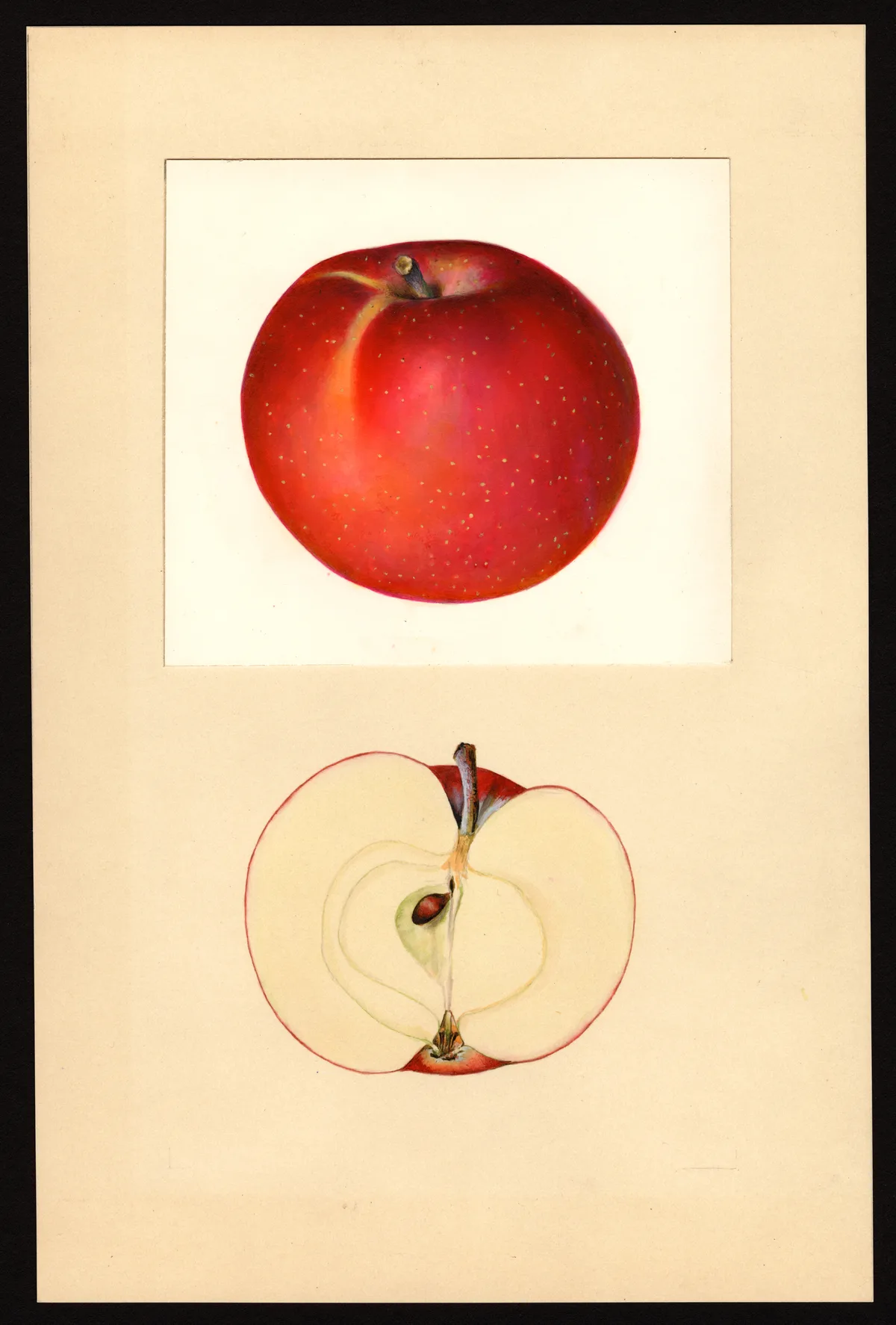
USDA Pomological Watercolor Collection
Sweet McIntosh
Origin / History
The cross Lawver x McIntosh, made in 1909, produced Sweet McIntosh. The breeding record number was 11650, and the seedling number was Station 505. It was selected in 1920 and, without a second test, introduced in 1922. It was given the name Sweet McIntosh because of its sweet flavor and because the fruit somewhat resembles McIntosh. That name is a misnomer, since it implies a sweet-flavored sport of McIntosh, whereas the variety is a seedling of McIntosh and is not a McIntosh in any sense. The introductory description of Sweet McIntosh was published by Hedrick. It was also briefly described by Wellington and in the Register of New Fruit and Nut Varieties.
Tree
The tree is large, very vigorous, tall, upright, medium in density, and round-topped. Tree trunks are stocky, reddish gray, and shaggy. Twigs are thick, long, and slightly pubescent. Trees are moderately productive and bear annually.
Sweet McIntosh trees bloom in midseason, less than half a day later than Delicious. The variety is diploid, and the pollen is viable. Following a spring frost in New England in 1945, Sweet McIntosh suffered less blossom injury than Delicious.
Fruit
Size: Fruit large, often up to 3¼ inches in diameter; size sometimes variable.
Form: Fruit oblate and quite symmetrical.
Stem: Stem short and moderately slender.
Cavity: Cavity medium in depth, broad, and obtuse. Usually the bottom half of the cavity is russeted. Cavity symmetrical and not furrowed.
Calyx: Calyx small and nearly closed. Calyx lobes medium in length, broad, and acuminate. Calyx tube long (8 mm), narrow (4 mm), and funnel-shaped. Stamens basal.
Basin: Basin medium in depth and width; abrupt, symmetrical, and sometimes slightly furrowed.
Skin: Skin medium in thickness, tough, smooth, and glossy, covered with prominent scarfskin and rather heavy bloom. Color 90 percent light to dark red and distinctly striped; ground color yellow. Dayton found that in the skin of Sweet McIntosh fruits, 85 percent of the cells in the epidermal layer and only 40 percent of the cells in the outer hypodermal layer contain red pigment.
Dots: Dots light brown russet, few, small, and obscure.
Flesh and flavor: Flesh nearly white, semifirm, medium grained, tender, crisp, and only slightly juicy. Flavor sweet and aromatic. Flesh has no resemblance to McIntosh, except that both are apples. Eating quality good. Exposed flesh oxidizes rather rapidly.
Core and seeds: Core large (30 mm wide) and nearly closed, with core lines sometimes pinkish. Carpels oval and slightly tufted. Seeds numerous, medium sized, wide, plump, acute, and nearly black.
Season
The average ripening date for Sweet McIntosh at Geneva is October 18, 8 days later than Delicious. The average number of days from full bloom to harvest is 153, 8 days more than Delicious. After they ripen, fruits have some tendency to drop from the tree. The variety is a good keeper, with an estimated storage life of 150 days at 31°F. The shelf life after storage is very good.
Uses
Sweet McIntosh is a dessert type. Nursery trees were sold by the New York State Fruit Testing Association for 33 years, 1923–55. In the 1960–68 period, the variety was sold by one commercial nursery. It was tested at experiment stations in Delaware and Ottawa in 1954, at stations in New Jersey, New York, Oregon, and Wyoming in 1963, and at stations in New York, North Carolina, and Ontario in 1968. A 1941 New York circular described Sweet McIntosh as one of the best and most important apple cultivars. It was later said to be one of the New York Station introductions that found the greatest favor with American fruit growers. However, no real commercial-scale plantings have ever been made. In Vermont, Sweet McIntosh was an excellent sweet winter apple producing heavy crops, but it was not a suitable substitute for Pound Sweet, which had considerable market demand. Because it is a sweet apple, Sweet McIntosh is not a good commercial cultivar and is not recommended for planting.
Subtypes / Variants
Not described in source.
Other
Sweet McIntosh contains 11 mg ascorbic acid per 100 gm fruit, compared with 37 for Calville Blanc and 4 for McIntosh.
Book Sources
Described in 1 period pomological work
View original book sources (1)
— Roger D. Way, Apple Cultivars Introduced by the New York State Agricultural Experiment Station, 1914–1968 (1971)Sweet McIntosh
Origin. The cross, Lawver x McIntosh, made in 1909 produced Sweet McIntosh. The breeding record number was 11650, and the seedling number was Station 505. It was selected in 1920, and without a second test it was introduced in 1922 (Table 2). It was given the name, Sweet McIntosh, because of its sweet flavor and because the fruit somewhat resembles McIntosh. This name is a misnomer because it implies that it is a sweet-flavored sport of McIntosh, but it is actually a seedling of McIntosh and is not a McIntosh in any sense. The introductory description of Sweet McIntosh was published by Hedrick (92). It was also briefly described by Wellington (235) and in the Register of New Fruit and Nut Varieties (31).
Tree. The tree characteristics of Sweet McIntosh are summarized in Table 5. The tree is large, very vigorous, tall, upright, medium in density, and round-topped. Trees are moderately productive, and they bear annually. Tree trunks are stocky, reddish gray, and shaggy. Twigs are thick, long, and slightly pubescent.
Pollination. Sweet McIntosh trees bloom in midseason (238), less than half a day later than Delicious (Table 6). It is diploid (Table 4), and the pollen is viable (238). Following a spring frost in New England in 1945 (160), Sweet McIntosh suffered less blossom injury than Delicious.
Fruit. Sweet McIntosh fruits are illustrated in Figure 33. The fruit characteristics are summarized in Table 8.
The average ripening date for Sweet McIntosh at Geneva is October 18, 8 days later than Delicious (Table 7). The average number of days from full bloom to harvest is 153, 8 days more than Delicious. After they ripen, Sweet McIntosh fruits have some tendency to drop from the tree.
Sweet McIntosh fruits are large, often up to 3¼ inches in diameter, and the size is sometimes variable. The fruits are oblate and quite symmetrical. The stem is short and moderately slender. The cavity is medium in depth, broad, and obtuse. Usually, the bottom half of the cavity is russeted. The cavity is symmetrical and not furrowed. The calyx is small and nearly closed. The calyx lobes are medium in length, broad, and acuminate. The basin is medium in depth and width; it is abrupt, symmetrical, and sometimes slightly furrowed. The fruit skin is medium in thickness, tough, smooth, glossy, and covered with prominent scarfskin and rather heavy bloom. The color is 90 per cent light to dark red and distinctly striped; the ground color is yellow. Dayton (55) found that in the skin of Sweet McIntosh fruits, 85 per cent of the cells in the epidermal layer and only 40 per cent of the cells in the outer hypodermal layer contain red pigment. The dots are light brown russet, few, small, and obscure. The calyx tube is long (8 mm), narrow (4 mm), and funnel-shaped. The stamens are basal. The core is large (30 mm wide) and nearly closed. The carpels are oval and slightly tufted. The seeds are numerous, medium sized, wide, plump, acute, and nearly black. The fruit flesh is nearly white with core lines sometimes pinkish. The flesh is semifirm, medium grained, tender, crisp, only slightly juicy, sweet, and aromatic. It has no resemblance to McIntosh, except that they are both apples. The eating quality is good. It is a dessert type. Exposed flesh oxidizes rather rapidly. It is a good keeper with an estimated storage life of 150 days at 31° (Table 10). The shelf life after storage is very good. Sweet McIntosh contains 11 mg ascorbic acid per 100 gm fruit, which compares with 37 for Calville Blanc and 4 for McIntosh (105).
Commercial Usefulness. Nursery trees of Sweet McIntosh were sold by the New York State Fruit Testing Association for 33 years, 1923-55 (Table 2). In the 1960-68 period, it was sold by one commercial nursery (Table 3). In 1954 (186), Sweet McIntosh was tested at experiment stations in Delaware and Ottawa. In 1963, a survey of apple clones in the United States (79) showed that it was tested at stations in New Jersey, New York, Oregon, and Wyoming. In 1968 (184), it was tested at stations in New York, North Carolina, and Ontario. In a 1941 New York circular (103), Sweet McIntosh was described as one of the best and most important apple cultivars. It was later (241) said to be one of the New York Station introductions which found the greatest favor with American fruit growers. However, no real commercial scale plantings have ever been made. In Vermont (54), Sweet McIntosh was an excellent sweet winter apple producing heavy crops, but it was not a suitable substitute for Pound Sweet which had considerable market demand.
In summary: Because it is a sweet apple, Sweet McIntosh is not a good commercial cultivar and is not recommended for planting.