Therese Appert
Pear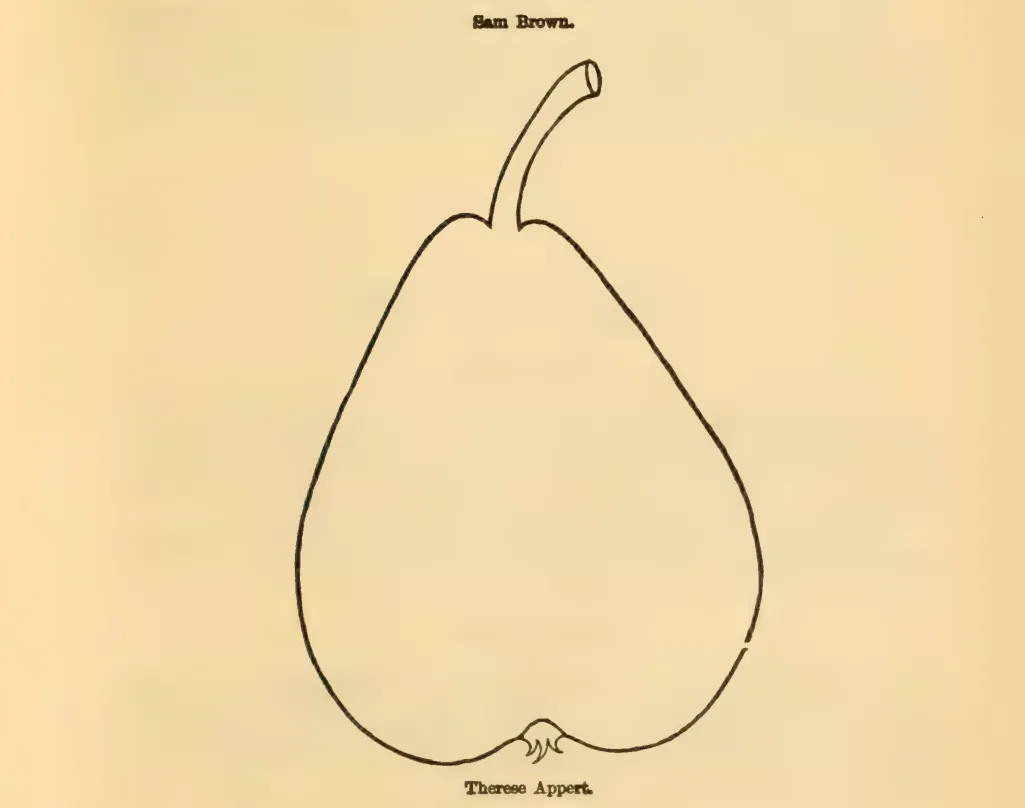
Therese Appert
Origin/History
A new variety raised by André Leroy of Angers, France (Downing; Hedrick; Budd & Hansen; Thomas). According to Hedrick, it was first fruited in 1861 from seed of Beurre Clairgeau by André Leroy at Angers. Early pomological references include Leroy's Dictionnaire de Pomologie 2:699, fig. (1869) and Downing's Fruits and Fruit Trees of America, 2d Appendix, p. 136, fig. (1872).
Tree
Strong, vigorous, and an abundant/productive bearer (Downing; Hedrick). Often grown on the quince stock (Budd & Hansen).
Fruit
Size: Medium (Downing; Hedrick; Thomas); medium to large (Budd & Hansen).
Form: Sources give varying form descriptions. Downing: rather long pyriform to roundish obovate pyriform, a little obtuse. Hedrick: oblong, turbinate. Thomas: pyriform. Budd & Hansen: pyriform, rounded toward the basin and tapering to the stem by two deep concave curves.
Stem: Short, a trifle/little inclined (Downing; Hedrick). Budd & Hansen describe the stem as short, fleshy, inserted without depression.
Cavity: Small, often without (Downing); small (Hedrick); none / very slight — stem inserted without depression (Budd & Hansen).
Calyx: Open (Downing; Hedrick).
Basin: Rather shallow, smooth (Downing); shallow (Hedrick); also very slight depression (Budd & Hansen).
Skin: Deep yellow, partially netted, dotted, and patched with russet, sometimes a shade of rich brownish red in the sun (Downing). Yellowish-orange, washed with vermilion (Hedrick). Deep yellow with some russet, a rich brown cheek (Thomas). Yellow, mottled with areas of green, and well covered with russet dots; cheek mottled with crimson (Budd & Hansen).
Flesh/Flavor: Whitish yellow, half fine, juicy, melting, sweet, slightly vinous; very good (Downing). Whitish-yellow, very juicy, very sweet, aromatic; very good (Hedrick). Juicy, melting; very good (Thomas). Tender, buttery, melting, sprightly, vinous; very good (Budd & Hansen).
Core/Seeds: Not described in source.
Season
September.
Uses
Not described in source.
Subtypes/Variants
Not described in source.
Other
Not described in source.
Book Sources
Described in 4 period pomological works
View original book sources (4)
— A.J. Downing, The Fruits and Fruit Trees of America (1900)Therese Appert.
A new variety raised by Andre Leroy, Angers, France. Tree strong, vigorous, an abundant bearer.
Fruit medium, rather long pyriform to roundish obovate pyriform, a little obtuse; skin deep yellow, partially netted, dotted, and patched with russet, sometimes a shade of rich brownish red in the sun; stalk short, a little inclined; cavity small, often without; calyx open; basin rather shallow, smooth; flesh whitish yellow, half fine, juicy, melting, sweet, slightly vinous; very good. September.
— U.P. Hedrick, The Pears of New York (1921)Therese Appert.
i. Leroy Dict. Pom. 2:699, fig. 1869. 2. Downing Fr. Trees Am. 2d App. 136, fig. 1872.
First fruited in 1861 from seed of Beurre Clairgeau by André Leroy, Angers, Fr. Tree vigorous, productive. Fruit medium, oblong, turbinate, yellowish-orange, washed with vermilion; stem short, a trifle inclined; cavity small; calyx open; basin shallow; flesh whitish-yellow, very juicy, very sweet, aromatic; very good; Sept.
— John J. Thomas, The American Fruit Culturist (1903)Therese Appert. Medium, pyriform, deep yellow with some russet, a rich brown cheek; juicy, melting; very good. September. New. French.
— J.L. Budd & N.E. Hansen, American Horticultural Manual, Part II: Systematic Pomology (1914)Thérèse Appert. — Medium to large, pyriform, rounded toward the basin and tapering to the stem by two deep concave curves; color yellow, mottled with areas of green, and well covered russet dots; cheek mottled with crimson; stem short, fleshy, inserted without depression; basin also very slight depression. Flesh tender, buttery, melting, sprightly, vinous, very good. Season, September. Often grown on the quince. France.