Titovka
Apple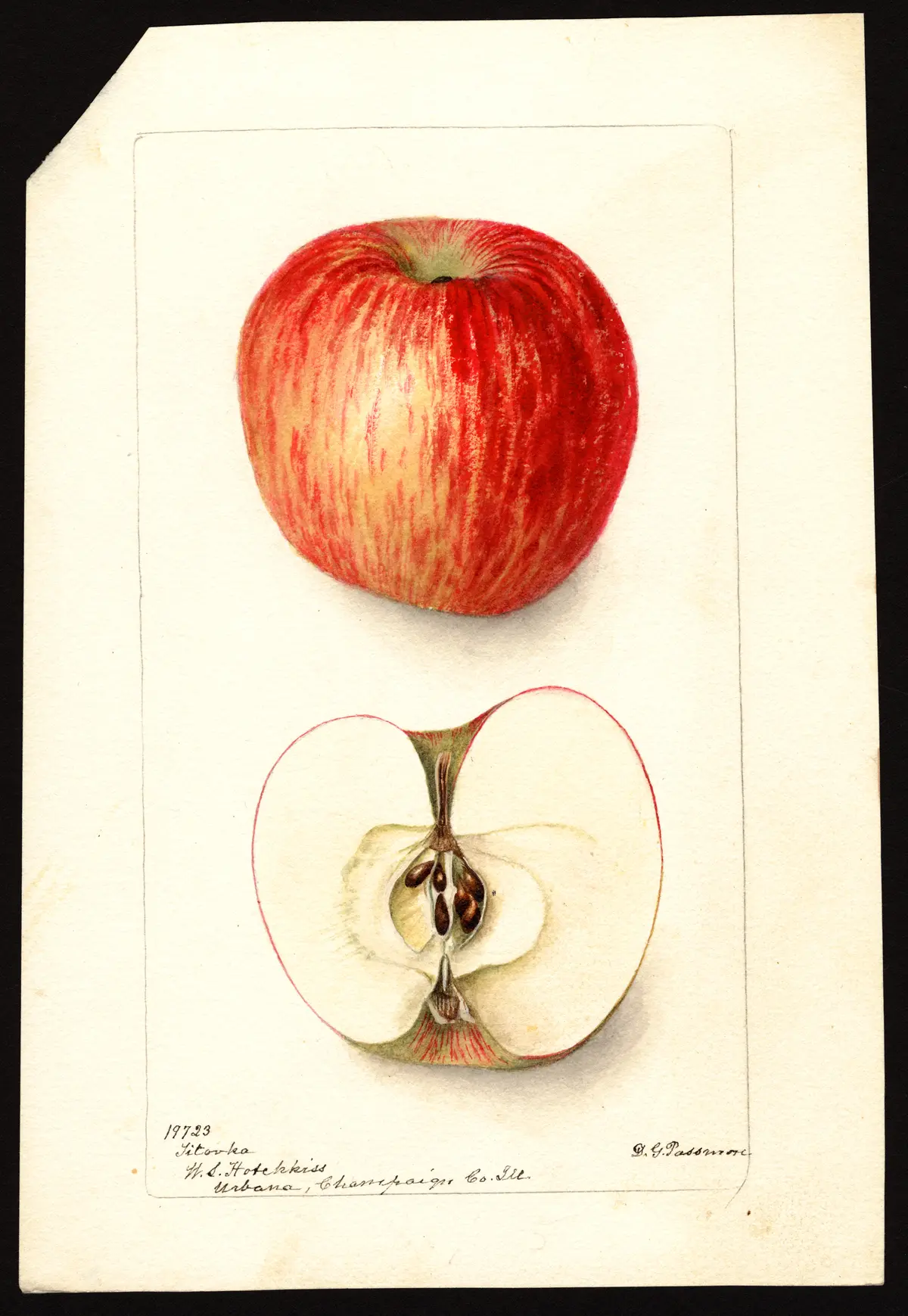
USDA Pomological Watercolor Collection
Titovka
[NOTE: Source text may be incorrect — Beach states that the apple he describes appears to be the one Hansen calls "Titovka Department," which Hansen distinguishes from a variety called Titovka with Titus Riga as a synonym. Hansen's 1902 entry, reproduced in Budd and Hansen's 1914 manual, is headed "Titovka (Titus Riga)" and may therefore describe that other apple. Hansen's details, including his differing season, flesh color, and core, are included below and attributed to him.]
Origin / History
Russian origin. Imported from Russia by the United States Department of Agriculture in 1870. The earliest reference Beach cites is the Montreal Horticultural Society report for 1881–82, where it appears partly under the name "Titus Apple." Received in 1883 from Ellwanger and Barry, Rochester, N. Y., for testing at the New York Station. In 1897 the American Pomological Society entered it in its catalogue as a variety of value in the pomological district that includes the Dakotas, Montana, and Wyoming.
Beach calls it "one of the best Russian apples of its season which we have tested." He adds that it is but little known in New York and that, so far as he could learn, its cultivation was not increasing in that state. Hedrick calls Titovka valuable in the upper Mississippi Valley, with considerable merit in all regions where hardiness must be taken into account.
Tree
Vigorous; hardy and healthy (Hedrick). Hedrick describes the tree as dwarfish but vigorous, upright, and dense, with stout, twiggy branches. It comes into bearing rather young (Beach). Beach calls it moderately productive; Hedrick calls it productive.
Fruit
Size: Large.
Form: Roundish to oblong, a little inclined to conic, regular or nearly regular, pretty symmetrical. Hansen calls it oblong and truncated.
Stem: Short, usually not exserted; Hansen calls it very short.
Cavity: Very deep, acuminate or acute, sometimes slightly russeted; yellow (Hansen).
Calyx: Medium size and closed. Segments small, convergent; Hansen calls them erect convergent. Calyx tube elongated cone-shape or funnel-form. Stamens median or below (Beach); median (Hansen).
Basin: Moderately shallow to deep, very abrupt, and wrinkled, with corrugations in the bottom (Hansen).
Skin: Smooth; very unctuous (Hansen). Greenish yellow, pale green becoming yellow, shaded and striped with bright red and overspread with light bloom. When fully mature the ground color is yellow and the red bright and dark, often nearly covering the fruit (Beach). Hansen describes it as yellow, mostly covered with fine marbled red, with carmine splashes and stripes. Handsome, beautifully colored.
Dots: Minute, white, obscure, and few (Hansen).
Flesh and flavor: Juicy and subacid. Beach describes the flesh as whitish, coarse, and crisp, and rates it "good to very good" for culinary uses. Hansen describes the flesh as yellow and rates it "good."
Core and seeds: Core lines clasping; cells open. Beach describes the core as rather large and somewhat abaxile, with pretty symmetrical cells. Hansen calls the core wide open, sessile, and roundish oblate, with obovate, roomy, widely slit cells. Carpels broadly roundish or somewhat obovate, emarginate (Beach). Seeds few, plump, rather small or short. Hansen also notes several minute imperfect seeds.
Season
The recorded season runs from August into October. Beach gives August and September. Hansen gives September and October, following Duchess (Oldenburg in Budd and Hansen) in season. The crop does not ripen uniformly, and more than one picking is required to secure the fruit in prime condition for market (Beach).
Uses
Culinary. Hedrick calls the fruit suitable for culinary use, "but scarcely so for dessert." Beach considers Titovka "perhaps worthy of testing for market where fruit of this type and season is desired."
Subtypes / Variants
Beach writes that his variety "appears to be" the one Hansen describes under the name "Titovka Department." Hansen adopted that name to distinguish it on the one hand from a variety called Titovka, with Titus Riga as a synonym, and on the other from a variety called Titovka Speer.
Other
Not described in source.
Book Sources
Described in 4 period pomological works
Nursery Catalog Sources
Found in 6 catalogs (1890–1909) from Maryland, Massachusetts, New Jersey, Pennsylvania
- William H. Moon Co. , Morrisville, Bucks County , Pennsylvania — 1890 — listed as Sitovka
- Rogers Nursery Co. , Moorestown , New Jersey — 1893 — listed as Sitovka
- Reading Nursery , Jacob W. Manning, Proprietor, Reading , Massachusetts — 1898 — listed as Sitovka
- Brown Brothers Co. , Continental Nurseries, Rochester, NY (also operated from Toronto, Canada) — 1899 — listed as Sitovka
- Brown Brothers Co. , Continental Nurseries, Rochester, NY (also operated from Toronto, Canada) — 1901 — listed as Sitovka
- Wm. J. Corse (successor to Robert Sinclair / Sinclair Nurseries) , Baltimore , Maryland — 1909 — listed as Sitovka
View original book sources (4)
— N.E. Hansen, A Study of Northwestern Apples (1902)Titovka (Titus Riga)—Origin, Russia; a large, beautifully colored apple, following Duchess in season—Fruit large, oblong, truncated, regular; surface smooth, very unctuous, yellow, mostly covered with fine marbled red, with carmine splashes and stripes; dots minute, white, obscure, few; cavity very deep, acute, yellow; stem very short; basin deep, very abrupt, with corrugations in bottom; calyx closed, segments small, erect convergent. Core wide open, sessile, clasping, roundish oblate; cells obovate, roomy, widely slit; tube funnel-shaped; stamens median; seeds few, short, plump, several minute imperfect seeds; flesh yellow, juicy, subacid, good. September, October.
— S.A. Beach, The Apples of New York, Vol. 2 (1905)TITOVKA.
REFERENCES. 1. Montreal Hort. Soc. Rpt., 8:44. 1881-82. fig. 2. Ib., 8:74. 1881-82. 3. Ia. Hort. Soc. Rpt., 1882:80. 4. Budd, Ia. Agr. Coll. Bul., 1883:31. 5. Gibb, Ia. Hort. Soc. Rpt., 1883:431. 6. Mo. Hort. Soc. Rpt., 1883:173. 7. Barry, 1883:335. 8. Budd, Ia. Agr. Coll. Bul., 1885:8. 9. Thomas, 1885:526. 10. Gibb, Montreal Hort. Soc. Rpt., 1886-87:15. 11. Schroeder, Ib., 1886-87:78. 12. Hoskins, Can. Hort., 13:175. 1890. 13. Bailey, An. Hort., 1892:251. 14. Taylor, Me. Pom. Soc. Rpt., 1892:58. 15. Troop, Ind. Sta. Bul., 53:124. 1894. 16. Beach, N. Y. Sta. An. Rpt., 13:584. 1894. 17. Munson, Me. Sta. Rpt., 1896:77. 18. Mass. Hatch Sta. Bul., 44:4. 1897. 19. Am. Pom. Soc. Cat., 1897:15. 20. Woolverton, Ont. Fr. Stas. An. Rpt., 6:11. 1899. figs. 21. Troop, Ind. Sta. Rpt., 1899:81. 22. Eneroth-Smirnoff, 1901:470. 23. Hansen, S. D. Sta. Bul., 76:105. 1902. fig. 24. Munson, Me. Sta. An. Rpt., 18:85. 1902. 25. Budd-Hansen, 1903:188. fig. 26. Powell and Fulton, U. S. B. P. I. Bul., 48:58. 1903. 27. Farrand, Mich. Sta. Bul., 205:46. 1903.
SYNONYMS. No. 131 (11). No. 230 Gov. (4). TITOVCA (9). TITOVKA (1, 6, 7, 8, 10, 11, 12, 13, 14, 15, 16, 17, 18, 19, 20, 21, 22, 23, 24, 25, 26, 27). TITOWKA (5). TITUS APPLE (2, 3, 4). Titus Apple (1, 5, 7). Titus Riga (25).
A Russian apple, large, roundish or somewhat oblong, greenish-yellow, handsomely shaded and striped with red and covered with light bloom. When fully mature the ground color is yellow and the red is bright and dark often nearly covering the fruit. Quality good to very good for culinary use. Season August and September. The tree is a vigorous grower, comes into bearing rather young and is moderately productive. It is one of the best Russian apples of its season which we have tested. The crop does not ripen uniformly and more than one picking is required in order to secure the fruit in prime condition for market. Titovka is perhaps worthy of testing for market where fruit of this type and season is desired.
This appears to be the variety which Hansen describes under the name Titovka Department, which name he adopts to distinguish it on the one hand from a variety called Titovka with Titus Riga as a synonym and on the other from a variety called Titovka Speer (23).
Historical. Imported from Russia by the U. S. Department of Agriculture in 1870. It was received in 1883 from Ellwanger and Barry, Rochester, N. Y., for testing at this Station. In 1897 it was entered in the catalogue of the American Pomological Society as a variety of value in the pomological district which includes the Dakotas, Montana and Wyoming (19). It is but little known in New York and so far as we can learn its cultivation is not increasing in this state.
FRUIT.
Fruit large. Form roundish or somewhat oblong, a little inclined to conic, nearly regular, pretty symmetrical. Stem short, usually not exserted. Cavity acuminate, very deep, sometimes slightly russeted. Calyx medium size, closed; segments small, convergent. Basin moderately shallow to deep, very abrupt, wrinkled.
Skin smooth, pale green becoming yellow, shaded and striped with bright red and overspread with light bloom.
Calyx tube elongated cone-shape or funnel-form. Stamens median or below.
Core rather large, somewhat abaxile; cells pretty symmetrical, open; core lines clasping. Carpels broadly roundish or somewhat obovate, emarginate. Seeds, few, rather small, plump.
Flesh whitish, coarse, crisp, juicy, subacid, good to very good for culinary uses.
Season August and September.
— J.L. Budd & N.E. Hansen, American Horticultural Manual, Part II: Systematic Pomology (1914)Titovka (Titus Riga). — Origin, Russia. A large, beautifully colored apple, following Oldenburg in season.
Fruit large, oblong, truncated, regular; surface smooth, very unctuous, yellow, mostly covered with fine marbled red, with carmine splashes and stripes; dots minute, white, obscure, few; cavity very deep, acute, yellow; stem very short; basin deep, very abrupt, with corrugations in bottom; calyx closed; segments small, erect convergent. Core wide open, sessile, clasping, roundish oblate; cells obovate, roomy, widely slit; tube funnel-shaped; stamens median; seeds few, short, plump, several minute imperfect seeds; flesh yellow, juicy, subacid, good. September, October.
— U.P. Hedrick, Cyclopedia of Hardy Fruits (1922)TITOVKA. Titus Apple. Titus Riga.
Titovka is valuable in the upper Mississippi Valley, and has considerable merit in all regions where hardiness must be taken into account. The apples, which are large and handsome, are suitable for culinary use, but scarcely so for dessert. The trees, besides being hardy, are vigorous, healthy, and productive. The variety was imported from Russia in 1870 by the United States Department of Agriculture.
Tree dwarfish but vigorous, upright, dense, with stout, twiggy branches. Fruit large, round or oblong, sometimes conic, regular, symmetrical; stem short, usually not exserted; cavity acuminate, very deep, sometimes russeted; calyx of medium size, closed; segments small, convergent; basin shallow, very abrupt, wrinkled; skin smooth, yellow, shaded and striped with bright red and overspread with light bloom; calyx-tube elongated-cone-shape; stamens median; core large, abaxile; cells symmetrical, open; core-lines clasping; carpels broadly round or obovate, emarginate; seeds few, small, plump; flesh white, coarse, crisp, juicy, subacid; good to very good; August and September.