Trenton Early
Apple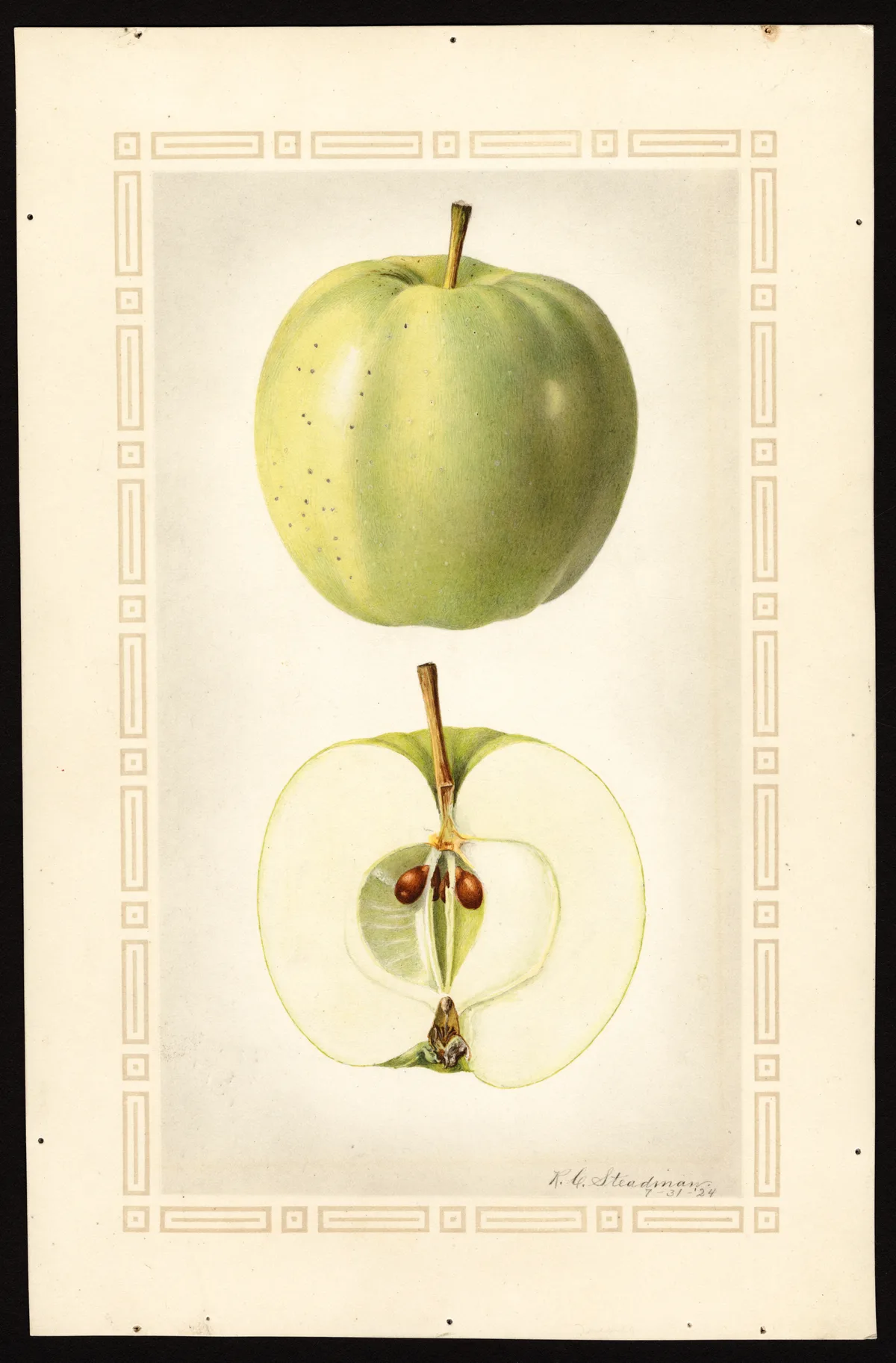
USDA Pomological Watercolor Collection
Trenton Early
[NOTE: Source text may be incorrect — Coxe's "Codling" (1817) and Bunyard's "English Codlin" (1920), and the separate Old English Codlin / English Codlin entries in Elliott, Downing, and Thomas, describe the English Codlin, a variety with which Trenton Early was only tentatively identified (Elliott and Downing both mark the identification with a query). Their details conflict with the Trenton Early descriptions in form, coloring, and season, so they are kept out of the Trenton Early account and are given separately under Other.]
Origin / History
Origin unknown. Elliott thought it an old English apple of the codlin class. Warder records that it has been thought to be the English Codling. Downing lists "Trenton Early ?" under Old English Codlin, but under its own heading says its origin or identity "has not yet been discovered."
It was one of Silas Wharton's varieties. In 1852 R. W. Steele, Esq., of Dayton, Ohio, introduced it to the notice of the Ohio Pomological Society with these notes: "A large, white apple, of excellent flavor, and is highly esteemed both for eating and cooking. It ripens in August. The tree is a vigorous grower and an abundant bearer. It was introduced here many years ago by Silas Wharton, of Warren County, to whom this portion of the Miami Valley is largely indebted for the introduction of many excellent varieties of apples and pears."
Warder calls it "a great favorite wherever known." Downing gives it as somewhat grown in Ohio and the West, and Thomas calls it "Valued at the West." Elliott writes: "Our warm suns and rich soils have so improved it that it is often a right good table fruit, and always valuable for cooking."
Tree
Vigorous, though Downing calls it only a moderately vigorous grower. Hardy (Downing). An abundant bearer; quite productive (Downing). Young wood reddish brown (Downing).
In Lowther's station table it is reported by 1 station in the Northern Division, 4 in the Central Division, and 2 in the Southern Division. Each count is marked as adapted to more than one division.
Fruit
Size: Medium to large, most descriptions placing it at medium or above medium. Warder, following Steele, calls it large.
Form: Conical or roundish conical, angular, irregular, slightly ribbed to ribbed. Thomas gives it as roundish-oblate, and Lowther's table as round.
Stem: Medium (Warder).
Cavity: Wide. Regular and brown (Warder); Budd and Hansen call it russeted.
Calyx: Eye medium or small, closed (Warder).
Basin: Narrow, folded or furrowed. Elliott says often furrowed.
Skin: Smooth, oily or unctuous. Yellow or yellowish to yellowish white, very pale yellow, or white (Warder), with suffused patches of green or slight green undulations over the surface (Elliott, Downing), somewhat marked with green.
Dots: Rare, minute (Warder).
Flesh and flavor: White, very light, tender to very tender, juicy, not very fine-grained (Downing). Flavor pleasant subacid; Steele calls it "of excellent flavor." Quality good (Downing, and Lowther's table) to "very good" (Warder).
Core and seeds: Core large, rather open. Seeds numerous, angular (Warder).
Season
Summer, July into September. Late summer by most accounts. Every dated account includes August; Elliott begins the season in July, and Warder carries it into September. Warder nonetheless calls it "This fine autumn apple."
Uses
Dessert and kitchen. Highly esteemed for both eating and cooking (Steele). Primary use family, in Lowther's table.
Subtypes / Variants
Not described in source.
Other
The English Codlin, with which Trenton Early has been identified, is described as follows.
Origin English and of great antiquity, known before the seventeenth century (Bunyard). Bunyard says it is very little grown nowadays, was much used in olden times for espaliers, and was propagated by rooted branches.
Tree uncommonly handsome, vigorous, and fruitful, bearing very young and constantly, and making a fine appearance in an orchard (Coxe). Downing calls it very vigorous and fruitful; Bunyard gives growth moderate and fertility immense. Leaves large, rather large, round oval, sharply serrate (Bunyard).
Fruit medium to very large, mostly given as large or rather large, generally above medium (Downing). Coxe says it grows very large and fair, and Bunyard gives medium, 3½ by 2½ inches. Form oblong, oblong conic, or conical, rather or a little irregular, somewhat pointed toward the blossom end (Coxe). Skin bright though pale yellow to clear lemon yellow, frequently with a fine or faint blush next the sun. Bunyard gives "yellow with red flush and slight russet."
Stalk short and stout. Bunyard gives it as fairly long, in a wide and deep cavity from which russet veining extends. Eye closed in a wide and deep ribbed basin (Bunyard).
Flesh white, tender, sprightly, of a rather pleasant subacid. Bunyard calls it acid, with a pleasant aroma.
A large and fair cooking apple, very fine for pies and stewing and much esteemed for cooking. Coxe calls it a pleasant table apple and one of the most profitable apples for market, ripening gradually and being very free from rot. Downing also notes that it ripens gradually upon the tree.
Fit for stewing from the first of August, fully ripe at the end of that month, and in season till late October (Coxe). Others give July to November or summer and autumn; Bunyard gives August to September.
Book Sources
Described in 8 period pomological works
- Warder, American Pomology: Apples (1867)
- Downing, Fruits and Fruit Trees of America (1900)
- Coxe, A View of the Cultivation of Fruit Trees (1817) — listed as Codling
- Budd & Hansen, Systematic Pomology (1914)
- Elliott, The Western Fruit Book (1865) — listed as Trenton Early ?
- Lowther (ed.), Encyclopedia of Practical Horticulture (1914)
- Thomas, The American Fruit Culturist (1903)
- Bunyard, A Handbook of Hardy Fruits (1920) — listed as English Codlin
Nursery Catalog Sources
Found in 6 catalogs (1845–1916) from California, Illinois, Massachusetts, New Jersey
- Winship's Nursery (Brighton Nurseries , operated by the Winship family), Brighton (Boston) , Massachusetts — 1845 — listed as English Codling
- Felix Gillet , Barren Hill Nursery, Nevada City , California — 1884 — listed as English Codlin
- Palouse Nursery and Pleasant Dale Fruit Farm , Colfax, Washington Territory (situated two miles northeast of Colfax) - undated (single-page broadside flyer; "Washington Territory" suggests pre — 1889
- Benjamin Buckman (personal inventory) , Farmingdale , Illinois — 1901
- Benjamin Buckman (personal inventory) , Farmingdale , Illinois — 1913
- Manalapan Nurseries , Englishtown , New Jersey — 1916 — listed as English Codling
View original book sources (8)
— William Coxe, A View of the Cultivation of Fruit Trees (1817)NO. 9. CODLING.
The Codling, called also the English Codling, is a very fine fruit for pies and stewing, and is also a pleasant table apple: it grows very large and fair; the form is oblong, rather irregular; the skin is a bright, though pale yellow, with a fine blush frequently towards the sun; it is somewhat pointed towards the blossom end; the stalk short, the flesh white, tender, and sprightly.
The tree is uncommonly handsome, vigorous, and fruitful; bearing very young, and constantly; the leaves are large; it makes a fine appearance in an orchard: the fruit is fit for stewing from the first of August, but does not become fully ripe till the end of that month, and continues in season till late in October: it is one of the most profitable apples for market, ripening gradually, and being very free from rot.
— F.R. Elliott, The Western Fruit Book (1865)Trenton Early ? History unknown. We think it an old English apple belonging to the class of codlins. Our warm suns and rich soils have so improved it that it is often a right good table fruit, and always valuable for cooking. Fruit, medium or above, roundish conical, slightly ribbed ; color, yellowish, with suffused patches of green ; skin, smooth, oily ; basin, often furrowed ; flesh, white, tender, pleasant, sub-acid. July and August.
[Additional entry in this volume: "Old English Codlin", pp. 195–195]
Old English Codlin. English Codlin. Large, oblong conical, lemon yellow ; flesh, white, tender, cooking. July to November.
— John A. Warder, American Pomology: Apples (1867)Trenton Early.
This fine autumn apple has been thought to be the English Codling. Of its origin and history we know little, except that it was one of Silas Wharton's varieties, and that it has been a great favorite wherever known. It was introduced to the notice of the Ohio Pomological Society, 1852, by R. W. Steele, Esq., of Dayton, Ohio, with the following notes: "A large, white apple, of excellent flavor, and is highly esteemed both for eating and cooking. It ripens in August. The tree is a vigorous grower and an abundant bearer. It was introduced here many years ago by Silas Wharton, of Warren County, to whom this portion of the Miami Valley is largely indebted for the introduction of many excellent varieties of apples and pears."
Fruit large, conical, angular; Surface smooth, very pale yellow or white; Dots rare, minute.
Basin narrow, folded; Eye medium or small, closed.
Cavity wide, regular, brown; Stem medium.
Core large, rather open; Seeds numerous, angular; Flesh white, very tender, juicy; Flavor sub-acid, pleasant; Quality very good; Use, dessert and kitchen; Season, August, September.
— A.J. Downing, The Fruits and Fruit Trees of America (1900)Trenton Early ?
A variety somewhat grown in Ohio and the West, the origin or identity of which has not yet been discovered. The tree is a moderately vigorous grower, hardy, and quite productive. Young wood reddish brown. Fruit above medium, irregular, ribbed. Color yellowish, with slight undulations over the surface, which are green. Skin smooth and oily. Cavity wide. Basin furrowed. Flesh not very fine-grained, very light and tender, with a pleasant, subacid flavor. Good. August.
[Additional entry in this volume: "Old English Codlin", pp. 318–318]
Old English Codlin.
English Codlin. Trenton Early ?
The trees are very vigorous and fruitful. A large and fair cooking Apple, in use from July to November.
Fruit generally above medium size, oblong or conical, and a little irregular, clear lemon yellow, with a faint blush next the sun. Stalk stout and short. Flesh white, tender, and of a rather pleasant subacid. Much esteemed for cooking, ripens gradually upon the tree.
— John J. Thomas, The American Fruit Culturist (1903)Trenton Early. Size medium, roundish-oblate, ribbed; color yellowish, somewhat marked with green; surface smooth, cavity wide, basin furrowed; flesh light, tender, with a pleasant sub-acid flavor. Late summer. Valued at the West.
[Additional entry in this volume: "English Codlin", pp. 724–724]
English Codlin. Rather large, oblong conic, yellow; sub-acid—cooking. Summer and autumn.
— J.L. Budd & N.E. Hansen, American Horticultural Manual, Part II: Systematic Pomology (1914)Trenton Early.—Origin unknown; first brought to notice in Ohio in 1852, where it was introduced many years previously by Silas Wharton; tree vigorous, productive.
Fruit large, conical, angular, and ribbed; surface smooth, unctuous, yellowish white, with slight green undulations; dots few, minute; cavity wide, regular, russeted; stem medium; basin narrow, furrowed; calyx rather small, closed. Core large, partially open; seeds many, angular; flesh white, very light and tender, juicy, pleasant subacid, very good. August, September.
— Granville Lowther (ed.), Encyclopedia of Practical Horticulture (1914)Trenton Early is medium in size, round in form, and yellow in color. Quality is good; primary use is family. Season is summer. Reported by 1 station in the Northern Division, 4 stations in the Central Division, and 2 stations in the Southern Division; all three division counts carry an asterisk indicating the variety is reported as adapted to more than one division.
— E.A. Bunyard, A Handbook of Hardy Fruits (1920)ENGLISH CODLIN. Her. Pom., 31. (Common Codlin, Quodlin.) Culinary, August to September, medium, 3½ by 2½, conical, irregular. Colour, yellow with red flush and slight russet. Flesh, tender, white, acid, pleasant aroma. Eye, closed in a wide and deep ribbed basin. Stem, fairly long in a wide and deep cavity from which russet veining extends. Growth, moderate ; fertility immense. Leaf, rather large, round oval, sharply serrate. Origin, English and of great antiquity ; known before the seventeenth century. Very little grown nowadays. Much used in olden times for espaliers, and propagated by rooted branches.