Triomphe de Vienne
Pear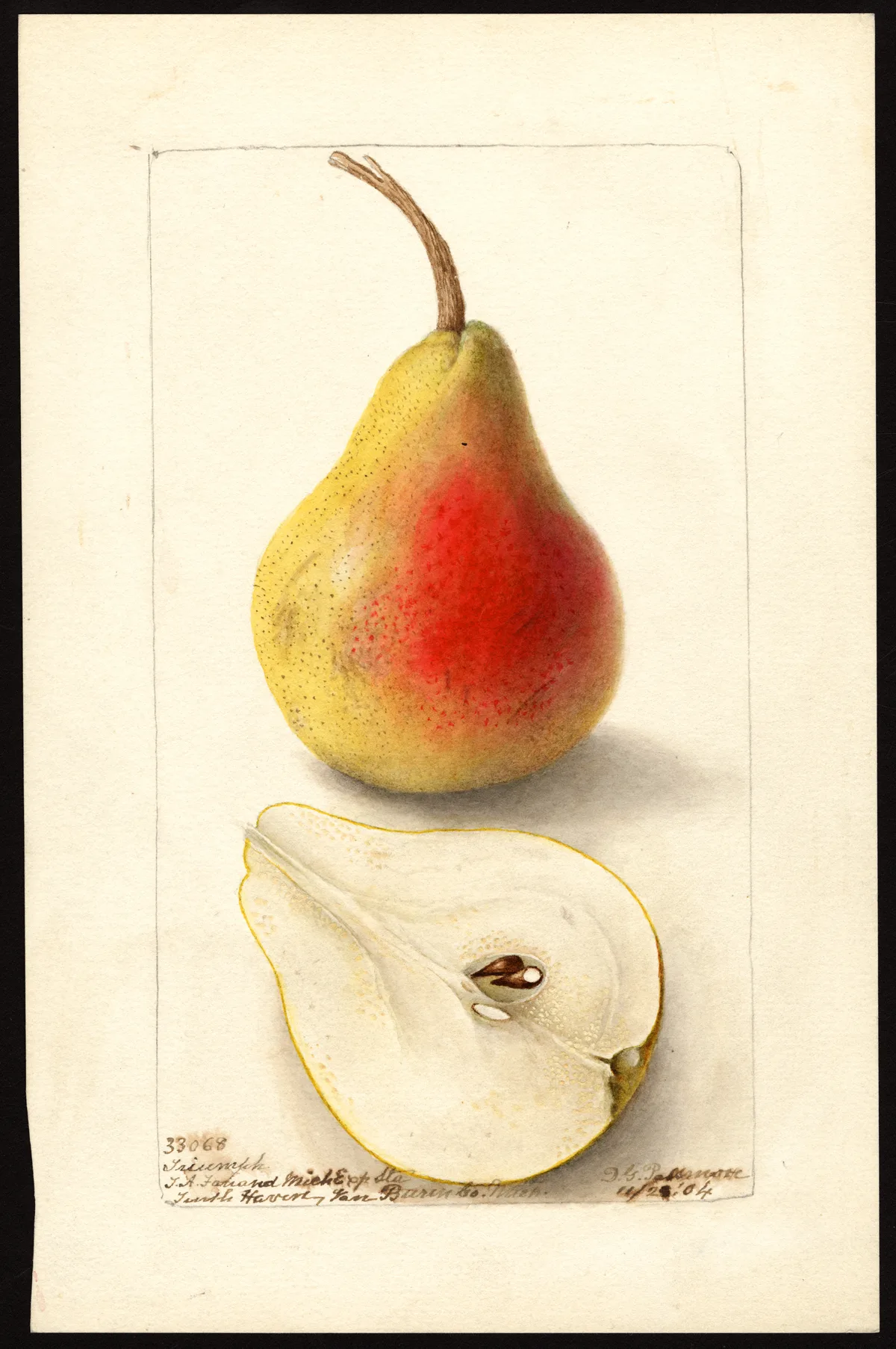
USDA Pomological Watercolor Collection
Triomphe de Vienne
Origin / History
Raised in 1864. Bunyard gives the raiser as M. Collaud, gardener at Montagnon, and says it was put into commerce by M. Claude Blanchet, of Vienne, France. Hedrick gives the raiser as M. Jean Colland, Vienne, France, with first distribution in 1874, and says the pear has been the recipient of several awards of merit. Bunyard calls it "a valuable fruit which will be appreciated by those who find Williams too strongly scented."
Tree
Tree vigorous, pyramidal, a heavy cropper (Hedrick). Growth moderate on Quince, fertility very good (Bunyard). Bunyard finds it rather weak on Quince and says it does best on pear for most soils. Leaf medium, rounded oval, entire or faintly crenate, turns brilliant crimson red (Bunyard).
Fruit
Size: Large (Hedrick); medium, 3½ by 2½ (Bunyard).
Form: Obovate-pyriform, pyriform oval; uneven, rather irregular.
Stem: 1½ in. long, surrounded by stronger russet (Bunyard).
Cavity: Not described in source.
Calyx: Open; eye set in a shallow basin.
Basin: Shallow (Bunyard).
Skin: Smooth (Bunyard). Greenish yellow, with patches of russet, often blushed with red (Hedrick).
Dots: Not described in source.
Flesh and flavor: Flesh white to nearly white, melting, juicy to very juicy, a little gritty (Bunyard). Flavor rich, sweet, spicy (Hedrick); of delicate flavor (Bunyard). Quality "very good" (Hedrick).
Core and seeds: Core small; seeds usually imperfect (Hedrick).
Season
September to early October. Bunyard gives September; Hedrick gives September and early October.
Uses
Dessert.
Subtypes / Variants
Not described in source.
Other
Not described in source.
Book Sources
Described in 2 period pomological works
Nursery Catalog Sources
Found in 22 catalogs (1894–1917) from California, England, Illinois, Missouri, Oregon, Washington
- Felix Gillet , Barren Hill Nursery, Nevada City , California — 1894
- Woodburn Nurseries , Woodburn, Marion Co. , Oregon — 1894
- Felix Gillet , Barren Hill Nursery, Nevada City , California — 1895
- Kelway & Son , Langport, Somerset , England — 1897
- Stark Bros. Nurseries & Orchards Co. , Louisiana , Missouri — 1898 — listed as Triumph
- George Bunyard & Co. , Royal Nurseries, Maidstone, Kent , England — 1900
- Central Experimental Farm , Dominion Department of Agriculture, Agassiz, British Columbia (under test; Bulletin No. 3, Second Series) — 1900
- Benjamin Buckman (personal inventory) , Farmingdale , Illinois — 1901
- Stark Bros. Nurseries & Orchards Co. , Louisiana , Missouri — 1906 — listed as Triumph
- Island Nurseries & Fruit Farm , Vashon (Vashon Island) , Washington — 1910 — listed as Triumph
- Stark Bros. Nurseries & Orchards Co. , Louisiana , Missouri — 1910 — listed as Triumph
- James Veitch & Sons , Ltd., Royal Exotic Nursery, Chelsea, London (also Coombe Wood, Langley, and Feltham) , England — 1911
- Island Nurseries & Fruit Farm , Vashon (Vashon Island) , Washington — 1911 — listed as Triumph
- Stark Bros. Nurseries & Orchards Co. , Louisiana , Missouri — 1911 — listed as Triumph
- Stark Bros. Nurseries & Orchards Co. , Louisiana , Missouri — 1912 — listed as Triumph
- Thomas Rivers & Son , Sawbridgeworth, Hertfordshire , England — 1913
- George Bunyard & Co. , Royal Nurseries, Maidstone, Kent , England — 1914
- Island Nurseries & Fruit Farm , Vashon (Vashon Island) , Washington — 1914 — listed as Triumph
- Island Nurseries & Fruit Farm , Vashon (Vashon Island) , Washington — 1915 — listed as Triumph
- Island Nurseries & Fruit Farm , Vashon (Vashon Island) , Washington — 1916 — listed as Triumph
- George Bunyard & Co. , Royal Nurseries, Maidstone, Kent , England — 1917
- Island Nurseries & Fruit Farm , Vashon (Vashon Island) , Washington — 1917 — listed as Triumph
View original book sources (2)
— E.A. Bunyard, A Handbook of Hardy Fruits (1920)TRIOMPHE DE VIENNE. Dessert, September, medium, 3½ by 2½, pyriform oval, uneven. Skin, smooth. Flesh, nearly white, melting, very juicy and of delicate flavour. Eye, open in a shallow basin. Stem, 1½ in., surrounded by stronger russet. Growth, moderate on Quince; fertility very good. Leaf, medium rounded oval, entire or faintly crenate, turns brilliant crimson red. Origin, raised by M. Collaud, gardener at Montagnon, in 1864, and put into commerce by M. Claude Blanchet, of Vienne, France. A valuable fruit which will be appreciated by those who find Williams too strongly scented. A little gritty; it is rather weak on Quince, and does best on pear for most soils.
— U.P. Hedrick, The Pears of New York (1921)Triomphe de Vienne.
- Can. Hort. 11:261. 1888. 2. Soc. Nat. Hort. France Pom. 446, fig. 1904. Triumph. 3. Can. Hort. 25:442, fig. 1902.
Raised in 1864 by M. Jean Colland, Vienne, Fr., and first distributed in 1874, this pear has been the recipient of several awards of merit. Tree vigorous, heavy-cropper, pyramidal. Fruit large, obovate-pyriform, rather irregular, greenish-yellow, with russet patches, often blushed with red; calyx open; core small; seeds usually imperfect; flesh white, melting, juicy; flavor rich, sweet, spicy; very good; Sept. and early Oct.