Triumph De Jodoigne
Pear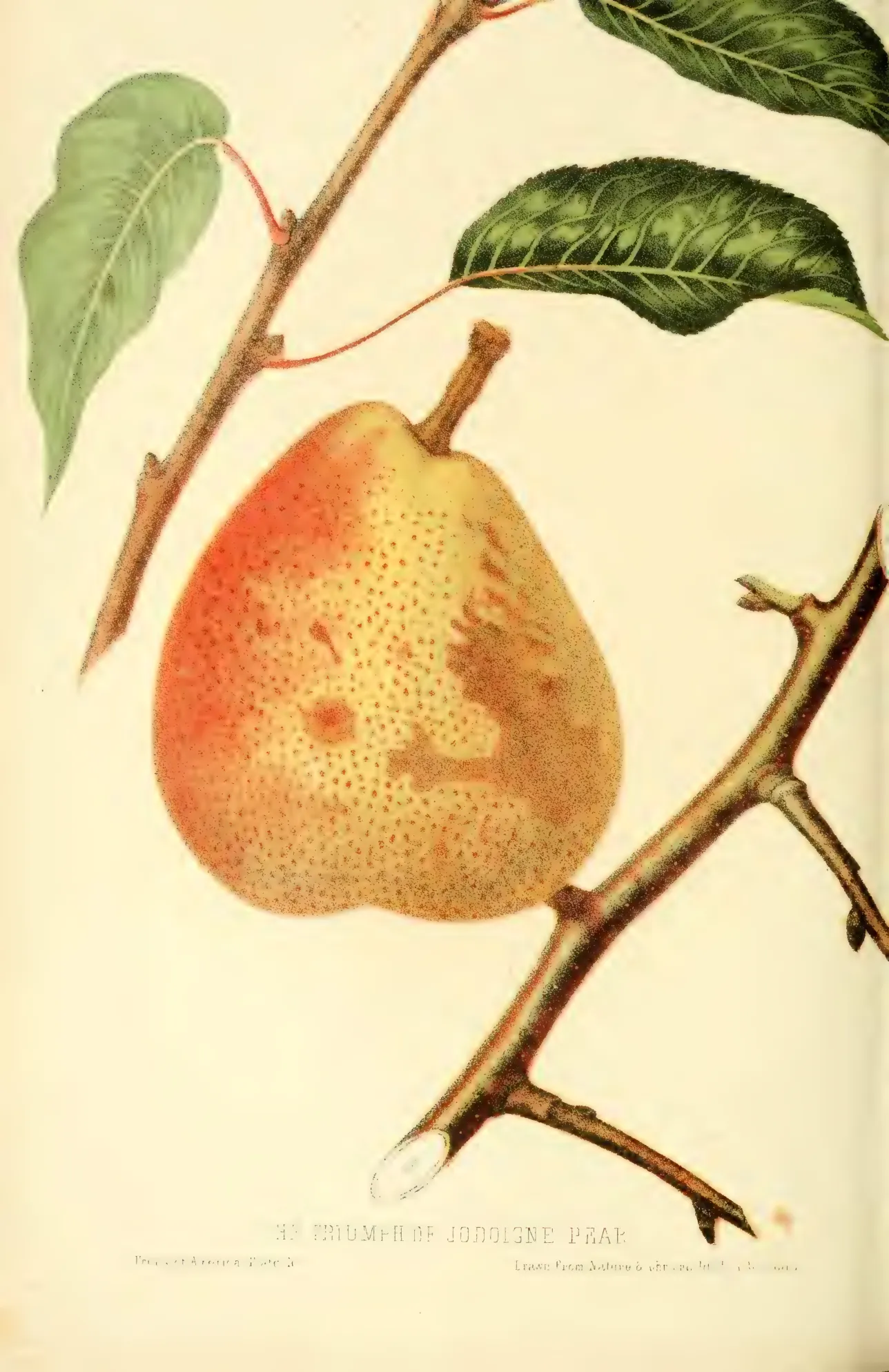
Triumph De Jodoigne
Origin / History
The Triumph De Jodoigne is a pear first described in the Bon Jardinier of 1848, which gives the earliest account of the variety. It was raised by the late M. Bouvier, a well-known amateur pomologist who resided at Jodoigne, in Belgium, and who originated several fine varieties. It was first offered for sale in the French nurseries in 1844 or 1845, at which time C.M. Hovey received his trees from M. Jamin, of Paris. The variety first fruited in Hovey's collection in 1848. "Its introduction was preceded by a high reputation, and we think we may say its qualities have not disappointed the expectations of cultivators." At the time of Hovey's account it was "a new and comparatively very little known pear."
Tree
Tree vigorous, with a somewhat spreading, irregular habit, requiring careful pruning to form a symmetrical head. The tree is very vigorous growing, approaching in this respect the character of the Beurre Diel, as its fruit also resembles that pear. Annual shoots very stout. Wood brownish olive, thickly dotted with round grayish specks, very strong, stout, and short-jointed. Old wood grayish brown. Buds large, broad, rather short, pointed, slightly diverging, with prominent shoulders. Flower buds large. Leaves large, broadly ovate, narrowing to each end, thick, very deep green, glossy, finely nerved, wavy, and nearly entire on the edge. Petioles medium length, about one inch long, stout, reddish. Flowers large, with petals large and ovate; clusters compact. Fruit produced in clusters of three or four each. The variety succeeds well upon the quince, and is one of the sorts which make a vigorous pyramid on that stock. On the pear it is rather late in coming into bearing.
Fruit
Size: Large, about four inches long and three and a half inches in diameter. As large as the Beurre Diel.
Form: Oblong obovate, little irregular, with a large swollen crown, contracted slightly in the middle, and obtuse at the stem. Somewhat resembling the Beurre Diel in shape.
Stem: Medium length, about three inches long, moderately stout, curved, and obliquely inserted in a small, shallow cavity, highest on one side.
Cavity: Small and shallow, with the stem obliquely inserted, highest on one side.
Calyx: Eye medium size, open, and but little depressed in a small basin. Segments of the calyx short and stiff.
Basin: Small and shallow, in which the eye is but little depressed.
Skin: Fair, slightly rough, dull greenish yellow, much russeted in spots and splashes, deeply tinged with bronzy red in the sun. Over the greenish yellow lies a fine, ruddy crimson cheek, blotched. The fruit is a very handsome and showy fruit.
Dots: Conspicuously dotted over with very large russety specks.
Flesh and flavor: Flesh yellowish white, coarse, melting, and juicy. Flavor rich, sugary, sprightly, and agreeably perfumed.
Core and seeds: Core medium size. Seeds small, long, sharply pointed, and dark.
Season
Ripe in November, and in eating two or three weeks. The fruit is ripe and nearly gone before the Beurre Diel is mature.
Uses
Eating pear, rich, sugary, sprightly, and agreeably perfumed, for eating two or three weeks from its November ripening.
Subtypes / Variants
Not described in source.
Other
Not described in source.
Book Sources
Described in 1 period pomological work
- Hovey, The Fruits of America (1852) — listed as THE TRIUMPH DE JODOIGNE PEAR.
View original book sources (1)
— C.M. Hovey, The Fruits of America (1852)THE TRIUMPH DE JODOIGNE PEAR.
Triumph de Jodoigne. Bon Jardinier, 1848.
The Triumph de Jodoigne is a new and comparatively very little known pear. It fruited here, we believe, for the first time, in our collection, in 1848. Its introduction was preceded by a high reputation, and we think we may say its qualities have not disappointed the expectations of cultivators. It is as large as the Beurre Diel, which it somewhat resembles in shape, but it is ripe and nearly gone before that sort is mature. It is a very handsome and showy fruit, having a fine, ruddy crimson cheek, blotched, and very conspicuously dotted with russet.
The Bon Jardinier, in which we find the earliest account of this pear, states that it was raised by the late M. Bouvier, a well-known amateur pomologist, who resided at Jodoigne, in Belgium, and who has originated several fine varieties. It was first offered for sale in the French nurseries, in 1844 or 1845, at which time we received our trees from M. Jamin, of Paris.
The Triumph de Jodoigne is a very vigorous growing tree, in this respect approaching to the character of the Beurre Diel, as its fruit also resembles that pear. The foliage is broad, rich and glossy, and the fruit is produced in clusters of three or four each. It succeeds well upon the quince, and is one of the sorts which make a vigorous pyramid on that stock. It is rather late in coming into bearing on the pear.
Tree.—Vigorous, with a somewhat spreading, irregular habit, and requiring careful pruning to form a symmetrical head; annual shoots very stout.
Wood.—Brownish olive, thickly dotted with round grayish specks, very strong, stout, and short-jointed; old wood, grayish brown; buds, large, broad, rather short, pointed, slightly diverging, with prominent shoulders: Flower-buds, large.
Leaves.—Large, broadly ovate, narrowing to each end, thick, very deep green, glossy, finely nerved, wavy, and nearly entire on the edge; petioles, medium length, about one inch long, stout, reddish.
Flowers.—Large; petals, large, ovate; clusters, compact.
Fruit.—Large, about four inches long, and three and a half in diameter: Form, oblong obovate, little irregular, with a large swollen crown, contracted slightly in the middle, and obtuse at the stem: Skin, fair, slightly rough, dull greenish yellow, much russeted in spots and splashes, deeply tinged with bronzy red in the sun, and conspicuously dotted over with very large russety specks: Stem, medium length, about three inches long, moderately stout, curved, and obliquely inserted in a small, shallow cavity, highest on one side: Eye, medium size, open, and but little depressed in a small basin; segments of the calyx, short, stiff: Flesh, yellowish white, coarse, melting, and juicy: Flavor, rich, sugary, sprightly, and agreeably perfumed: Core, medium size: Seeds, small, long, sharply-pointed, and dark.
Ripe in November, and in eating two or three weeks.