VICOMTE DE SPOELBERCH
Pear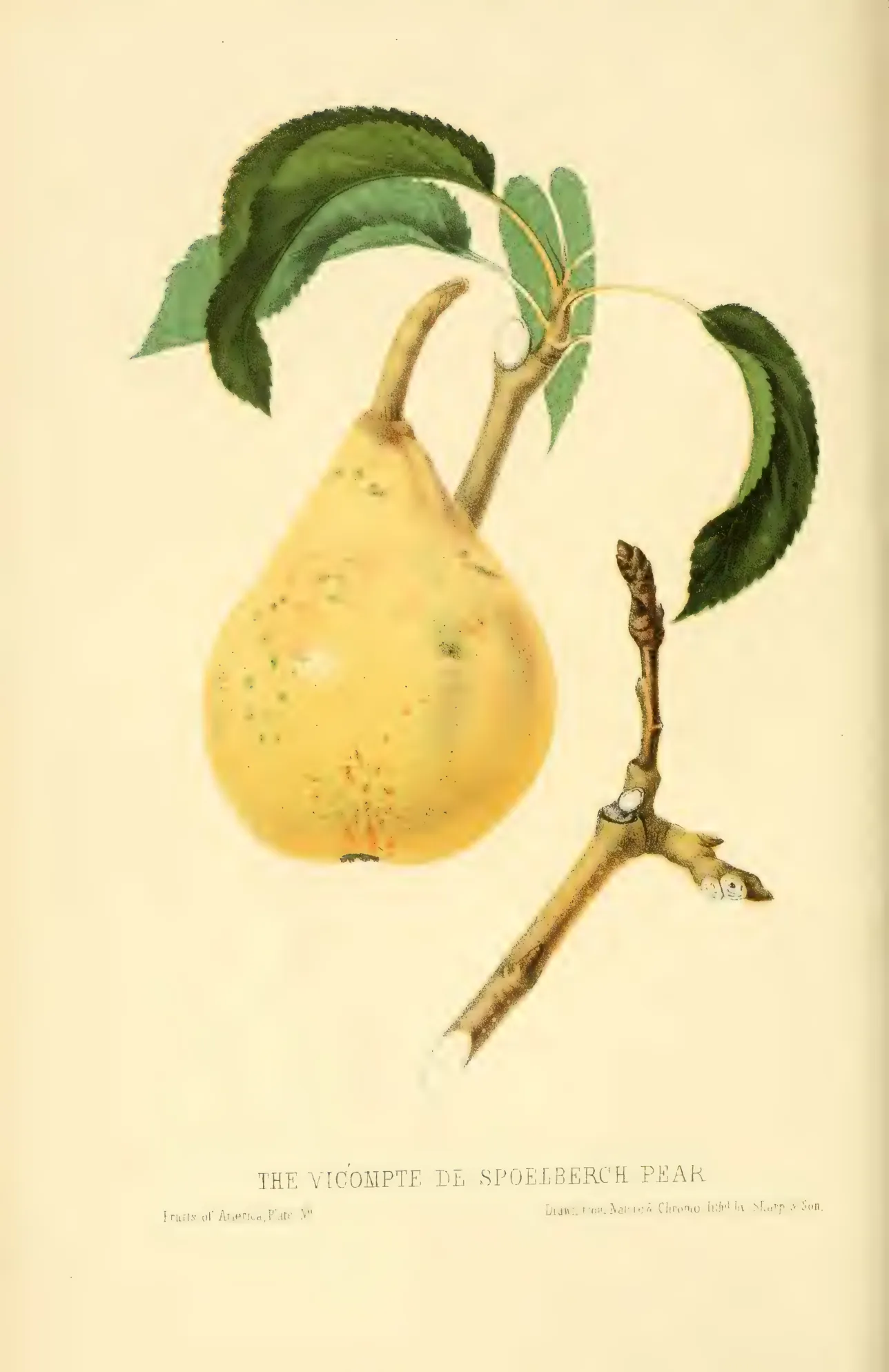
VICOMTE DE SPOELBERCH
Origin / History
A seedling raised by Dr. Van Mons of Belgium, first described in 1830 (Downing) and named in honor of the Vicomte de Spoelberch, a member of the Botanical and Agricultural Society of Louvain (Hovey); Downing gives the dedicatee more fully as "M. le Vicomte de Spoelberg de Lovenjoul." Elliott and Thomas identify the variety as foreign/Belgian.
About 1829, the late Mr. Manning, Gen. Dearborn, and Wm. Kenrick opened a correspondence with Dr. Van Mons to secure some of his new pears. In the spring of 1831, upwards of seventy varieties were received, embracing the sorts Van Mons designated as of "greatest merit" in his extensive collection; the Vicomte de Spoelberch was one of them. With the scions Van Mons sent a copy of his Pomographie Belgique Moderne (containing lithographed figures of several of his choicest seedlings) and several parts of the Revue des Revues, in which he was giving complete descriptions of his best pears. Gen. Dearborn translated the descriptions of those Van Mons designated as the best, the Vicomte de Spoelberch among them; the high character given to it made cultivators very anxious to possess it. Until 1845 it had not fruited in any of the collections around Boston: the first package of scions received was so long delayed on the passage that nearly or quite all died, and in a later duplicate shipment the Vicomte de Spoelberch was one that did not survive. It first fruited in Hovey's collection in 1845, from trees received from Jersey, and proved to be an exceedingly rich and delicious pear, somewhat of the character of the Winter Nelis.
Tree
Moderately vigorous (Hovey, Elliott); Downing calls the tree "vigorous." Habit erect and rather compact, with the ends of the branches inclining toward the main stock (Hovey); Elliott: branches upright. Comes into bearing early and is productive (Hovey, Downing). Flourishes either upon the pear or quince stock; Hovey's specimens were from a small tree upon the quince, about four years from the bud or graft. Thomas notes it "needs high cultivation to develop its fine qualities."
Wood / Twigs / Buds
Annual shoots rather stout, wrinkled, and contorted; woolly (Hovey). Wood yellowish brown (Hovey), or reddish yellow brown (Downing); Elliott: yellowish brown. Stout, short-jointed, and thickly sprinkled with grayish white specks (Hovey); Elliott likewise describes whitish gray specks on the branches. Buds large, short, broad, pointed, and flattened; flower-buds large, oblong-oval.
Leaves
Large, elongate, pointed, smooth, dark green, narrower toward the end than at the base, recurved, and somewhat folded, irregularly and rather obtusely serrated; petioles short and rather slender.
Flowers
Medium size, very slightly cupped; petals oblong.
Fruit
Size and form. Large (Hovey, Elliott) — Hovey gives specimens about three inches long and two and a half in diameter; Downing calls it medium and Thomas medium or rather large. Form obovate (Elliott, Thomas); Elliott further specifies obovate obtuse pyriform, Thomas "obovate, somewhat conic," Downing "roundish acute pyriform." Hovey describes it as full and slightly flattened around the eye, swollen towards the middle, and contracted near the stem, where it is also a little flattened.
Skin. Fair, slightly rough (Hovey; Thomas also "slightly rough"), greenish yellow, becoming a fine lemon yellow when mature (Hovey); pale yellow (Elliott, Downing) or yellow (Thomas). Washed and marbled, or blotched, with purplish red on the sunny side (Hovey); Elliott: "little red in sun"; Thomas: "with a purplish blotched cheek to the sun." Somewhat russeted in patches extending from the stem (Hovey), with russet patches and specks (Elliott), small patches of russet (Downing), or "very slightly russeted" (Thomas). Covered with small, greenish brown specks (Hovey) or numerous small dots (Downing).
Stem. Rather long, about one and a half inches (Hovey) or an inch and a fourth (Thomas); Elliott simply "long." Stout, swollen, curved, and obliquely attached to the fruit by a fleshy junction (Hovey); Elliott: "stout, fleshy at base"; Thomas: "stout, curved"; Downing: "curved, fleshy at its insertion, with slight russet."
Calyx and basin. Eye medium size, moderately sunk in a small round basin; segments of the calyx short and stiff, projecting (Hovey). Elliott: calyx medium, segments short, erect. Thomas: basin round, shallow; calyx erect, short. Downing: calyx open, basin small.
Flesh and flavor. Flesh white, fine (Hovey) or fine-grained (Elliott), buttery, melting, and very juicy. Flavor rich, sprightly, saccharine, and delicious, with a very high perfume (Hovey); Elliott: sugary, "best"; Thomas: rich, fine. Downing dissents, calling the flesh "not high flavored" and rating the variety only "Good."
Core and seeds. Core medium size; seeds medium size, dark, nearly round (Hovey).
Season
Ripe in December and keeps into January (Hovey); Van Mons calls it "decidedly a winter fruit," sometimes keeping till spring. Elliott: December. Downing: November, December. Thomas: early winter.
Uses
Not described in source.
Subtypes / Variants
Not described in source.
Other
Not described in source.
Book Sources
Described in 4 period pomological works
- Downing, Fruits and Fruit Trees of America (1900)
- Thomas, The American Fruit Culturist (1903)
- Elliott, The Western Fruit Book (1865) — listed as Vicompte de Spoelberch
- Hovey, The Fruits of America (1852) — listed as THE VICOMPTE DE SPOELBERCH PEAR
Nursery Catalog Sources
Found in 1 catalog (1900)
- Central Experimental Farm , Dominion Department of Agriculture, Agassiz, British Columbia (under test; Bulletin No. 3, Second Series) — 1900 — listed as De Spoelberg
View original book sources (4)
— C.M. Hovey, The Fruits of America (1852)THE VICOMPTE DE SPOELBERCH PEAR.
Vicompte de Spoelberch. Revue des Revues. (N. E. Farmer, vol. x.) Vicompte de Spoilberg, Despoilberg, } of some French Collections. Poire de Mons,
About the year 1829, the late Mr. Manning, Gen. Dearborn, and Wm. Kenrick, with the zeal which they ever manifested in pomological science, opened a correspondence with Dr. Van Mons, for the purpose of securing some of the new and fine varieties of pears which he had originated. Their request for scions was most liberally complied with, and, in the spring of 1831, upwards of seventy varieties were received, embracing, as Dr. Van Mons stated, the sorts which possessed the "greatest merit" in his extensive collection; and, among them, the Spoelberch. With the scions, Dr. Van Mons sent a copy of his Pomographie Belgique Moderne, which contained lithographed figures of several of his choicest seedlings, and also several parts of the Revue des Revues, a work in which complete descriptions of all his best pears were to be given by himself. Gen. Dearborn immediately made a translation of the descriptions of those which Dr. Van Mons designated as the best, and the Vicompte de Spoelberch was one of the number. In consequence of the high character given to this variety, cultivators were very anxious to possess it; but we believe, until 1845, it had not fruited in any of the collections around Boston. Unfortunately, the first package of scions received were so long delayed on the passage, that nearly or quite all died. Later, a duplicate lot of scions was forwarded, but the Vicompte de Spoelberch was one among the number which never survived. It first fruited in our collection in 1845, from trees received from Jersey, and it proves to be an exceedingly rich and delicious pear, somewhat of the character of the Winter Nelis. It was named in honor of the Vicompte de Spoelberch, a member of the Botanical and Agricultural Society of Louvain.
The Vicompte de Spoelberch is of moderately vigorous growth, and flourishes either upon the pear or quince stock. It comes into bearing early, and is a productive variety. Our specimens were from a small tree upon the quince, about four years from the bud or graft.
Tree. — Moderately vigorous, erect, and of rather compact habit, with the ends of the branches inclining towards the main stock: annual shoots rather stout, wrinkled, and contorted.
Wood. — Yellowish brown, stout, short-jointed, and thickly sprinkled with grayish white specks; annual shoots woolly; buds large, short, broad, pointed, and flattened: Flower-buds large, oblong-oval.
Leaves. — Large, elongate, pointed, smooth, dark green, narrower towards the end than at the base, recurved, and somewhat folded, irregularly and rather obtusely serrated; petioles short and rather slender.
Flowers. — Medium size, very slightly cupped; petals oblong.
Fruit. — Large, about three inches long, and two and a half in diameter: Form, obovate, full, and slightly flattened around the eye, swollen towards the middle, and contracted near the stem, where it is also a little flattened: Skin fair, slightly rough, greenish yellow, becoming of a fine lemon yellow when mature, washed and marbled, or blotched, with purplish red on the sunny side, somewhat russeted in patches extending from the stem, and covered with small, greenish brown specks: Stem, rather long, about one and a half inches, stout, swollen, curved, and obliquely attached to the fruit by a fleshy junction: Eye, medium size, and moderately sunk in a small round basin; segments of the calyx short and stiff, projecting: Flesh, white, fine, buttery, melting, and very juicy: Flavor, rich, sprightly, saccharine, and delicious, with a very high perfume: Core, medium size: Seeds, medium size, dark, nearly round.
Ripe in December, and keeps into January. Dr. Van Mons calls it "decidedly a winter fruit," sometimes keeping till spring.
— F.R. Elliott, The Western Fruit Book (1865)VICOMPTE DE SPOELBERCH. Despoilberg, | Bezi de Spoelberch, | Vicompte de Spoelberg. Foreign. Tree, moderately vigorous, branches upright, yellowish brown, with whitish gray specks. Fruit, large, obovate obtuse pyriform, pale yellow when mature, little red in sun, and russet patches and specks ; stem, long, stout, fleshy at base ; calyx, medium ; segments, short, erect : core, medium ; flesh, white, fine-grained, buttery, melting, juicy, sugary ; "best." December.
— A.J. Downing, The Fruits and Fruit Trees of America (1900)VICOMTE DE SPOELBERCH.
De Spoelberg. Beurré de Spoelberg. De Spoilberg.
A seedling of Van Mons', described in 1830, and dedicated to M. le Vicomte de Spoelberg de Lovenjoul. Tree vigorous, productive. Young wood reddish yellow brown.
Fruit medium, roundish acute pyriform. Skin pale yellow, covered with numerous small dots, and small patches of russet. Stalk curved, fleshy at its insertion, with slight russet. Calyx open. Basin small. Flesh white, buttery, juicy, melting, not high flavored. Good. November, December.
— John J. Thomas, The American Fruit Culturist (1903)Vicomte de Spoelberch. (De Spoelberg, Delices Van Mons.) Medium or rather large, obovate, somewhat conic; skin slightly rough, yellow, with a purplish blotched cheek to the sun, very slightly russeted; stalk an inch and a fourth long, stout, curved, basin round, shallow; calyx erect, short; flesh buttery, melting, rich, fine. Needs high cultivation to develop its fine qualities. Early winter. Belgian.