Virgouleuse
Pear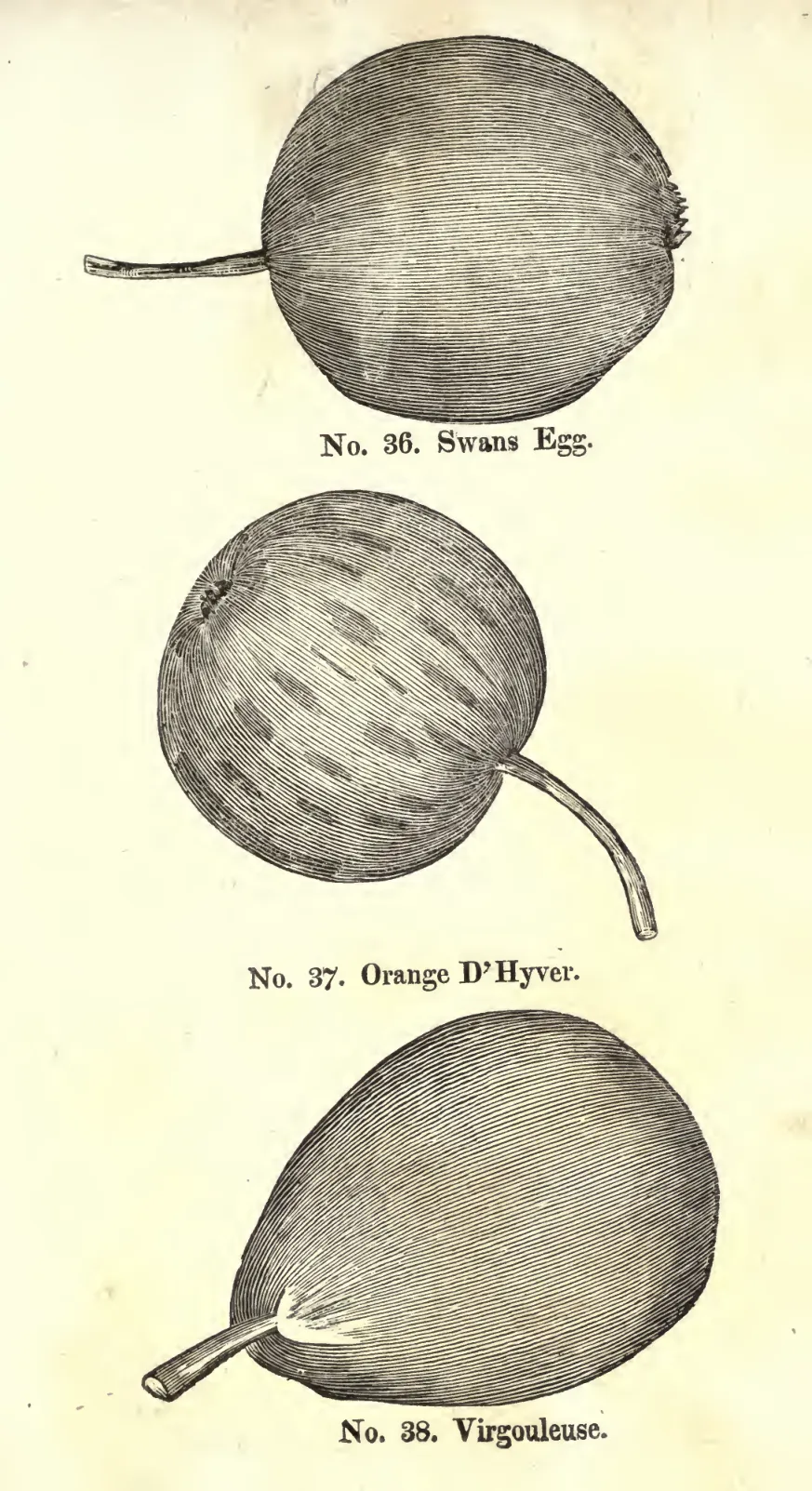
Virgouleuse
Origin / History
Originated at the village of Virgoulée, near Limoges, of which the Marquis Chambrette was the baron, and by whom it was first introduced about 1650 (Hedrick). From this circumstance it has often been called Chambrette, after the marquis. Coxe imported it from France and says it derives its name from a village called Virgoulé in Limousin. He adds that the yellow Beurré, which by most persons in New-York and East Jersey is "erroneously called the Virgouleuse", is like it in size and appearance. Downing calls it "an old French variety, of little value." Hedrick says that in Europe it is regarded as an excellent dessert pear, but in this country it has not met with great success.
Tree
Strong and vigorous (Hedrick). A late and indifferent bearer, apt to drop its fruit before ripe (Hedrick).
Fruit
Size: Medium to large. In size and appearance resembles the yellow Beurré (Coxe).
Form: Pyriform, rounded towards the eye and tapering thickly towards the stalk.
Stem: An inch long, fleshy at the base.
Cavity: Wanting; the stem is attached with no depression.
Calyx: Small, open.
Basin: Small, shallow.
Skin: Smooth to very smooth, delicate; lively green becoming a beautiful pale lemon-yellow, yellowish green at maturity. Coxe finds the skin thicker and rougher than that of the yellow Beurré.
Dots: Numerous, sprinkled, gray and red; Downing gives gray or reddish.
Flesh and flavor: Flesh white to yellowish white, delicate, buttery, melting, very juicy, with a sugary and perfumed flavor. Coxe alone describes the flesh as "singularly firm, rich, juicy, and highly flavoured." Downing rates the quality "Good".
Core and seeds: Not described in source.
Season
November to January (Downing and Hedrick). Coxe gives ripening in November and keeping in perfection till March. The fruit is said to be very susceptible to absorbing odors and flavors and must be stored near materials which will improve rather than impair the flavor (Hedrick).
Uses
Dessert pear.
Subtypes / Variants
Not described in source.
Other
Hedrick cites Duhamel, Traité des arbres fruitiers 2:224, Pl. 1 (1768); Brookshaw, Hortus Reposit. 1: Pl. XLIX, fig. 1 (1823); and Hogg, Fruit Manual 661 (1884).
Book Sources
Described in 3 period pomological works
Nursery Catalog Sources
Found in 2 catalogs (1845–1900) from Massachusetts
- Winship's Nursery (Brighton Nurseries , operated by the Winship family), Brighton (Boston) , Massachusetts — 1845
- Central Experimental Farm , Dominion Department of Agriculture, Agassiz, British Columbia (under test; Bulletin No. 3, Second Series) — 1900
View original book sources (3)
— William Coxe, A View of the Cultivation of Fruit Trees (1817)
- VIRGOULEUSE.
This pear I imported from France; it derives its name from a village called Virgoule' in Limousin---in size and appearance it resembles the yellow Beurree', (which by most persons in New-York and East Jersey is erroneously called the Virgouleuse) but the skin is thicker and rougher; the flesh is singularly firm, rich, juicy, and highly flavoured---it ripens in November and keeps in perfection till March; it is one of
— A.J. Downing, The Fruits and Fruit Trees of America (1900)VIRGOULEUSE.
Poire-glace. Le Virgoule. Poire de Glace. Chambrette. Virgolese. Ice Pear. Bujaleuf. Chambrette d'Hiver. La Virguleuse.
An old French variety, of little value.
Fruit medium, pyriform. Skin very smooth, yellowish green at maturity, sprinkled with numerous gray or reddish dots. Flesh white, buttery. Good. November to January.
— U.P. Hedrick, The Pears of New York (1921)Virgouleuse. 1. Duhamel Trait. Arb. Fr. 2:224, Pl. 1. 1768. 2. Brookshaw Hort. Reposit. 1:Pl. XLIX, fig. 1. 1823. 3. Hogg Fruit Man. 661. 1884.
This variety originated at the village of Virgoulée, near Limoges, of which the Marquis Chambrette was the baron, and by whom it was first introduced about 1650. From this circumstance it has often been called Chambrette, after the marquis. The tree is strong and vigorous but is a late and indifferent bearer and is apt to drop its fruit before ripe. It is said that the fruit is very susceptible to absorbing odors and flavors and must be stored near materials which will improve rather than impair the flavor. In Europe it is regarded as an excellent dessert pear, but in this country it has not met with great success.
Fruit medium to large, pyriform, rounded towards the eye and tapering thickly towards the stalk; skin smooth, delicate, lively green becoming a beautiful pale lemon-yellow, sprinkled with numerous gray and red dots; calyx small, open, set in a small shallow basin; stem an inch long, fleshy at the base, attached with no depression; flesh yellowish-white, delicate, buttery, melting, very juicy, with a sugary and perfumed flavor; Nov. to Jan.