Winter Royal
Pear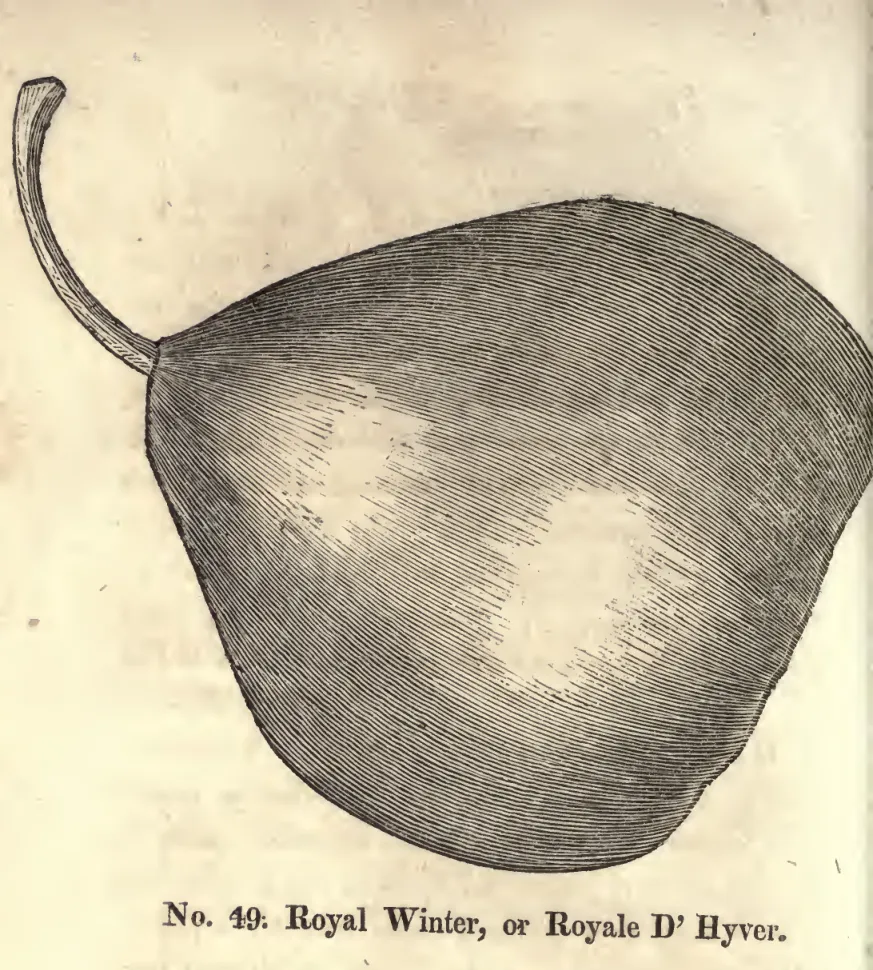
Winter Royal
Origin/History
An old variety of unknown origin, as noted by Downing. Coxe notes a close resemblance to the Muscat Alle pear as delineated by the Abbé Rozier, observing that the two are frequently confounded by French gardeners, and that both are highly estimable winter fruits.
Tree
Not described in source.
Fruit
Size
The two sources differ: Coxe describes Winter Royal as a very large pear, while Downing characterizes the fruit as rather large.
Form
Both sources agree the fruit is pyriform in shape. Coxe provides additional detail: it is much swelled at the blossom end and diminishes toward the stalk in such a manner as to exhibit a triangular figure when viewed in profile. Downing describes the shape as obovate pyriform, or nearly pyriform.
Stem
Long, and large at the extremity. (Coxe; not mentioned by Downing.)
Cavity
Not described in source.
Calyx / Eye
The eye is very small and planted very deep. (Coxe; not mentioned by Downing.)
Basin
Not described in source.
Skin
Both sources agree: the skin is yellow on the shaded side, with red toward the sun. Coxe describes the skin as smooth and fine, with little dots on the red portion and russet spots on the yellow. Downing describes it as yellow with fine red in the sun, marbled with numerous brown specks and dots.
Flesh and Flavor
The flesh is yellowish and melting in both sources. Coxe calls it half breaking with a juice that is very saccharine. Downing describes it as half buttery, melting, juicy, sweet, and well flavored.
Core/Seeds
Not described in source.
Season
December to February. (Both sources agree.)
Uses
Not described in source.
Subtypes/Variants
Not described in source.
Other
Downing cites this description to Lindley. Coxe notes the strong resemblance between Winter Royal and the Muscat Alle pear, stating that as delineated by the Abbé Rozier the two resemble each other very much, and that they are both highly estimable winter fruits — a remark that may be of use when distinguishing the variety in a mixed collection.
Book Sources
Described in 2 period pomological works
- Coxe, A View of the Cultivation of Fruit Trees (1817) — listed as Royale d'Hyver, Or Winter Royal
- Downing, Fruits and Fruit Trees of America (1900)
View original book sources (2)
— William Coxe, A View of the Cultivation of Fruit Trees (1817)
- ROYALE D'HYVER, OR WINTER ROYAL.
This is a very large pear, of a pyriform shape, much swelled at the blossom end, and diminished towards the stalk in such a manner as to exhibit a triangular figure when viewed in profile—the skin is smooth and fine, a handsome red towards the sun, yellow on the shady side, spotted with little dots on the red, and russet spots on the yellow—the flesh is half breaking, melting, of a yellowish cast, the juice very saccharine; the eye is very small, and planted very deep—the stalk long, and large at the extremity; the time of ripening is from December to February; in the appearance of this pear and the Muscat Alle, and there is little perceptible difference; as delineated by the Abbé Rozier, they resemble each other very much; and it is stated by the same author, that they are frequently confounded by the French gardeners, they are both highly estimable winter fruits.
— A.J. Downing, The Fruits and Fruit Trees of America (1900)Winter Royal.
Royale d'Hiver. Royal Winter. Spina di Carpi.
An old variety, of unknown origin.
Fruit rather large, obovate pyriform, or nearly pyriform. Skin yellow, with fine red in the sun, marbled with numerous brown specks and dots. Flesh yellowish, half buttery, melting, juicy, sweet, well flavored. December to February. (Lind.)