Winter Sweet Paradise
Apple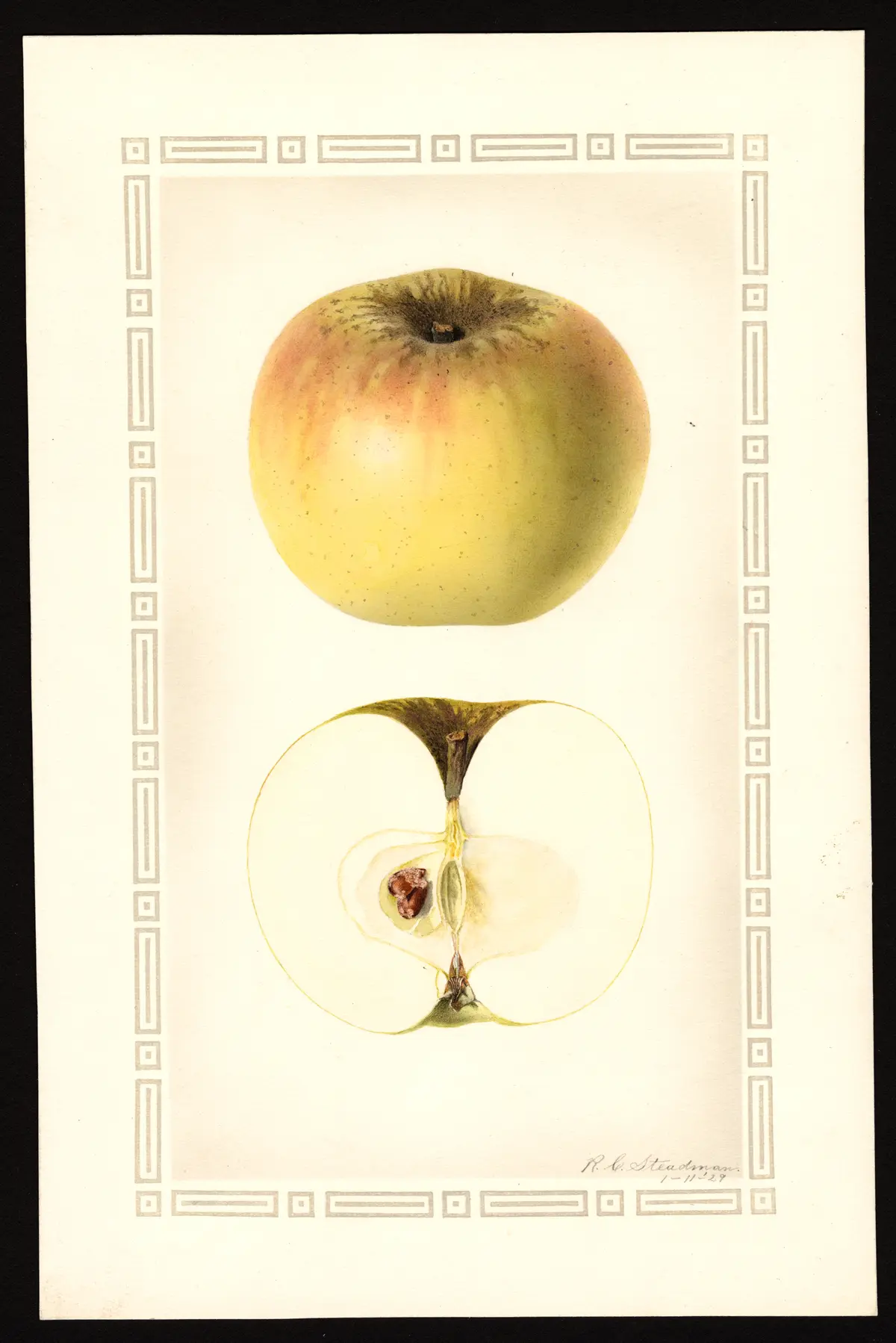
USDA Pomological Watercolor Collection
Winter Sweet Paradise
Origin / History
From Pennsylvania. In 1845 Downing wrote: "We received it some years ago along with the Summer Sweet Paradise from Mr. Garber of Columbia, Pa., and consider it a native fruit." Hedrick states that it originated with a Mr. Garber of Columbia, Pennsylvania, "nearly a century ago." Elliott gives its source as Columbia Co., Pa. Warder records an origin believed to be the same as that of the variety preceding it in his work, Lancaster County, Pennsylvania. Elliott and Warder published it under the name Paradise Winter Sweet.
From Pennsylvania it was carried into Ohio, and its cultivation was later extended into other portions of the Middle West (Beach). Thomas says it "succeeds well at the West." Downing calls it "a productive and excellent orchard fruit." Beach and Hedrick both call it an old variety. Beach says it is "but little known in New York," though still propagated to a considerable extent by nurserymen. Hedrick calls it "seldom found in orchards," though still offered by nurserymen, and writes: "It is doubtful whether it has characters sufficiently good to make its cultivation worth while."
Tree
Hardy (Downing), vigorous, upright, productive, not an early bearer. Hedrick, condensing Beach, calls it very productive. Beach takes his note on the tree from Barry (1883). Young shoots reddish gray (Downing).
Fruit
Size: Large to rather large. Most authors call it large; Downing and Thomas call it rather large.
Form: Roundish to roundish oblate or roundish flattened. Downing calls it regularly formed; Warder calls it globular and often unequal.
Stem: Short. Warder alone describes it as long and slender.
Cavity: Round, rather deep to deep, often russeted (Downing). Warder describes it as acute and brown.
Calyx: Small and closed. Elliott calls it medium.
Basin: Small (Thomas), abrupt and regular (Warder). Downing calls it rather deep and slightly corrugated; Elliott calls it not deep.
Skin: Smooth (Warder). Dull green when picked, becoming a little paler at maturity (Downing), or pale greenish yellow to greenish yellow. Overlaid with a blush that runs from pale brownish through brown to brownish red. Warder describes the surface as yellowish-white. Downing calls the fruit "always fair, and of fine appearance."
Dots: Scattered, minute (Warder).
Flesh and flavor: White, fine-grained, juicy, tender and breaking (Warder). Flavor sweet, very sweet in Warder's words, and sprightly (Downing). Most authors rate it "very good"; Warder rates it "good." Elliott finds the quality "a little variable."
Core and seeds: Core rather small to medium. Warder alone calls it large, wide, open, and clasping. Seeds ovate pyriform (Elliott), plump and dark (Warder).
Season
A winter apple, ripening through winter, November or December to March. Beach places it in early winter and midwinter.
Uses
Baking and stock (Warder). A family apple (Lowther).
Subtypes / Variants
Not described in source.
Other
Warder illustrates it as Fig. 187. Beach's references are Downing (1845, 1872), Cole (1849), Emmons (Nat. Hist. N. Y., 1851), Elliott (1854, with figure), Hooper (1857), Mag. Hort. (1861), Kirtland (Mag. Hort., 1867), Warder (1867), Fitz (1872), Thomas (1875), Barry (1883), Bailey (An. Hort., 1892), and Ill. Sta. Bul. 45 (1896). Lowther's station table gives a rating of 3* from the Northern Division and 10* from the Central Division, with cross-division reporting in both, and leaves the Southern Division blank.
Book Sources
Described in 7 period pomological works
- Downing, Fruits and Fruit Trees of America (1900)
- Warder, American Pomology: Apples (1867) — listed as Paradise Winter Sweet
- Elliott, The Western Fruit Book (1865) — listed as Paradise Winter Sweet
- Beach, The Apples of New York Vol. 1 (1905)
- Hedrick, Cyclopedia of Hardy Fruits (1922)
- Thomas, The American Fruit Culturist (1903)
- Lowther (ed.), Encyclopedia of Practical Horticulture (1914) — listed as Winter S. Paradise
Nursery Catalog Sources
Found in 9 catalogs (1894–1918) from Alabama, Illinois, Missouri, Virginia, Washington
- The Vineland Nurseries (Kelsey & Co. , Proprietors), St. Joseph, Missouri (Office: 13th and Atchison Sts., 2 Blocks East of the Citizens St. Car Line) — 1894 — listed as Paradise Winter Sweet
- The Salem Nursery (John A. Francis , Proprietor), Salem , Virginia — 1897 — listed as Paradise Winter Sweet
- Alabama Nursery Co. , Huntsville , Alabama — 1900 — listed as Paradise Winter Sweet
- Central Experimental Farm , Dominion Department of Agriculture, Agassiz, British Columbia (under test; Bulletin No. 3, Second Series) — 1900 — listed as Paradise Winter Sweet
- Benjamin Buckman (personal inventory) , Farmingdale , Illinois — 1901 — listed as Paradise Winter Sweet
- Stark Bros. Nurseries & Orchards Co. , Louisiana , Missouri — 1912 — listed as Paradise Winter Sweet
- Vineland Nurseries Company , Clarkston , Washington — 1912 — listed as Paradise Winter Sweet
- Benjamin Buckman (personal inventory) , Farmingdale , Illinois — 1913 — listed as Paradise Winter Sweet
- Stark Bros. Nurseries & Orchards Co. , Louisiana , Missouri — 1918 — listed as Paradise Winter Sweet
View original book sources (7)
— F.R. Elliott, The Western Fruit Book (1865)Paradise Winter Sweet.
Honey Sweet, of some.
From Columbia Co., Pa. Tree, productive. Fruit, large, roundish flattened; dull green, with a pale brownish blush; stem, short; cavity, rather deep; calyx, medium; basin, not deep; core, medium; seeds, ovate pyriform; flesh, white, fine grained, juicy, sweet; "very good." November to March. Quality a little variable.
— John A. Warder, American Pomology: Apples (1867)Paradise Winter Sweet.
Origin believed to be similar to its predecessor—Lancaster County, Pennsylvania. Fruit large, globular, often unequal; Surface smooth, yellowish-white; Dots scattered, minute. Basin abrupt, regular; Eye small, closed. Cavity deep, acute, brown; Stem long, slender. Core large, wide, open, clasping; Seeds plump and dark; Flesh white, tender, breaking, juicy; Flavor very sweet; Quality good; Use, baking and stock; Season, December to March.
Fig. 187.—PARADISE WINTER SWEET.
— A.J. Downing, The Fruits and Fruit Trees of America (1900)Winter Sweet Paradise.
Paradise Winter Sweet. Grandmother.
From Pennsylvania. The Winter Sweet Paradise is a productive and excellent orchard fruit, always fair, and of fine appearance. Tree hardy, upright, vigorous, not an early bearer. Young shoots reddish gray. Fruit rather large, regularly formed, roundish oblate. Color dull green when picked, with a brownish blush, becoming a little paler at maturity. Stalk short, set in a round cavity, often russeted. Calyx closed, small. Basin rather deep, slightly corrugated. Flesh white, fine-grained, juicy, sweet, sprightly, and very good. Core rather small. November to March.
— John J. Thomas, The American Fruit Culturist (1903)Winter Sweet Paradise. Rather large, roundish; skin pale greenish yellow with a brown blush; stalk short; calyx and basin small; flesh white, with a sweet, "very good" flavor. Ripens through winter. Origin, Pennsylvania. Succeeds well at the West.
— S.A. Beach, The Apples of New York, Vol. 1 (1905)WINTER SWEET PARADISE.
References. 1. Downing, 1845:124. 2. Cole, 1849:130. 3. Emmons, Nat. Hist. N. Y., 3:85. 1851. 4. Elliott, 1854:150. fig. 5. Hooper, 1857:102. 6. Mag. Hort., 27:99. 1861. 7. Kirtland, Ib., 33:53. 1867. 8. Warder, 1867:737. 9. Fitz, 1872:143, 156. 10. Downing, 1872:10 index, app. 11. Thomas, 1875:212. 12. Barry, 1883:357. 13. Bailey, An. Hort., 1892:253. 14. Ill. Sta. Bul., 45:346. 1896.
Synonyms. Honey Sweet of some (4). Paradise Winter (8). Paradise Winter Sweet (4). White Robinson (14). Wine Sweet (10).
Fruit large, roundish oblate, dull green with brownish-red blush, fine-grained, juicy, sweet; in season during early winter and midwinter. Tree a vigorous, upright grower and productive, but it is not an early bearer (12).
Historical. In 1845 Downing made the following observation concerning this variety. "We received it some years ago along with the Summer Sweet Paradise from Mr. Garber of Columbia, Pa., and consider it a native fruit" (1). From Pennsylvania it was carried into Ohio and later its cultivation was extended into other portions of the Middle West. Although an old variety it is but little known in New York. It is still propagated to a considerable extent by nurserymen.
— Granville Lowther (ed.), Encyclopedia of Practical Horticulture (1914)Winter S. Paradise: size large; form roundish (oblate); color greenish yellow; quality very good; use family; season winter; Northern Division reports 3* (cross-division reporting); Central Division reports 10* (cross-division reporting); Southern Division blank.
— U.P. Hedrick, Cyclopedia of Hardy Fruits (1922)WINTER SWEET PARADISE. Winter Paradise. Honey Sweet. Paradise Winter. Seldom found in orchards, this old variety is still offered by nurserymen. It is doubtful whether it has characters sufficiently good to make its cultivation worth while. It originated with a Mr. Garber, Columbia, Pennsylvania, nearly a century ago. The tree is described as vigorous, upright, very productive, but not an early bearer. The fruit is large, round, oblate, dull green with a reddish-brown blush. The flesh is fine-grained, juicy, and sweet. The season is early winter and midwinter.