WINTERSTEIN
Apple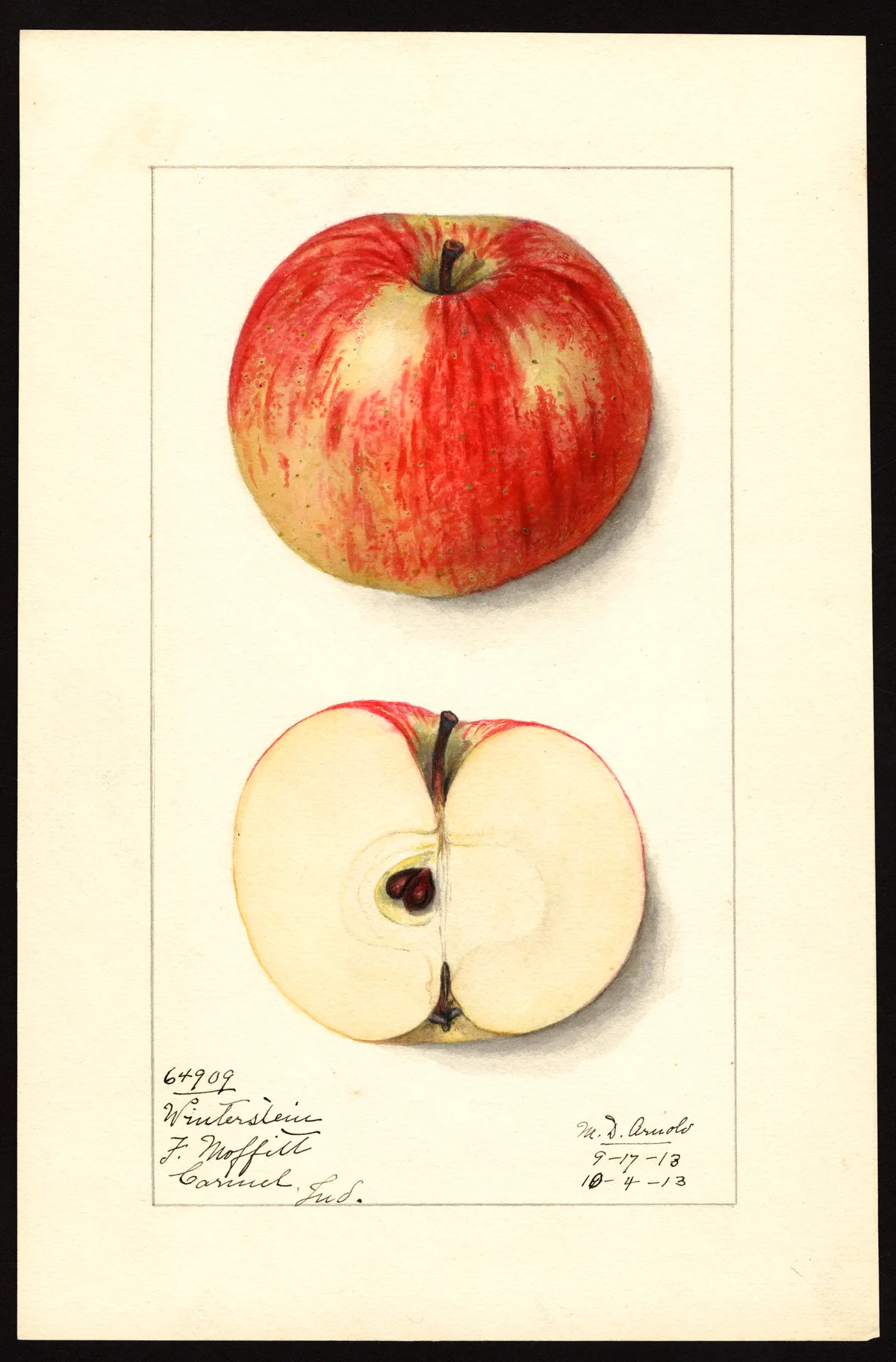
USDA Pomological Watercolor Collection
WINTERSTEIN
Origin/History
WINTERSTEIN is a seedling of Gravenstein, which it resembles in fruit and tree. It originated with Luther Burbank of Santa Rosa, California, about 1898. The variety is favorably spoken of in the Pacific states but seems to be little grown east of the Rocky Mountains (Hedrick). A Stark Bros. catalog from 1910 — predating Hedrick's account — confirms the Gravenstein parentage and describes WINTERSTEIN as a valuable addition to the nursery list, while noting it was considered too tender for extensive commercial planting.
A notable practical distinction from its parent: WINTERSTEIN keeps much longer than Gravenstein — as long as Baldwin (Hedrick).
Tree
Upright, vigorous, hardy, fairly productive, bearing every year in the West (Hedrick).
Fruit
Size and Form: Medium to large, not uniform, oblate or round-oblate, slightly ribbed, sides unequal.
Stem: Long, slender.
Cavity: Obtuse, narrow, smooth, compressed.
Calyx: Open, medium size.
Basin: Medium, narrow, obtuse, furrowed.
Skin: Greenish-yellow overlaid with dull red stripes and splashes of deeper red. Dots medium in size, scattered and russet.
Flesh/Flavor: Yellowish-white, firm, fine, crisp, tender, juicy, subacid, sprightly.
Core/Seeds: Core medium size, closed, axile; core-lines meeting. Calyx-tube short, wide, conical.
Season
November to April (Hedrick).
Uses
Good for culinary purposes (Hedrick).
Subtypes/Variants
Not described in source.
Other
The Stark Bros. (1910) catalog entry is partially garbled and includes the notation "NCS," likely an internal stock or catalog code. The legible portion characterizes WINTERSTEIN as high quality but insufficiently robust for extensive commercial planting, and frames it as a valuable addition precisely because it offers hardiness and robustness on an apple of Gravenstein quality — the precise wording is unclear due to apparent transcription error in the source.
Book Sources
Described in 1 period pomological work
Nursery Catalog Sources
Found in 11 catalogs (1901–1913) from Illinois, Missouri, Washington
- Washington Nursery Co. , Toppenish , Washington — 1901
- Stark Bros. Nurseries & Orchards Co. , Louisiana , Missouri — 1906
- Russellville Nursery Co. , Montavilla Station, Portland, OR (three miles east of Portland, one mile from Montavilla car line) — 1907
- Washington Nursery Company , Toppenish , Washington — 1909
- Stark Bros. Nurseries & Orchards Co. , Louisiana , Missouri — 1910
- Stark Bros. Nurseries & Orchards Co. , Louisiana , Missouri — 1911
- Stark Bros. Nurseries & Orchards Co. , Louisiana , Missouri — 1912
- Vineland Nurseries Company , Clarkston , Washington — 1912
- Washington Nursery Company , Toppenish , Washington — 1912
- Benjamin Buckman (personal inventory) , Farmingdale , Illinois — 1913
- Washington Nursery Company , Toppenish, Washington (on Yakima Indian Reservation) - [undated; companion to the 1912 "Sixth Edition" descriptive catalogue; same cover design and incorporated 1903 date; dated as c.1912]
View original book sources (2)
— U.P. Hedrick, Cyclopedia of Hardy Fruits (1922)WINTERSTEIN. Winterstein is a seedling of Gravenstein, which it resembles in fruit and tree, but the fruit keeps much longer—as long as that of Baldwin. The variety is favorably spoken of in the Pacific states, but seems to be little grown east of the Rocky Mountains. Winterstein originated with Luther Burbank, Santa Rosa, California, about 1898. Tree upright, vigorous, hardy, fairly productive, bearing every year in the West. Fruit medium to large, not uniform, oblate or round-oblate, slightly ribbed, sides unequal; stem long, slender; cavity obtuse, narrow, smooth, compressed; calyx open, medium size; basin medium, narrow, obtuse, furrowed; skin greenish-yellow overlaid with dull red stripes and splashes of deeper red; dots medium in size, scattered and russet; core medium size, closed, axile; core-lines meeting; calyx-tube short, wide, conical; flesh yellowish-white, firm, fine, crisp, tender, juicy, subacid, sprightly; good for culinary purposes; November to April.
— Stark Bros. Nurseries & Orchards Co., Stark Bros. Year Book (1910) (1910)Being of Gravenstein, of high quality but too tender for extensive commercial planting. Winterstein is a valuable addition to our list as it offers on an apple less possibly for quality, robustness and hardiness. NCS