Worcester Pearmain
Apple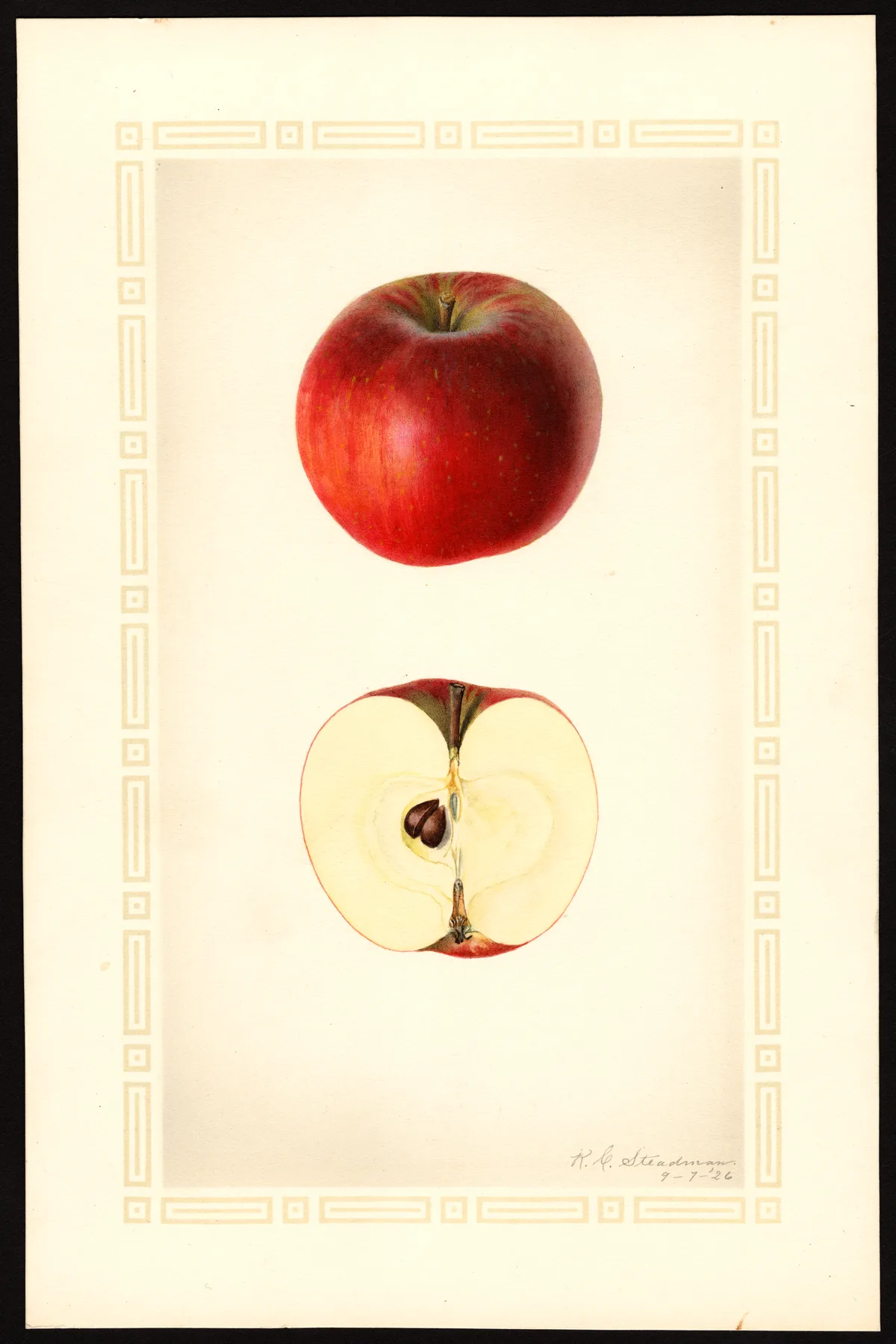
USDA Pomological Watercolor Collection
Worcester Pearmain
Origin / History
Accounts of the origin differ between sources. The Herefordshire Pomona (1885) states that Worcester Pearmain was produced in the St. John's Nurseries, Worcester, in 1873, by Mr. Richard Smith, and received a first-class certificate from the London Horticultural Society in 1874. It has been supposed to be a seedling from the Devonshire Quarrenden, but this is not known with certainty. Bunyard's Handbook of Hardy Fruits (1920) states instead that it originated at Swan Pool, near Worcester, by a Mr. Hale, and was introduced by Messrs. Smith of Worcester in 1874.
Tree
The tree is hardy and begins to bear at a very early age, being very productive (Herefordshire Pomona). Bunyard describes the growth as moderate, very regularly fertile, and notes that it makes a neat, round-headed standard. The George Bunyard catalog (1914) describes the tree as hardy, upright, pyramidal, and very prolific; very handsome. Veitch (1911) calls it very hardy and productive of all seasons. When well trained on the paradise stock, and laden with its bright red fruit (which has a peculiar rosy tint), it forms a very beautiful object (Herefordshire Pomona).
Leaf
Rather pale, oval, upfolded, undulating, coarsely serrate (Bunyard).
Fruit
Size
Sources differ on size. Herefordshire Pomona describes the fruit as medium sized, two inches and three-quarters wide and the same in height. Bunyard gives the dimensions as medium, 2½ by 2¼. Veitch describes it as large and handsome. Thomas Rivers (1914) describes it as a large raised apple. George Bunyard's catalog calls it rather small.
Form
Conical, even, and very slightly angular towards the crown, where it is narrow (Herefordshire Pomona). Round conical, regular (Bunyard). A "raised" apple of brilliant colour (Thomas Rivers).
Skin / Color
Very smooth and completely covered with a brilliant red, dotted with minute fawn-coloured dots; here and there in some of the specimens, the yellow ground shows faintly through the red (Herefordshire Pomona). Bright crimson on a golden-yellow ground (Bunyard). Red-cheeked, with yellow ground (George Bunyard catalog). Brilliant colour (Thomas Rivers).
Stem / Cavity
Stalk three quarters of an inch long, deeply inserted in a russety cavity (Herefordshire Pomona). Stem short, in a rather narrow russeted cavity (Bunyard).
Calyx / Eye / Basin
Eye small, closed with long segments forming a cone, set on the apex of the fruit, with a few plaits round it (Herefordshire Pomona). Eye closed, in a shallow ribbed basin (Bunyard).
Flesh / Flavor
Very tender, crisp, juicy, sweet, and sprightly, with a very pleasant flavour (Herefordshire Pomona). Crisp, greenish, very sweet, with a pleasant strawberry flavour (Bunyard). Flesh very crisp and juicy, very richly flavoured, a great favourite (Veitch). Flesh sub-acid and moderately good flavour; very good indeed (George Bunyard catalog). Very good (Thomas Rivers). Bunyard adds that the flavour of this fruit is greatly underrated by many, as it is usually gathered and eaten far before it is ripe.
Core / Seeds
Not described in source.
Season
Ripe in August and September (Herefordshire Pomona). Dessert, September to October (Bunyard). Sept. & Oct. (Veitch; Thomas Rivers). Autumn (George Bunyard catalog).
Uses
The great beauty of the fruit, and its usefulness, both for dessert and culinary purposes, cannot fail to render it a general favourite (Herefordshire Pomona). A dessert apple (Bunyard). An esteemed market variety, seldom failing to crop (Bunyard). A first-rate apple for all districts (George Bunyard catalog).
Subtypes / Variants
Not described in source.
Other
Not described in source.
Book Sources
Described in 2 period pomological works
Nursery Catalog Sources
Found in 9 catalogs (1897–1917) from England, Illinois
- Kelway & Son , Langport, Somerset , England — 1897
- George Bunyard & Co. , Royal Nurseries, Maidstone, Kent , England — 1900
- Central Experimental Farm , Dominion Department of Agriculture, Agassiz, British Columbia (under test; Bulletin No. 3, Second Series) — 1900
- Benjamin Buckman (personal inventory) , Farmingdale , Illinois — 1901
- James Veitch & Sons , Ltd., Royal Exotic Nursery, Chelsea, London (also Coombe Wood, Langley, and Feltham) , England — 1911
- Thomas Rivers & Son , Sawbridgeworth, Hertfordshire , England — 1913
- Benjamin Buckman (personal inventory) , Farmingdale , Illinois — 1913
- George Bunyard & Co. , Royal Nurseries, Maidstone, Kent , England — 1914
- George Bunyard & Co. , Royal Nurseries, Maidstone, Kent , England — 1917
View original book sources (5)
— Woolhope Naturalists Field Club, The Herefordshire Pomona (1885)
- WORCESTER PEARMAIN.
This very handsome early apple was produced in the St. John's Nurseries, Worcester, in 1873, by Mr. Richard Smith; and received a first-class certificate from the London Horticultural Society in 1874. It has been supposed to be a seedling from the Devonshire Quarrenden, but this is not known with certainty.
Description.—Fruit; medium sized, two inches and three-quarters wide, and the same in height; conical even, and very slightly angular towards the crown, where it is narrow. Skin; very smooth and completely covered with a brilliant red, dotted with minute fawn-coloured dots; here and there in some of the specimens, the yellow ground shows faintly through the red. Eye; small, closed with long segments, forming a cone, set on the apex of the fruit, with a few plaits round it. Stalk; three quarters of an inch long, deeply inserted in a russety cavity. Flesh; very tender, crisp, juicy, sweet and sprightly, with a very pleasant flavour.
The great beauty of the fruit, and its usefulness, both for dessert and culinary purposes, cannot fail to render it a general favourite. It is ripe in August and September.
The tree is hardy, begins to bear at a very early age, and is very productive. When well trained, on the paradise stock, and laden with its bright red fruit, which has a peculiar rosy tint, it forms a very beautiful object.
— E.A. Bunyard, A Handbook of Hardy Fruits (1920)WORCESTER PEARMAIN. Her. Pom., P. 2. Dessert, September to October, medium, 2½ by 2¼, round conical, regular. Colour, bright crimson on golden-yellow ground. Flesh, crisp, greenish, very sweet, with a pleasant strawberry flavour. Eye, closed, in a shallow ribbed basin. Stem, short, in a rather narrow russeted cavity. Growth, moderate; very regularly fertile. Leaf, rather pale, oval, upfolded, undulating, coarsely serrate. Originated at Swan Pool, near Worcester, by a Mr. Hale. Introduced by Messrs. Smith, of Worcester, in 1874. An esteemed market variety, seldom failing to crop. The flavour of this fruit is greatly underrated by many, as it is usually gathered and eaten far before it is ripe. Makes a neat, round-headed standard.
— James Veitch & Sons, Veitch's Fruit Trees (1911) (1911)large and handsome, being very richly flavoured, very hardy and productive of all seasons, flesh very crisp and juicy, a great favourite. Sep. & Oct.
— George Bunyard & Co., George Bunyard Catalog of Fruit Trees (1914) (1914)Autumn; Syn. Oct. Rather small, red-cheeked, with yellow ground. Flesh sub-acid and moderately good flavour. Very good indeed. The tree is hardy, upright, pyramidal, and very prolific; very handsome. A first-rate apple for all districts.
— Thomas Rivers & Son, Thomas Rivers Catalogue of Fruits (1914) (1914)a large raised apple of brilliant colour; very good; - Sept.-Oct.