Missouri Pippin
| Missouri Pippin | |
|---|---|
| Species | Apple |
| Trees Found | 1 |
| Orchards | McCoin Lower |
| Preserved | Clarno Arboretum({{{clarno_year}}}) |

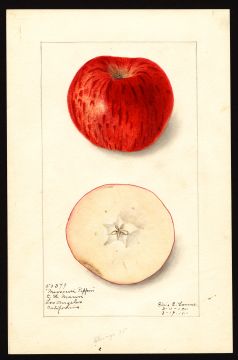
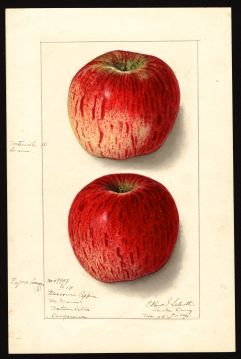
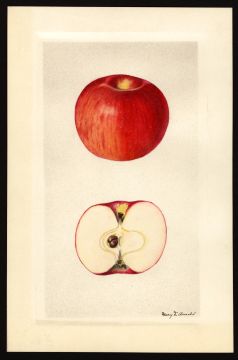
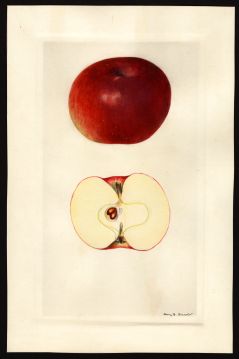
Large, oblong; bright red, with darker red stripes; very handsome and of fair quality, slightly better than Ben Davis; tree not quite so hardy. A good grower and an early and immense bearer; for years past we have not failed to find apples on trees in nursery rows, only two years from graft, the earliest bearer known to us among apples. Should be the first to be planted on any farm where there are no apples. Also a very profitable market sort. Dec. to April. Read the full entry: Missouri Pippin on the Variety Finder for deeper history, every book quote, and all nursery catalog references.
Quick Facts
| Type | Apple |
| Season | Late (Very late fall to winter (late harvest)) |
| Flavor | subacid, brisk |
| Flavor notes | Pleasant, mild flavor; good for fresh eating |
| Uses | fresh eating, cooking |
| Keeping quality | Excellent |
| Size | Large |
| Shape | Round |
| Skin color | red, yellow, green, striped |
| Flesh | White medium |
| Origin | Johnson County, Missouri, USA, c. 1854. Johnson County, Missouri, USA; grown by Brinkley Hornsby in 1854 from seeds brought from the East |
Synonyms
Aberdeen, Accidental, Alleghany, Big Hill, Buckman's Red, Carolina Spice, Chaltram Pippin, Chatham Pippin, Cheatan Pippin, Cheataw, Edward Shantee, Edward Shanty, Forsyth's Seedling, Gowden, Graham's Red Warrior, Hollman, Jackson Red, Jackson's Red, Leanham, Missouri, Missouri Keeper, Missouri Orange, Missouri Red, Mobbs, Pound, Red Hazel, Red Pippin, Red Warrior, Ruckman's Red, Summerour, Trenham, Walb, Wall, Wander, Winter Horse, Winter Rose, World's Wonder
Origin and History
Said to have originated on the farm of Brinkley (also given as "Brink") Hornsby, Kingsville, Johnson County, Missouri, from seed planted about 1840 (Beach, Lowther, Hedrick; Downing gives simply "Johnson County, Mo."; Budd-Hansen gives "Johnson Co., Missouri"). Shortly after the Civil War it began to be disseminated outside of the locality of its origin, and its cultivation spread with such rapidity that in a very few years it was being extensively planted in Missouri, Kansas, Illinois and adjacent states. The good degree of hardiness and vigor which it possesses, the ease with which it is propagated in the nursery, and particularly its habit of bearing early and abundantly were the qualities which recommended it to the fruit growers of that region. During the early years of fruit production in the prairie sections of that country this variety was more often seen than any other.
As the trees became older it was found that they were inclined to overbear, with the result that frequently a large percentage of the fruit failed to attain good marketable size. Missouri Pippin then began to wane in popularity; by Beach's time (1905) it was used chiefly as a filler for planting between the rows of permanent trees, and Lowther (1914) reports that at that date comparatively few of this variety were being planted. Hedrick (1922) notes it remained one of the standard commercial apples in Missouri and neighboring states, prized for attractive appearance and long keeping quality in the fruit, and earliness, reliability, and heavy bearing in the trees, but that the variety fails in the North and East. Beach reports it was not grown in New York so far as he could discover, and doubted the fruit would commonly develop to good marketable size there even in the southeastern part of the state. There has been some complaint of its scalding in storage (Beach, citing Beach and Clark, N.Y. Sta. Bul. 248), but this fault does not appear to be serious enough to affect materially its popularity. It is regarded with favor by fruit dealers because of its attractive appearance and good keeping quality.
Fruit
Size. Medium to large (Downing); medium in size (Beach, Lowther, Hedrick). On old trees inclined to be rather too small for market.
Form. Roundish oblate, slightly oblique, somewhat flattened at the ends (Downing); roundish, somewhat inclined to conic (Beach, Lowther); round-conic (Hedrick).
Stem. Short, small (Downing); medium in length, rather slender (Beach, Lowther, Hedrick).
Cavity. Large, deep (Downing); acute to nearly acuminate, moderately wide, rather deep, faintly russeted (Beach, Lowther); acute, wide, deep, faintly russeted (Hedrick).
Calyx. Closed, or half open (Downing); medium in size, closed or nearly so, with lobes moderately long, rather narrow (Beach); medium in size, closed or nearly so (Lowther); closed or nearly so, with lobes long, narrow (Hedrick). Budd-Hansen (fragmentary text) gives "open; segments short, erect convergent."
Basin. Rather abrupt, deep, slightly corrugated (Downing); medium to deep, rather wide, abrupt, usually somewhat wrinkled (Beach); medium to deep, wide, abrupt, wrinkled (Hedrick).
Skin. Pale whitish yellow, shaded, striped and splashed with light and dark red, often quite dark in the sun, having many large and small light and gray dots (Downing). Thick, tough, smooth, rather glossy, thinly coated with grayish bloom; color pale greenish or yellow overspread with bright red striped with purplish red; highly colored specimens are almost of a solid red color; dots conspicuous, russet, or rather large, pale gray (Beach). Thick, tough, rather glossy, thinly coated with grayish bloom; color ranges from a greenish or pale yellow, to red striped and deep red (Lowther). Thick, tough, smooth, glossy, thinly coated with bloom; color pale yellow overspread with bright red, striped with dark red, highly colored specimens almost solid red; dots conspicuous, russet, or large, pale gray (Hedrick).
Flesh / Flavor. Whitish, a little coarse, crisp or breaking, moderately juicy, subacid; good (Downing). Tinged somewhat with yellow, firm, medium to rather fine-grained, not very tender, not very juicy, briskly subacid, fair to good in quality (Beach). White, pleasant subacid, good (Budd-Hansen). Yellow, firm, fine-grained, brisk subacid; fair to good in quality (Hedrick). Overall quality only second-rate (Beach, Hedrick); the fruit is not first-class for dessert (Lowther).
Core / Seeds. Core small (Downing, Beach, Hedrick), axile or nearly so; cells symmetrical, slightly open (Beach) / open (Hedrick); core lines clasping. Calyx tube funnel-form with wide limb, sometimes broadly conical; stamens median. Carpels smooth, roundish elliptical to slightly obovate, sometimes emarginate (Beach); round-elliptical, sometimes emarginate (Hedrick). Seeds medium to rather small, moderately long and wide, slightly obtuse, dark brown (Beach); small, obtuse, dark brown (Hedrick). Budd-Hansen (fragmentary): "Core closed; cells round, slit; tube funnel-shaped; stamens median; seeds plump."
Season
January to April (Downing). October to January (Lowther, Hedrick). Beach: in common storage October to January; in cold storage January to April. Budd-Hansen: winter.
Uses
A well-known market apple of the Middle West / middle states, grown chiefly for commercial sale on the strength of its attractive appearance and good keeping quality; only second-rate in quality and not first-class for dessert. In its waning period, used chiefly as a filler for planting between the rows of permanent trees.
Illustrations
-
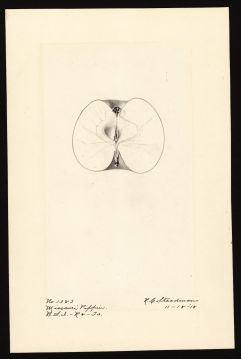 USDA Pomological Watercolor of Missouri Pippin
 -
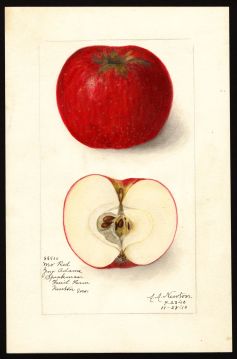 USDA Pomological Watercolor of Missouri Pippin
 -
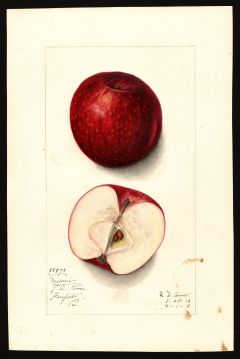 USDA Pomological Watercolor of Missouri Pippin
 -
 USDA Pomological Watercolor of Missouri Pippin
 -
 USDA Pomological Watercolor of Missouri Pippin
 -
 USDA Pomological Watercolor of Missouri Pippin
 -
 USDA Pomological Watercolor of Missouri Pippin
 -
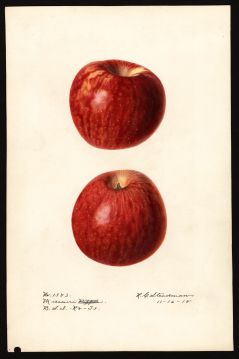 USDA Pomological Watercolor of Missouri Pippin
 -
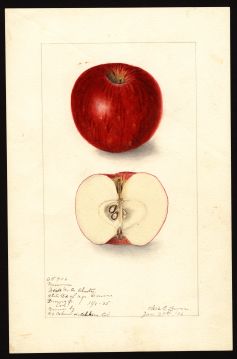 USDA Pomological Watercolor of Missouri Pippin
 -
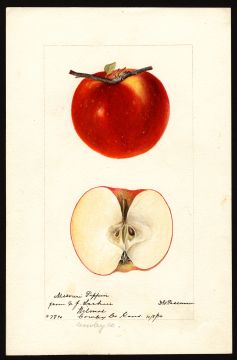 USDA Pomological Watercolor of Missouri Pippin
 -
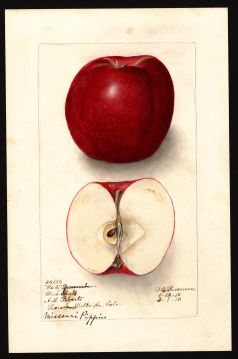 USDA Pomological Watercolor of Missouri Pippin
 -
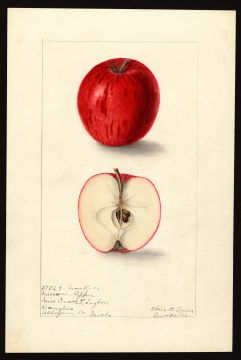 USDA Pomological Watercolor of Missouri Pippin
 -
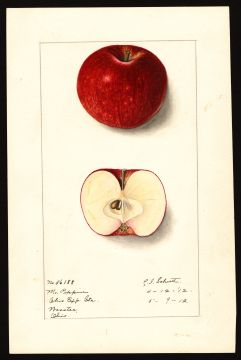 USDA Pomological Watercolor of Missouri Pippin
 -
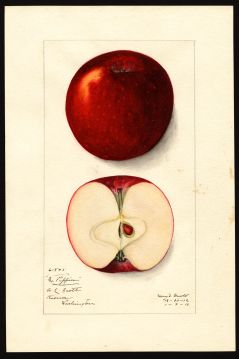 USDA Pomological Watercolor of Missouri Pippin


U.S. Department of Agriculture Pomological Watercolor Collection. Rare and Special Collections, National Agricultural Library, Beltsville, MD 20705
USDA Bulletin 56 Notes
USDA name: Aberdeen
USDA citations: IllB45
- Not Nickajack, of which Aberdeen is a synonym.
Sources
- J.L. Budd & N.E. Hansen, American Horticultural Manual, Part II: Systematic Pomology (1914). Public domain.
- S.A. Beach, The Apples of New York Vol. 1 (1905). Public domain.
- A.J. Downing, Fruits and Fruit Trees of America (1869). Public domain.
- Granville Lowther (ed.), Encyclopedia of Practical Horticulture (1914). Public domain.
- U.P. Hedrick, Cyclopedia of Hardy Fruits (1922). Public domain.
- 31 historical nursery catalog references (see Variety Finder for the full list).
- Full entry with all citations: Missouri Pippin on the Variety Finder
Trees of this Variety in Our Collection
| Orchard | Tag | Condition | |
|---|---|---|---|
| McCoin Lower Tree 72 | McCoin Lower | 72 | good |