Missouri Pippin
Apple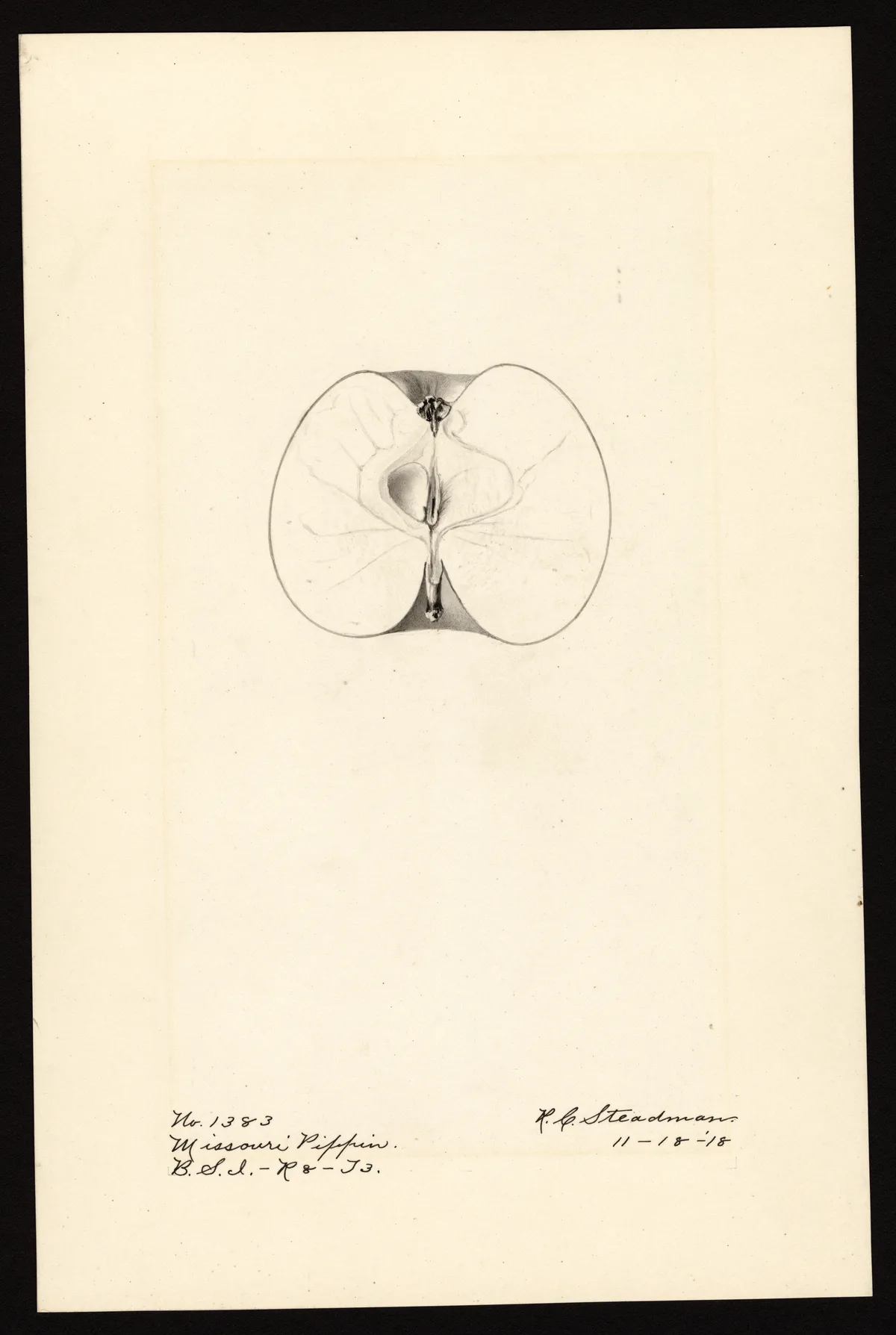
USDA Pomological Watercolor Collection
Missouri Pippin
Origin/History
Missouri Pippin is said to have originated on the farm of Brinkley Hornsby (also given as "Brink Hornsby"), Kingsville, Johnson County, Missouri, from seed planted about 1840. Warder (1867) lists the origin as unknown, with his specimens supplied by Norman J. Colman, Esq., editor of the Rural World, St. Louis, Missouri.
Shortly after the Civil War the variety began to be disseminated outside of the locality of its origin, and its cultivation spread with such rapidity that in a very few years it was being extensively planted in Missouri, Kansas, Illinois, and adjacent states. During the early years of fruit production in the prairie sections of that country, this variety was more often seen than any other. The qualities which recommended it to fruit growers of that region were its good degree of hardiness and vigor, the ease with which it is propagated in the nursery, and particularly its habit of bearing early and abundantly.
As the trees became older it was found that they were inclined to overbear, with the result that frequently a large percentage of the fruit failed to attain good marketable size. Missouri Pippin then began to wane in popularity, and by Beach's time (1905) was used chiefly as a filler for planting between the rows of permanent trees. Lowther (1914) notes that when commercial fruit growing came to be an important industry, it was found unprofitable compared with other commercial fruits, and that comparatively few were being planted by that date. Hedrick (1922) records that the variety fails in the North and East but remained one of the standard commercial apples in Missouri and neighboring states. Beach reports that, so far as he could discover, it was not grown in New York, and doubted whether its fruit would commonly develop there to good marketable size even in the southeastern part of the state.
Fruit dealers regarded it with favor because of its attractive appearance and good keeping quality. There was some complaint of its scalding in storage (Beach citing Beach and Clark, N.Y. Sta. Bul., 248:132, 1904), but this fault did not appear to be serious enough to materially affect its popularity.
Tree
Tree hardy (Downing); moderately vigorous (Beach, Lowther) to vigorous (Hedrick); a strong grower (Downing, Budd-Hansen). Central Experimental Farm (1900), reporting on trees planted Spring 1894 at Agassiz BC, describes the tree as a medium grower. An early and abundant annual bearer (Downing); heavy annual bearer (Budd-Hansen); reliable and heavy cropper that comes into bearing at an early age (Beach). Short-lived in the Mississippi valley; in orchards more than twenty years old it is seldom profitable (Beach); the tree would seldom bear a good quality of fruit after the age of 20 years (Lowther).
Form upright, becoming roundish or rather spreading (Beach, Lowther); strong upright, rather spreading grower (Downing); upright-spreading (Hedrick). Branches long, slender, curved. Characteristic on account of its numerous, slender twigs and general crab-like appearance (Beach, Lowther, Hedrick).
Twigs moderately long, straight, slender; internodes short. Bark dark brown, mottled with heavy scarf-skin, pubescent. Lenticels scattering, medium, oval to oblong, raised. Buds deeply set, small, plump, obtuse, appressed, slightly pubescent.
Fruit
Size
Medium to small (Warder); medium to large (Downing); medium (Budd-Hansen, Beach, Lowther, Hedrick, Central Experimental Farm). On old trees the fruit is inclined to be rather too small for market (Beach).
Form
Round, irregular (Warder); roundish oblate, slightly oblique, somewhat flattened at the ends (Downing); roundish oblate, somewhat conical (Budd-Hansen); roundish, oblate (Central Experimental Farm); roundish, somewhat inclined to conic (Beach, Lowther); round-conic (Hedrick).
Stem
Medium to short, knobby, thick (Warder); short, small (Downing); short (Budd-Hansen); medium in length, rather slender (Beach, Lowther, Hedrick).
Cavity
Narrow, regular (Warder); large, deep (Downing); deep, regular, acute (Budd-Hansen); acute to nearly acuminate, moderately wide, rather deep, faintly russeted (Beach, Lowther); acute, wide, deep, faintly russeted (Hedrick).
Calyx
Eye small, closed (Warder); closed, or half open (Downing); half open; segments divergent (Budd-Hansen); medium in size, closed or nearly so; lobes moderately long, rather narrow (Beach); medium in size, closed or nearly so (Lowther); closed or nearly so; lobes long, narrow (Hedrick). Calyx tube funnel-form with wide limb, sometimes broadly conical (Beach); tube funnel-shaped (Budd-Hansen); calyx-tube funnel-form with wide limb, sometimes broadly conical (Hedrick). Stamens median (Beach, Budd-Hansen, Hedrick).
Basin
Abrupt, regular (Warder); rather abrupt, deep, slightly corrugated (Downing); abrupt, deep, nearly smooth (Budd-Hansen); medium to deep, rather wide, abrupt, usually somewhat wrinkled (Beach); medium to deep, wide, abrupt, wrinkled (Hedrick).
Skin
Surface smooth, shaded, mixed, striped red (Warder). Pale whitish yellow, shaded, striped and splashed with light and dark red, often quite dark in the sun, having many large and small light and gray dots (Downing). Yellow, mostly covered with light and dark distinct crimson stripes and splashes (Budd-Hansen). Greenish yellow, striped and splashed with light and dark red, with a few gray dots (Central Experimental Farm). Skin thick, tough, smooth, rather glossy, thinly coated with grayish bloom; color pale greenish or yellow overspread with bright red striped with purplish red; highly colored specimens are almost of a solid red color (Beach). The color ranges from a greenish or pale yellow to red striped and deep red (Lowther). Skin thick, tough, smooth, glossy, thinly coated with bloom; color pale yellow overspread with bright red, striped with dark red, highly colored specimens almost solid red (Hedrick).
Dots
Numerous, large, white, distinct (Warder); many large and small light and gray dots (Downing); distinct, white and gray, numerous, large and small (Budd-Hansen); conspicuous, russet, or rather large, pale gray (Beach); conspicuous, russet, or large, pale gray (Hedrick); a few gray dots (Central Experimental Farm).
Flesh and Flavor
Yellow, breaking, tender, fine-grained, juicy; flavor sub-acid; quality good to very good (Warder). Whitish, a little coarse, crisp or breaking, moderately juicy, subacid; good (Downing). Yellow, with yellowish veinings, pleasant subacid, good (Budd-Hansen). Whitish, juicy, firm, pleasant, quality good (Central Experimental Farm). Tinged somewhat with yellow, firm, medium to rather fine-grained, not very tender, not very juicy, briskly subacid, fair to good in quality (Beach). Yellow, firm, fine-grained, brisk subacid; fair to good in quality (Hedrick). The fruit is of good color but only second rate in quality (Beach); not first-class for dessert (Lowther); but second-rate in quality (Hedrick).
Core and Seeds
Core regular, closed; seeds numerous, long, plump, angular (Warder). Core small (Downing). Core small, closed; cells round, entire; seeds short, plump (Budd-Hansen). Core small, axile, or nearly so; cells symmetrical, slightly open; core lines clasping; carpels smooth, roundish elliptical to slightly obovate, sometimes emarginate; seeds medium to rather small, moderately long and wide, slightly obtuse, dark brown (Beach). Core small, axile, or nearly so; cells symmetrical, open; core-lines clasping; carpels smooth, round-elliptical, sometimes emarginate; seeds small, obtuse, dark brown (Hedrick).
Season
January to July (Warder); January, April (Downing); January to April (Budd-Hansen); October to January (Lowther, Hedrick); early Winter (Central Experimental Farm). Beach distinguishes: in common storage October to January; in cold storage January to April. Warder notes that specimens cut and described on the 25th of June were in perfect condition. Long keeping quality is repeatedly cited as one of the variety's commercial virtues. There has been some complaint of its scalding in storage (Beach).
Uses
Table, market, and kitchen (Warder). Regarded as a market apple — one of the well-known market apples of the Middle West (Beach); one of the standard commercial apples in Missouri and neighboring states (Hedrick). Fruit dealers favored it for its attractive appearance and good keeping quality. Not first-class for dessert (Lowther). Latterly used chiefly as a filler for planting between the rows of permanent trees (Beach).
Subtypes/Variants
Not described in source.
Other
Not described in source.
Book Sources
Described in 6 period pomological works
- Beach, The Apples of New York Vol. 1 (1905)
- Budd & Hansen, Systematic Pomology (1914)
- Downing, Fruits and Fruit Trees of America (1900)
- Lowther (ed.), Encyclopedia of Practical Horticulture (1914)
- Hedrick, Cyclopedia of Hardy Fruits (1922)
- Warder, American Pomology: Apples (1867) — listed as Missouri Keeper
USDA Nomenclature (1905)
From W.H. Ragan, Nomenclature of the Apple, USDA Bulletin No. 56
Not Nickajack, of which Aberdeen is a synonym.
Nursery Catalog Sources
Found in 31 catalogs (1891–1921) from Alabama, Illinois, Kansas, Missouri, Nebraska, Oregon, Washington
- Missouri Nursery Co. , Louisiana , Missouri — 1891
- Milwaukie-Canby Nurseries , Canby, OR (and Milwaukie, OR) — 1893
- Multnomah Nurseries , Russellville , Oregon — 1894
- The Vineland Nurseries (Kelsey & Co. , Proprietors), St. Joseph, Missouri (Office: 13th and Atchison Sts., 2 Blocks East of the Citizens St. Car Line) — 1894
- Woodburn Nurseries , Woodburn, Marion Co. , Oregon — 1894
- Stark Bros. Nurseries & Orchards Co. , Louisiana , Missouri — 1896
- J.V. Cotta (Cotta Nursery) , Carroll County , Illinois — 1898
- Stark Bros. Nurseries & Orchards Co. , Louisiana , Missouri — 1898
- Alabama Nursery Co. , Huntsville , Alabama — 1900
- Central Experimental Farm , Dominion Department of Agriculture, Agassiz, British Columbia (under test; Bulletin No. 3, Second Series) — 1900
- Washington Nursery Co. , Toppenish , Washington — 1901
- Benjamin Buckman (personal inventory) , Farmingdale , Illinois — 1901
- Mountain Grove Nurseries (Tippin & Moore , Proprietors; Geo. T. Tippin, J. W. Tippin, J. C. Moore), Mountain Grove , Missouri — 1901
- Pacific Nursery Company (W. O. Hudson & A. D. Hudson) , Tangent , Oregon — 1903
- Phoenix Nursery Company (W. E. Rossney , President; Sidney Tuttle, Vice-President), Bloomington , Illinois — 1904
- The Dalles Nurseries , The Dalles , Oregon — 1906
- Stark Bros. Nurseries & Orchards Co. , Louisiana , Missouri — 1906
- Carlton Nursery Co. , Carlton , Oregon — 1909
- Milton Nursery Co. (A. Miller & Sons , Proprietors), Milton , Oregon — 1909
- Washington Nursery Company , Toppenish , Washington — 1909
- Galbraith Nursery Co. (DeWitt Hansen , Pres.-Mgr.), Fairbury , Nebraska — 1911
- Ballygreen Nurseries , Hanford , Washington — 1912
- Pacific Nursery Company , Portland , Oregon — 1912
- Vineland Nurseries Company , Clarkston , Washington — 1912
- Washington Nursery Company , Toppenish , Washington — 1912
- Benjamin Buckman (personal inventory) , Farmingdale , Illinois — 1913
- Union Nurseries , J.B. Weaver & Sons, Union , Oregon — 1915
- Holsinger Bros. Nurseries (Holsinger Brothers Nursery) , Rosedale , Kansas — 1916
- Oregon Nursery Co. , Orenco , Oregon — 1920
- Benedict Nursery Co. , Portland , Oregon — 1921
- North-Western Nurseries , Walla Walla , Washington
View original book sources (7)
— John A. Warder, American Pomology: Apples (1867)Missouri Keeper*.
Specimens from Norman J. Colman, Esq., Editor of the Rural World, St. Louis, Missouri. Origin unknown.
Fruit medium to small, round, irregular; Surface smooth, shaded, mixed, striped red; Dots numerous, large, white, distinct.
Basin abrupt, regular; Eye small, closed.
Cavity narrow, regular; Stem medium to short, knobby, thick.
Core regular, closed; Seeds numerous, long, plump, angular; Flesh yellow, breaking, tender, fine-grained, juicy; Flavor sub-acid; Quality good to very good; Use, table, market and kitchen; Season, January to July.
Specimens cut and described on the 25th of June were in perfect condition.
— A.J. Downing, The Fruits and Fruit Trees of America (1900)Missouri Pippin.
Missouri Keeper.
It is said to have originated in the orchard of Brink Hornsby, Johnson County, Mo. Tree hardy, a strong upright, rather spreading grower, an early and abundant annual bearer.
Fruit medium to large, roundish oblate, slightly oblique, somewhat flattened at the ends; skin pale whitish yellow, shaded, striped and splashed with light and dark red, often quite dark in the sun, having many large and small light and gray dots; stalk short, small; cavity large, deep; calyx closed, or half open; basin rather abrupt, deep, slightly corrugated; flesh whitish, a little coarse, crisp or breaking, moderately juicy, subacid; good; core small. January, April.
— S.A. Beach, The Apples of New York, Vol. 1 (1905)MISSOURI PIPPIN.
References. 1. Warder, 1867:656. 2. Downing, 1872:23 app. 3. Am. Pom. Soc. Cat., 1881:12. 4. Brackett, Am. Pom. Soc. Rpt., 1881:145. 5. Barry, 1883:349. 6. Thomas, 1885:518. 7. Coleman, Am. Pom. Soc. Rpt., 1885:28. 8. Bailey, Am. Hort., 1892:244. 9. Wright, Am. Gard., 17:33. 1896. 10. Powell, Del. Sta. Bul., 38:19. 1898. 11. Macoun, Can. Dept. Agr. Rpt., 1901:97. 12. Dickens and Greene, Kan. Sta. Bul., 106:54. 1902. 13. Budd-Hansen, 1903:130. fig. 14. Bruner, N. C. Sta. Bul., 182:27. 1903. 15. Powell and Fulton, U. S. B. P. I. Bul., 48:49. 1903. 16. Beach and Clark, N. Y. Sta. Bul., 248:132. 1904.
Synonyms. Missouri (15). Missouri Keeper (1). Missouri Keeper (2, 3, 4, 5). Missouri Orange (4). Missouri Pippin (2, 3, 4, 5, 6, 7, 8, 9, 10, 11, 12, 14). Missouri Pippin (15).
This is one of the well-known market apples of the Middle West. As grown in that region the tree is short-lived, and in the Mississippi valley in orchards more than twenty years old it is seldom profitable, but it comes into bearing at an early age and is a reliable and heavy cropper. The fruit is of good color but only second rate in quality, and on old trees is inclined to be rather too small for market. It is regarded with favor by fruit dealers because of its attractive appearance and good keeping quality. There has been some complaint of its scalding in storage (16), but this fault does not appear to be serious enough to affect materially its popularity. So far as we have been able to discover it is not grown in New York. It is quite doubtful whether its fruit would commonly develop here to good marketable size even if grown in the southeastern part of New York, where the climatic and soil conditions are more favorable to varieties of this class than they are in the more northern and western portions of the state.
Historical. The Missouri Pippin is supposed to have originated on the farm of Brinkley Hornsby, Kingsville, Johnson county, Missouri, from seed planted about 1840 (2, 4, 7). Shortly after the Civil War it began to be disseminated outside of the locality of its origin and its cultivation spread with such rapidity that in a very few years it was being extensively planted in Missouri, Kansas, Illinois and adjacent states. The good degree of hardiness and vigor which it possesses, the ease with which it is propagated in the nursery, and particularly its habit of bearing early and abundantly were the qualities which recommended it to the fruit growers of that region. During the early years of fruit production in the prairie sections of that country this variety was more often seen than any other. As the trees became older it was found that they were inclined to overbear with a result that frequently a large percentage of the fruit failed to attain good marketable size. Then Missouri Pippin began to wane in popularity and to-day it is used chiefly as a filler for planting between the rows of permanent trees.
Tree. Tree moderately vigorous with long, slender, curved branches, characteristic on account of its numerous, slender twigs and general crab-like appearance. Form upright becoming roundish or spreading. Twigs moderately long, straight, slender; internodes short. Bark dark brown, mottled with heavy scarf-skin, pubescent. Lenticels scattering, medium, oval to oblong, raised. Buds deeply set, small, plump, obtuse, appressed, slightly pubescent.
Fruit. Fruit medium in size. Form roundish, somewhat inclined to conic. Stem medium in length, rather slender. Cavity acute to nearly acuminate, moderately wide, rather deep, faintly russeted. Calyx medium in size, closed or nearly so; lobes moderately long, rather narrow. Basin medium to deep, rather wide, abrupt, usually somewhat wrinkled.
Skin thick, tough, smooth, rather glossy, thinly coated with grayish bloom; color pale greenish or yellow overspread with bright red striped with purplish red. Highly colored specimens are almost of a solid red color. Dots conspicuous, russet, or rather large, pale gray.
Calyx tube funnel-form with wide limb, sometimes broadly conical. Stamens median.
Core small, axile, or nearly so; cells symmetrical, slightly open; core lines clasping. Carpels smooth, roundish elliptical to slightly obovate, sometimes emarginate. Seeds medium to rather small, moderately long and wide, slightly obtuse, dark brown.
Flesh tinged somewhat with yellow, firm, medium to rather fine-grained, not very tender, not very juicy, briskly subacid, fair to good in quality.
Season in common storage October to January; in cold storage January to April.
— J.L. Budd & N.E. Hansen, American Horticultural Manual, Part II: Systematic Pomology (1914)Missouri Pippin. — Origin, Johnson Co., Missouri; tree strong grower and heavy annual bearer.
Fruit medium; form roundish oblate, somewhat conical; surface yellow, mostly covered with light and dark distinct crimson stripes and splashes; dots distinct, white and gray, numerous, large and small; cavity deep, regular, acute; stem short; basin abrupt, deep, nearly smooth; calyx half open; segments divergent. Core small, closed; cells round, entire; tube funnel-shaped; stamens median; seeds short, plump; flesh yellow, with yellowish veinings, pleasant subacid, good. January to April.
— Granville Lowther (ed.), Encyclopedia of Practical Horticulture (1914)Missouri Pippin
The Missouri Pippin is one of the well known market apples in the middle states. It originated in Missouri on the farm of Brinkley Hornsby, Kingsville, Johnson county, Missouri, from seed planted about 1840. Shortly after the Civil War it began to be disseminated outside of the locality of its origin, and its cultivation spread with such rapidity that in a few years it had been planted in Missouri, Kansas, Illinois and adjacent states. The good degree of hardiness and vigor which it possesses, the ease with which it is propagated in the nursery, and particularly the habit of bearing early and abundantly, were the qualities which recommended it to the growers of this section. However, the fruit is not first-class for dessert, and when commercial fruit growing came to be an important industry it was found that it was not a profitable variety as compared with other commercial fruits. It was also discovered that the tree was short lived, and would seldom bear a good quality of fruit after the age of 20 years. The popularity of the Missouri Pippin, therefore, rapidly waned, and at this date comparatively few of this variety are being planted.
Tree moderately vigorous with long, slender, curved branches, characteristic on account of its numerous slender twigs and general crab-like appearance. Form upright, becoming roundish or rather spreading. Bark dark brown, mottled with heavy scarf skin, pubescent. Fruit medium in size. Form roundish, somewhat inclined to conic. Stem medium in length, rather slender. Cavity acute to nearly acuminate, moderately wide, rather deep, faintly russeted. Calyx medium in size, closed or nearly so. Skin thick, tough, rather glossy, thinly coated with grayish bloom. The color ranges from a greenish or pale yellow, to red striped and deep red. Season October to January.
— U.P. Hedrick, Cyclopedia of Hardy Fruits (1922)MISSOURI PIPPIN. Missouri Orange. Missouri Keeper. Missouri Pippin is one of the standard commercial apples in Missouri and neighboring states. The qualities which give it standing are: attractive appearance and long keeping quality in the fruit, and earliness, reliability, and heavy bearing in the trees. The apples are, however, but second-rate in quality and the trees are usually short-lived. The variety fails in the North and East. Missouri Pippin is said to have originated on the farm of Brinkley Hornsby, Kingsville, Missouri, from seed planted about 1840. Tree vigorous, upright-spreading, with long, slender, curved branches, characteristic on account of its numerous, slender twigs. Fruit medium in size, round-conic ; stem medium in length, slender ; cavity acute, wide, deep, faintly russeted ; calyx closed or nearly so ; lobes long, narrow ; basin medium to deep, wide, abrupt, wrinkled ; skin thick, tough, smooth, glossy, thinly coated with bloom ; color pale yellow overspread with bright red, striped with dark red, highly colored specimens almost solid red ; dots conspicuous, russet, or large, pale gray ; calyx-tube funnel-form with wide limb, sometimes broadly conical ; stamens median ; core small, axile, or nearly so ; cells symmetrical, open ; core-lines clasping ; carpels smooth, round-elliptical, sometimes emarginate ; seeds small, obtuse, dark brown ; flesh yellow, firm, fine-grained, brisk subacid ; fair to good in quality ; October to January.
— Central Experimental Farm, Central Experimental Farm, Agassiz BC — Catalogue of Fruit Trees under Test (Bulletin No. 3, 1900) (1900)Planted Spring 1894. Tree a medium grower. Fruit of medium size, roundish, oblate. Skin greenish yellow, striped and splashed with light and dark red, with a few gray dots. Flesh whitish, juicy, firm, pleasant, quality good. Season early Winter.