Red Astrachan
| Red Astrachan | |
|---|---|
| Species | Apple |
| Trees Found | 6 |
| Orchards | Cyrus,Cyrus Horse Camp,East Springer,McCoin Upper |
| Preserved | Clarno Arboretum(2025) |

Tree hardy, and a regular bearer. Large, roundish; nearly covered with crimson, and with an exquisite bloom on the surface of the fruit, like that of the plum; an apple of extraordinary beauty and first rate quality, ripening very early, and suitable for the table and kitchen. July and Aug. Read the full entry: Red Astrachan on the Variety Finder for deeper history, every book quote, and all nursery catalog references.
Quick Facts
| Type | Apple |
| Season | Very Early (Very early (July to early August)) |
| Flavor | sweet tart, tart, acid, brisk, aromatic |
| Flavor notes | Highly flavored; strong sweet-tart balance with high acidity; juicy, crisp |
| Uses | fresh eating, pies, sauce, drying, cider, cooking |
| Keeping quality | Very Poor |
| Size | Above Medium |
| Shape | Round |
| Skin color | red, crimson, dark, yellow, green, striped, purple, russet, light, pale |
| Flesh | White crisp |
| Origin | Astrakhan, Russia, c. 1780. Astrakhan region along the lower Volga River, Russia; early 1780s |
Synonyms
ASTRACHAN, Abe Lincoln, American Red, Anglese Pippin, Anglesea Pippin, Astracan Rouge, Astrachan, Astrachan Red, Astrachan Rouge, Astrakhan Rouge, Beauty of Wales, Carmin de Juin, Castle Leno Pippin, Deterding's Early, Deterling's Early, Duke of Devon, Hamper's American, Kaiserlicher Calvill, Red Astracan, Red Astrachan, Red Astrakhan, Roter Astrachan, Rother Astrakan, Rother Astrakhan, Rouge Hätive, Rouge d'Astracan, Rouge d'Astrachan, Vermilion d'Ete, Vermillon d'Ete, Waterloo
Fruit
Size. Medium to large (Warder; Elliott; Beach; Hedrick); pretty large, rather above the middle size (Downing); above medium (Hansen; Budd-Hansen); medium (Bunyard 1920: 2¼ by 2¼); good medium size (Beach narrative); rather large, sometimes quite large (Thomas); large (Hovey: about three inches broad and two and a half deep). Beach and Hedrick note the fruit is not very uniform in size or shape, and that a considerable amount of it is small or otherwise unmarketable.
Form. Roundish (Downing; Hovey; Hansen; Budd-Hansen), roundish oblate (Beach; Hedrick: round-oblate), oblate (Warder), roundish-oblate slightly approaching conical (Thomas), somewhat conical (Hansen; Budd-Hansen), inclined to conical (Beach), conical (Hedrick), flattened round, fairly regular (Bunyard 1920). Flattened at the base, narrowing little towards the eye (Hovey); a little narrowed towards the eye (Downing); tapering toward the apex (Elliott). Somewhat ribbed; sides a little unequal (Beach; Hedrick: ribbed, sides unequal). Regular (Warder); rather smooth, smooth (Warder; Downing; Hovey; Hansen; Budd-Hansen; Thomas: rather smooth; Hedrick: smooth).
Stem/Stalk. Long, yellow (Warder); rather short and deeply inserted (Downing); short, about half an inch in length, rather stout, straight, and moderately inserted (Hovey); varying, generally short (Elliott); short (Hansen; Budd-Hansen; Bunyard 1920); one-half to three-fourths of an inch long (Thomas); medium, rather slender, bracted (Beach); slender, bracted (Hedrick).
Cavity. Shallow, regular (Warder); narrow (Elliott); shallow, regular, obtuse, russeted (Hansen; Budd-Hansen); scaly russet cavity (Bunyard 1920); broad, rather shallow basin [at base for stem] (Hovey); acute to sometimes obtuse, medium to deep, moderately broad, often thinly russeted with greenish russet, usually symmetrical, sometimes lipped (Beach); acute, deep, broad, often russeted with greenish-russet, usually symmetrical, sometimes lipped (Hedrick).
Calyx/Eye. Eye small, closed (Warder; Hansen; Budd-Hansen: calyx small, closed). Calyx partially closed (Downing); eye rather large, partially closed, and slightly depressed (Hovey); calyx large (Elliott); calyx medium to rather large, open or closed; lobes rather long, moderately broad (Beach); calyx large, open or closed; lobes long, broad (Hedrick); eye closed (Bunyard 1920). Calyx tube long, funnel-form (Beach; Hedrick: calyx-tube long, funnel-form; Hansen, Budd-Hansen: tube funnel-shaped). Stamens median to marginal (Beach); stamens median (Hedrick); stamens marginal or median (Hansen; Budd-Hansen).
Basin. Medium, regular (Warder); slight, sometimes a little irregular (Downing); shallow, uneven (Elliott); broad, shallow, and somewhat ridged (Hovey); shallow, smooth, sometimes a little irregular (Hansen; Budd-Hansen); small, slightly uneven (Thomas); shallow (Bunyard 1920); shallow, narrow to medium in width, obtuse, wrinkled (Beach); shallow, narrow, obtuse, wrinkled (Hedrick).
Skin. Surface smooth, mottled, marbled and striped crimson on greenish-yellow; dots minute, heavy bloom (Warder). Almost entirely covered with deep crimson, with sometimes a little greenish yellow in the shade, and occasionally a little russet near the stalk, and covered with a pale white bloom (Downing). Very fair, smooth, rich brilliant crimson on the sunny side, paler in the shade, though occasionally little greenish, sometimes russeted around the stem, dotted with large yellow specks, and covered with a thin whitish bloom (Hovey). Greenish yellow, mostly overspread with rich purplish crimson, a little russet near the stem and a white bloom (Elliott). Surface smooth, greenish yellow, almost entirely covered with mottled, marbled and striped deep crimson, with delicate white bloom, a beautiful fruit; dots minute (Hansen; Budd-Hansen). Yellow, largely covered with light and dark red, presenting a striped appearance, and overspread with bluish bloom (Beach narrative). Yellowish red, some parts being a dark red, causing the apple to present a striped appearance, also overspread with a bluish bloom (Lowther). Nearly whole surface brilliant deep crimson, with a thick bloom like a plum (Thomas). Medium pale yellow with rosy cheek (Bunyard 1901). Deep crimson, unstriped (Bunyard 1920), note this conflicts with the multiple sources describing splashed/striped coloring. Skin rather thin, moderately tender, smooth, pale yellow or greenish often nearly or quite overspread with light and dark red splashed and irregularly striped with deep crimson or carmine and covered with rather heavy distinct bluish bloom; dots numerous, small, whitish (Beach). Skin thin, tender, smooth, pale yellow often overspread with light and dark red, splashed and irregularly striped with deep crimson or carmine and covered with heavy bloom; dots numerous, white (Hedrick). The bloom is repeatedly compared to that of a plum (Downing; Hovey; Thomas), and Hovey emphasizes "the peculiar abruptness of the coloring from the sunny to the shaded side."
Flesh and Flavor. Yellow, breaking, juicy; flavor quite acid, not rich (Warder). Quite white, crisp, moderately juicy, with an agreeable, rich, acid flavor; good to very good (Downing). White, with occasional stains of pink, fine, crisp, and tender; juice tolerably abundant, subacid and good (Hovey). White, crisp, juicy, acid (Elliott). White, crisp, juicy, brisk acid, good (Hansen; Budd-Hansen). White, rather crisp; good, rather acid, slightly austere (Thomas). Crisp, white, sweet (Bunyard 1920), note the "sweet" descriptor conflicts with the brisk subacid/acid character given by all other sources. White often strongly tinged with red, rather fine, crisp, tender, juicy, brisk subacid, aromatic, sometimes slightly astringent, good to very good (Beach). White often tinged with red, fine, crisp, tender, juicy, brisk subacid, aromatic, sometimes astringent; good to very good (Hedrick).
Quality assessments: First rate for market and cooking, poor for table (Warder); rather acid as a dessert fruit unless fully ripe, but for marketing or cooking it has few equals at its time (Elliott); excellent for cooking, "of second-rate flavor, because of its earliness and very handsome and fair appearance" (Thomas); not very flavory, good for stewing (Bunyard 1901); fit for cooking long before maturity, and when fully ripe, fair for dessert (Hedrick); fit for culinary purposes before becoming fully ripe, desirable for dessert use when fully ripe and mellow (Beach); "one of the handsomest dessert fruits, and its quality is good, but if not taken from the tree as soon as ripe it is liable to become mealy" (Downing); Hovey notes that "although not quite equalling the Early Harvest, which ripens at about the same season, it is an excellent apple, and one without which no collection can be complete," and adds that "the fruit should be gathered as soon as ripe, for, if allowed to hang upon the tree, it soon becomes mealy."
Core and Seeds. Core regular, closed; seeds angular, small, dark (Warder). Core small (Elliott); core large, rather close (Hovey); core small, somewhat abaxile; cells closed or somewhat open; core lines clasping or sometimes nearly meeting; carpels broadly ovate or obovate, slightly tufted; seeds small, moderately wide, plump, obtuse (Beach). Core small, abaxile; cells closed or open; core-lines clasping; carpels broadly ovate, tufted; seeds small, wide, plump, obtuse (Hedrick). Core closed, barely clasping; cells open, obovate; seeds many, angular, plump, small (Hansen; Budd-Hansen). Seeds ovate, dark brownish black (Elliott); seeds small, ovate (Hovey).
Season
July (Warder); ripens from last of July to middle of August (Downing); ripe from the middle of August to the beginning of September (Hovey); August (Elliott); a few days after Early Harvest (Thomas); late July, early August (Hansen; Budd-Hansen); season Aug–Sept (Bunyard 1901); early August (Bunyard 1920); late July to September (Beach; Hedrick). For home use the season runs from late July to September because the fruit is fit for culinary purposes before it becomes fully ripe (Beach; Lowther). The crop matures unevenly, so to save the fruit it is important to give several pickings (Beach; Lowther). The fruit hangs to the tree pretty well until fully ripe, but unless picked promptly tends to drop and to become mealy (Beach; Downing; Hovey).
Uses
Excellent for cooking and culinary purposes (Warder; Elliott; Thomas; Hedrick; Beach; Lowther; Bunyard 1901: good for stewing). Fair to good for dessert when fully ripe and mellow (Downing; Beach: desirable for dessert use when fully ripe; Hedrick: fair for dessert when fully ripe; Hovey: an excellent apple, almost rivaling Early Harvest at the same season). Poor for table use (Warder). Especially valued for home use; not well adapted for shipping to distant markets because the fruit is very perishable; very common in local markets, where supply often exceeds demand and prices are low (Beach; Lowther; Hedrick: cannot be handled or stored, so has small place as a market fruit). One of the handsomest dessert fruits, Downing calls it "a fruit of extraordinary beauty"; Hovey says it would "bear off the palm" for beauty alone among the great number of varieties.
Illustrations
-
 USDA Pomological Watercolor by Newton, Amanda Almira (Missoula, Missoula, Montana)
 -
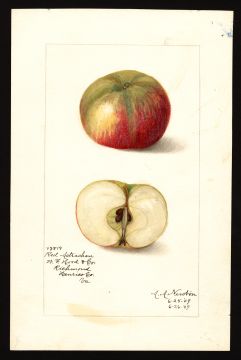 USDA Pomological Watercolor by Newton, Amanda Almira (Richmond, Virginia)
 -
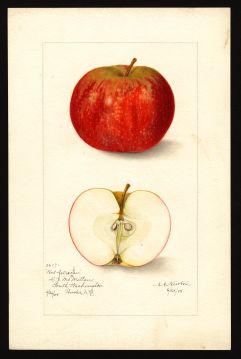 USDA Pomological Watercolor by Newton, Amanda Almira (Watha, Pender, North Carolina)
 -
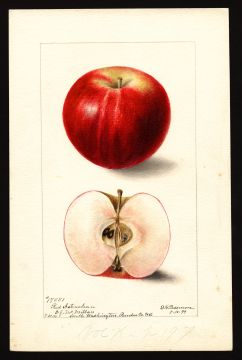 USDA Pomological Watercolor by Passmore, Deborah Griscom (Watha, Pender, North Carolina)
 -
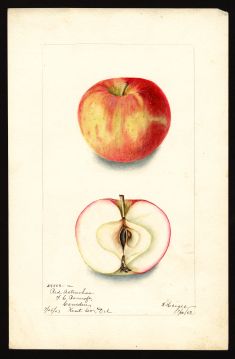 USDA Pomological Watercolor by Heiges, Bertha (Camden, Kent, Delaware)
 -
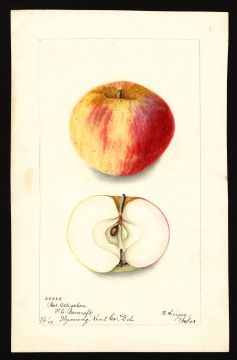 USDA Pomological Watercolor by Heiges, Bertha (Wyoming, Kent, Delaware)
 -
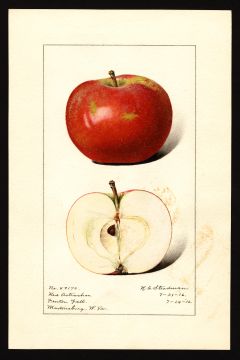 USDA Pomological Watercolor by Steadman, Royal Charles (Martinsburg, Berkeley, West Virginia)


U.S. Department of Agriculture Pomological Watercolor Collection. Rare and Special Collections, National Agricultural Library, Beltsville, MD 20705
Sources
- S.A. Beach, The Apples of New York Vol. 2 (1905). Public domain.
- John A. Warder, American Pomology: Apples (1867). Public domain.
- J.L. Budd & N.E. Hansen, American Horticultural Manual, Part II: Systematic Pomology (1914). Public domain.
- A.J. Downing, Fruits and Fruit Trees of America (1869). Public domain.
- F.R. Elliott, The Western Fruit Book (1865). Public domain.
- U.P. Hedrick, Cyclopedia of Hardy Fruits (1922). Public domain.
- Woolhope Naturalists' Field Club, The Herefordshire Pomona (1876–1885). Public domain.
- John J. Thomas, The American Fruit Culturist (1903). Public domain.
- Granville Lowther (ed.), Encyclopedia of Practical Horticulture (1914). Public domain.
- N.E. Hansen, A Study of Northwestern Apples (South Dakota Ag. Exp. Station Bulletin 76, 1902). Public domain.
- E.A. Bunyard, A Handbook of Hardy Fruits (1920). Public domain.
- H.H. Fisher, A Survey of Apple Clones in the United States (USDA ARS, 1963). Public domain.
- C.M. Hovey, The Fruits of America (1852). Public domain.
- USDA Pomological Watercolor Collection, U.S. National Agricultural Library.
- 72 historical nursery catalog references (see Variety Finder for the full list).
- Full entry with all citations: Red Astrachan on the Variety Finder