American Pippin
Apple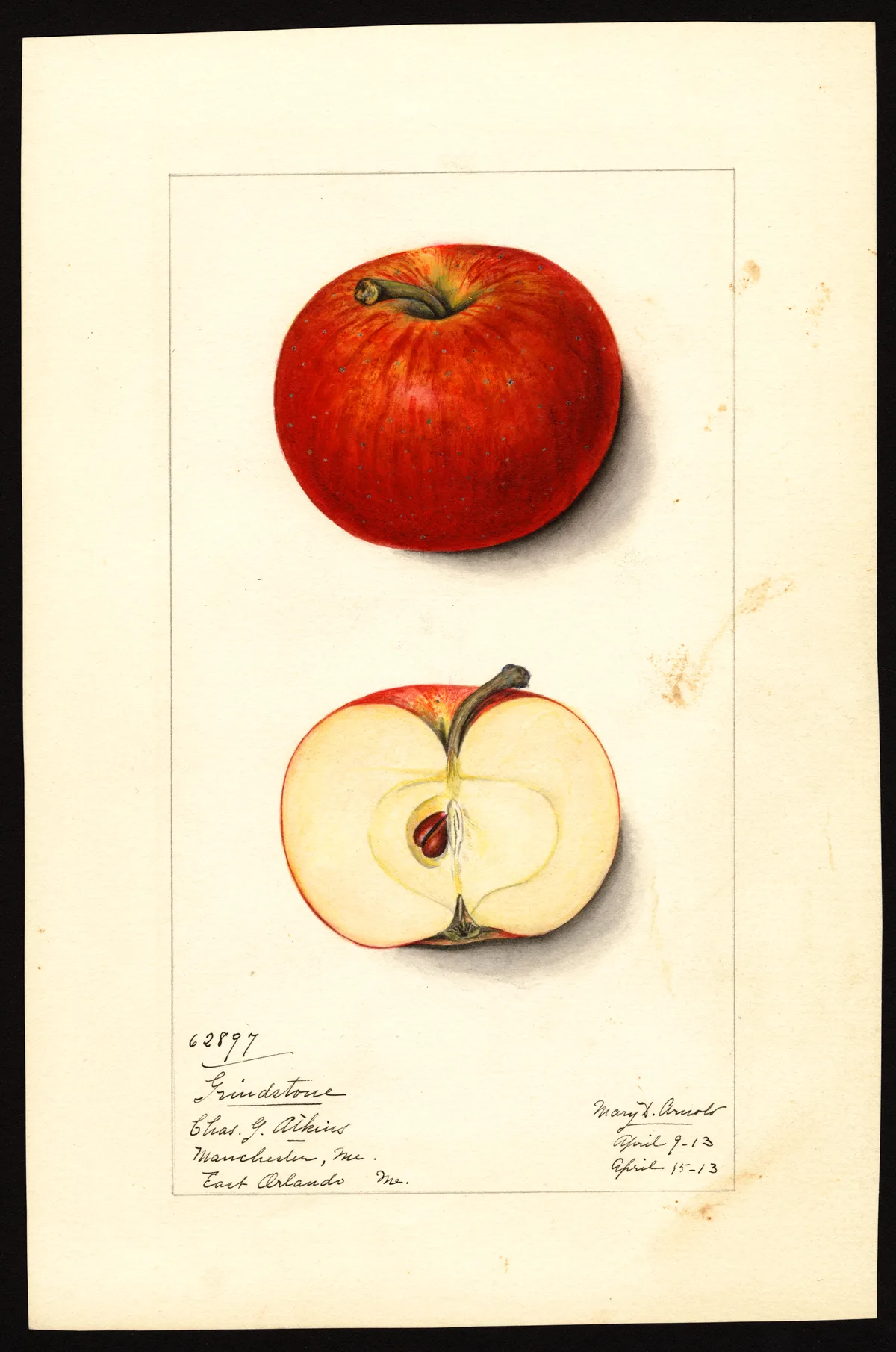
USDA Pomological Watercolor Collection
Editor's Note
American Pippin
Origin / History
American Pippin is an old variety, first documented in Coxe's 1817 A View of the Cultivation of Fruit Trees (No. 82), where it was already in very high reputation both for cider and for late keeping. Beach (1905) catalogs references stretching from Coxe (1817) through Downing (1845), Thomas (1849), Emmons (1851), Hooper (1857), Elliott (1859), Warder (1867), Downing (1872), Lyon (1890), Bailey (1892), and Thomas (1903), confirming its long-standing place in American pomological literature. Coxe reports having been informed by "an intelligent and experienced farmer" that fourteen bushels of this apple were required for a barrel of cider — a figure Warder repeats. The Central Experimental Farm at Agassiz, BC, planted their trees in Spring 1890 under test as Bulletin No. 3 (1900).
Beach (1905) notes that "there is a variety grown under the name of American Pippin in Northern New York and Canada which is valued on account of its hardiness and late keeping qualities," citing Macoun (Can. Dept. Agr. Bul. 37:42, 1901), who describes its fruit as large, roundish, greenish-yellow with pink or orange blush, dots not prominent, basin rather deep, calyx large and open, cavity deep, flesh yellow, subacid, good. Beach states: "I have not determined whether this is identical with the American Pippin of Coxe but it does not appear to be that variety."
Tree
Coxe describes the tree as "of a growth remarkably spreading, with hanging, crooked shoots, and very open." Warder concurs: "thrifty, with a low, spreading head and depending branches; very productive." Downing (1900) sums it as "thrifty, spreading, with crooked shoots." Warder adds that "the apples hang well to the tree, and will bear a considerable amount of freezing." The Central Experimental Farm (1900) reports the tree as "a strong grower and productive." In the season of bearing, Coxe says, it produces "abundance of sound and fair fruit."
Fruit
Size and Form: Medium (Elliott, Warder, Downing, Beach, Central Experimental Farm); Bunyard (1914) likewise calls it medium. Shape is flat / very flat / oblate, regular in form (Coxe: "flat, without any hollow at the ends"; Elliott: "roundish flattened"; Warder: "regular, very flat"; Downing: "regular form, oblate"; Beach: "regular, oblate, 'without any hollow at the ends' (Coxe)"; Central Experimental Farm: "regular form, oblate"). Bunyard (1914) gives the shape as "round."
Stem / Cavity: Coxe describes the stem as "singularly thick and fleshy." Warder gives stem as "medium, often thick and knobby." Warder describes the cavity as "regular, brown, this color extending over the base of the fruit."
Calyx / Basin / Crown: Coxe says "the crown very large." Warder describes the basin as "very shallow, wide, regular or plaited"; eye "quite small, open." Beach: "calyx small, open."
Skin: Sources broadly agree on a dull, mixed coloring of dull red over dull green, often striped, with rough surface and conspicuous dots — though some details differ.
- Coxe: "the skin a dull red, with faint yellow spots, and a portion of dull green."
- Elliott: "dull green, patches of dull red."
- Warder: "Surface rough, sometimes vein-russeted, dull green, covered with mixed red, and shaded with stripes of brick-dust color; Dots numerous, large, gray."
- Downing (1900): "dull red in patches and stripes, on a dull green ground."
- Beach (1905): "skin dull red, shaded and streaked with dull green, the surface being rough, sometimes with slight russet markings, thickly sprinkled with gray or coarse russet dots."
- Central Experimental Farm (1900): "Skin dull green, with a bronze reddish cheek."
- Bunyard (1914): "pale yellow, with red flush" — this is markedly lighter than the dull-red-on-dull-green of the American sources and may reflect the Macoun/Northern New York and Canada strain noted by Beach, or a different variety circulating under the name in England.
Flesh and Flavor: Sources agree the flesh is firm and hard, but disagree somewhat on color and juiciness.
- Coxe: "the flesh hard and white."
- Elliott: "flesh, white, firm, acid."
- Warder: "Flesh yellow, breaking, dry, very firm; Flavor mild sub-acid; Quality poor."
- Downing (1900): "Flesh white, firm, juicy, with a somewhat brisk, acid flavor. Good."
- Beach (1905): "flesh white or yellowish, hard, rather coarse, moderately juicy, mild subacid. Variously rated by pomologists from poor to good in quality."
- Central Experimental Farm (1900): "Flesh white, firm, juicy, mildly acid and of pleasant flavour."
Quality is widely contested: Warder calls it "poor," Downing rates it "Good," Beach notes pomologists rate it "from poor to good," and Lyon (quoted by Beach) says it "keeps a year, cooks well, but otherwise scarcely eatable." Warder remarks that the fruit is "dry and deficient in flavor" but is "considered profitable, because so easily kept until May and June, when it commands the highest price, because of the rarity of green fruit at that season." He adds the colorful fruitman's testimony to its ability to withstand rough usage: "that the apples might be whipped off the tree with a hoop-pole, shoveled into a cart, dumped upon the ground, and have some dirt thrown upon them, and that they would keep until next July; but, he added, they are then as good as dried apples; so lightly are they esteemed for table use." Warder also notes: "They are so firm as to suffer little from bruising, and are not disposed to rot when thus injured."
Core / Seeds: Warder: "Core wide, irregular, closed; Seeds numerous, plump, brown." Beach repeats: "core wide, irregular, closed; seeds numerous, plump, brown."
Season
A very late keeper, which is its chief recommendation. Coxe says it keeps "till very late in the spring, often till Harvest." Elliott: "January to June." Warder: keeps "until May and June," "until next July." Downing (1900): "Keeps till June." Lyon (per Beach): "keeps a year." Central Experimental Farm (1900) gives the season as "late Autumn" — at odds with the other sources, possibly reflecting climate at Agassiz, BC. Bunyard (1914) gives "Oct.-Dec." as a dessert season — also markedly earlier than the American sources, again possibly reflecting the alternative strain noted by Beach or a different apple circulating under the name in England.
Uses
Cider and late keeping are the variety's principal uses. Coxe rates its cider "nearly equal to the Grey-House," requiring fourteen bushels per barrel — a figure Warder repeats. Warder lists uses as "kitchen and market, which last means that it may be sold to those who do not appreciate the summer fruits of May and June." Lyon (per Beach): "cooks well, but otherwise scarcely eatable." Central Experimental Farm describes the flavor as "pleasant." Bunyard (1914) classifies it as "Dessert" and "A good culinary and market sort," with the parenthetical notation "(H, B.T., P.)" and the remark "entirely new to cultivation" — the latter incongruous given the variety's documented history back to Coxe (1817), again suggesting Bunyard may be describing a different apple under the same name.
Subtypes / Variants
Beach (1905) identifies what may be a distinct variety circulating in Northern New York and Canada under the name American Pippin, described by Macoun (1901) as: fruit large, roundish; greenish-yellow with pink or orange blush; dots not prominent; basin rather deep; calyx large, open; cavity deep; flesh yellow, subacid, good. Beach is explicit that he has not determined whether this is identical with Coxe's American Pippin, "but it does not appear to be that variety." The pale-yellow, red-flushed apple described by Bunyard (1914) and the late-autumn-season fruit described by Central Experimental Farm (1900) may relate to this northern strain rather than to Coxe's original.
Other
Beach (1905) summarizes the historical synonymy in the literature: Grindstone (Hooper 1857; Thomas 1849; Warder 1867; Downing 1872; Lyon 1890; Bailey 1892) and Stone (Downing 1872). Warder gives "Grindstone" as the principal alternate name in 1867; Elliott (1865) lists "Grindstone" and "Green Everlasting"; Downing (1900) gives "Stone. Grindstone." These names appear in the period literature in connection with the variety's hardness and durability.
Book Sources
Described in 5 period pomological works
Nursery Catalog Sources
Found in 4 catalogs (1894–1913) from Illinois, Oregon
- Woodburn Nurseries , Woodburn, Marion Co. , Oregon — 1894
- Central Experimental Farm , Dominion Department of Agriculture, Agassiz, British Columbia (under test; Bulletin No. 3, Second Series) — 1900
- Russellville Nursery Co. , Russellville, OR (three miles east of Portland, one mile from Montavilla car line) — 1903
- Benjamin Buckman (personal inventory) , Farmingdale , Illinois — 1913
View original book sources (7)
— William Coxe, A View of the Cultivation of Fruit Trees (1817)NO. 82. AMERICAN PIPPIN.
This apple is in very high reputation, both for cider and for keeping till very late in the spring, often till Harvest. The shape is flat, without any hollow at the ends ; the stem singularly thick and fleshy ; the crown very large, the skin a dull red, with faint yellow spots, and a portion of dull green ; the flesh hard and white ; the tree is of a growth remarkably spreading, with hanging, crooked shoots, and very open. It makes cider nearly equal to the Grey-House : I am informed by an intelligent and experienced farmer, that fourteen bushels of this apple are required for a barrel of cider. In the season of bearing, it produces abundance of sound and fair fruit.
— F.R. Elliott, The Western Fruit Book (1865)American Pippin. Grindstone, | Green Everlasting. Medium, roundish flattened, dull green, patches of dull red ; flesh, white, firm, acid. January to June.
— John A. Warder, American Pomology: Apples (1867)American Pippin.
GRINDSTONE.
This fruit is chiefly valued for keeping very late into the summer. Coxe commends it for its cider, rating it as nearly equal to the Grey-House ; he says that fourteen bushels are required to make a barrel of cider. The apples hang well to the tree, and will bear a considerable amount of freezing. They are so firm as to suffer little from bruising, and are not disposed to rot when thus injured. A fruitman once said of their ability to withstand rough usage, that the apples might be whipped off the tree with a hoop-pole, shoveled into a cart, dumped upon the ground, and have some dirt thrown upon them, and that they would keep until next July ; but, he added, they are then as good as dried apples ; so lightly are they esteemed for table use.
The tree is thrifty, with a low, spreading head and depending branches ; very productive ; notwithstanding the fruit is dry and deficient in flavor, it is considered profitable, because so easily kept until May and June, when it commands the highest price, because of the rarity of green fruit at that season.
Fruit medium, regular, very flat ; Surface rough, sometimes vein-russeted, dull green, covered with mixed red, and shaded with stripes of brick-dust color ; Dots numerous, large, gray.
Basin very shallow, wide, regular or plaited ; Eye quite small, open.
Cavity regular, brown, this color extending over the base of the fruit ; Stem medium, often thick and knobby.
Core wide, irregular, closed ; Seeds numerous, plump, brown ; Flesh yellow, breaking, dry, very firm ; Flavor mild sub-acid ; Quality poor ; Uses kitchen and market, which last means that it may be sold to those who do not appreciate the summer fruits of May and June.
— A.J. Downing, The Fruits and Fruit Trees of America (1900)American Pippin.
Stone. Grindstone.
Tree thrifty, spreading, with crooked shoots. Valuable only for its late keeping and for cider.
Fruit of medium size and regular form, oblate, dull red in patches and stripes, on a dull green ground. Flesh white, firm, juicy, with a somewhat brisk, acid flavor. Good. Keeps till June.
— S.A. Beach, The Apples of New York, Vol. 1 (1905)AMERICAN PIPPIN.
REFERENCES. 1. Coxe, 1817:147. 2. Downing, 1845:98. 3. Thomas, 1849:163. 4. Emmons, Nat. Hist. N. Y., 3:74. 1851. 5. Hooper, 1857:42. 6. Elliott, 1859:184. 7. Warder, 1867:420. 8. Downing, 1872:77. 9. Lyon, Mich. Hort. Soc. Rpt., 1890:288. 10. Bailey, An. Hort. 1892:234. 11. Thomas, 1903:689.
SYNONYMS. GRINDSTONE (5). Grindstone (3, 7, 8, 9, 10). Stone (8).
The American Pippin is an old variety. Coxe gives it a very high reputation both for cider and for keeping late (1). Lyon says of it (9) "keeps a year, cooks well, but otherwise scarcely eatable." Coxe describes the tree as very open, remarkably spreading with hanging crooked shoots. The fruit is medium, regular, oblate, "without any hollow at the ends" (Coxe); calyx small, open; skin dull red, shaded and streaked with dull green, the surface being rough, sometimes with slight russet markings, thickly sprinkled with gray or coarse russet dots; core wide, irregular, closed; seeds numerous, plump, brown; flesh white or yellowish, hard, rather coarse, moderately juicy, mild subacid. Variously rated by pomologists from poor to good in quality.
There is a variety grown under the name of American Pippin in Northern New York and Canada which is valued on account of its hardiness and late keeping qualities. Macoun¹ describes the fruit of this variety as large, roundish; greenish-yellow with pink or orange blush; dots not prominent; basin rather deep; calyx large, open; cavity deep; flesh yellow, subacid, good. I have not determined whether this is identical with the American Pippin of Coxe but it does not appear to be that variety. ¹Macoun, Can. Dept. Agr. Bul. 37:42. 1901.
— Central Experimental Farm, Central Experimental Farm, Agassiz BC — Catalogue of Fruit Trees under Test (Bulletin No. 3, 1900) (1900)Planted Spring 1890. Tree a strong grower and productive. Fruit of medium size, regular form, oblate. Skin dull green, with a bronze reddish cheek. Flesh white, firm, juicy, mildly acid and of pleasant flavour. Season, late Autumn.
— George Bunyard & Co., George Bunyard Catalog of Fruit Trees (1914) (1914)Dessert; Oct.-Dec. Medium, round, pale yellow, with red flush. A good culinary and market sort, entirely new to cultivation (H, B.T., P.)