Anis
Apple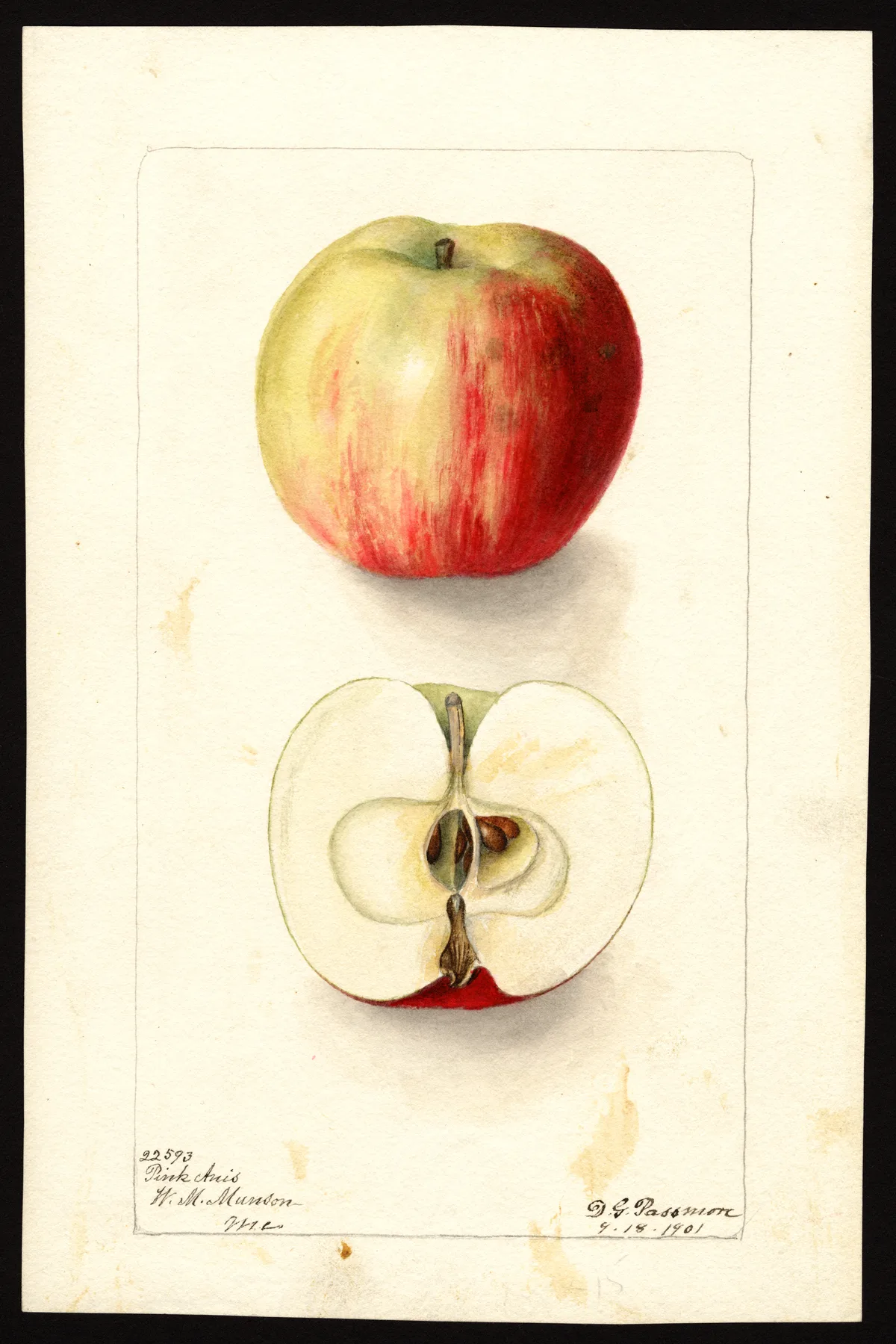
USDA Pomological Watercolor Collection
Anis
Origin / History
Origin, Russia. Anis belongs to a family of apples grown on the upper Volga in Russia on a large scale, all of which are valuable for cultivation in the northern limits of fruit culture (Thomas). Several varieties received from Russia prove to be so nearly identical that only one is regarded as necessary in fruit lists to represent the group (Budd & Hansen). The description used by Hansen (1902) and Budd & Hansen (1914) was adopted by the Russian Apple Nomenclature Commission, appointed by the State Horticultural Societies of Minnesota, Iowa, Wisconsin, and South Dakota, at a meeting held at La Crosse, Wisconsin, August 30–31, 1898.
At the discussion recorded by Hansen (1902), A. G. Tuttle moved that all members of the Anis group be discarded owing to small size. J. S. Harris seconded the motion, but thought the Russian Green should be retained for very cold latitudes, as it is very hardy and the tree is blight-proof; for milder sections he considered the Anis group too small.
Tree
Tree medium upright (Hansen; Budd & Hansen). Very hardy, but fruit too small for mild climates (Budd & Hansen). At the Central Experimental Farm trial (Agassiz, BC), trees planted Spring 1890 were described as a medium grower. Fruit drops easily (Hansen; Budd & Hansen).
Fruit
Size
Sources disagree. Hansen and Budd & Hansen give size "4 to 5" (on the Russian Nomenclature Commission scale). Thomas describes the fruit as small. The Central Experimental Farm describes it as of medium size.
Form
Roundish oblate, angular (Hansen; Budd & Hansen). Thomas describes it as oblate conical, ribbed. The Central Experimental Farm describes it as oblate, conical.
Stem
Short (Hansen; Budd & Hansen). Thomas adds that the stem is stout.
Cavity
Broad, deep (Hansen; Budd & Hansen). Thomas describes the cavity as deep.
Calyx
Medium, closed (Hansen; Budd & Hansen). Not described by Thomas or by the Central Experimental Farm.
Basin
Broad, irregular, angular (Hansen; Budd & Hansen). Thomas describes the basin as wide and shallow.
Skin / Color
Light green, striped with red in sun (Hansen; Budd & Hansen). Thomas describes the color as yellow, nearly covered with dark crimson in strips and splashes. The Central Experimental Farm describes the skin as yellow with reddish streaks on sunny side.
Flesh / Flavor
Tender, juicy, greenish white, with a dark green water line around the core; flavor agreeable, mild acid (Hansen; Budd & Hansen). Thomas describes the flesh as firm, fine grained, sub-acid, aromatic; quality best when properly ripened. The Central Experimental Farm describes the flesh as white, not juicy, mildly acid, quality poor.
Core / Seeds
Core open (Hansen; Budd & Hansen). Seeds not separately described in source.
Season
September and October (Hansen; Budd & Hansen). The Central Experimental Farm at Agassiz, BC reports the season as "last of July."
Uses
Valuable for cultivation in the northern limits of fruit culture (Thomas). The group is regarded as too small for milder sections, but the closely related Russian Green was recommended for retention in very cold latitudes for its hardiness and blight-proof tree (Hansen, reporting Harris's remarks).
Subtypes / Variants
Hansen (1902) lists the Anis Group as comprising: Anis; No. 317; White Pigeon (spurious); 984, Kursk Anis; Red Anis; 32 M; Russian Green; Blue Anis; Yellow Anis; Pink Anis; Striped Anis; Getman's Bean, 225. Budd & Hansen note that several varieties received from Russia under different names prove to be so nearly identical that only one is regarded as necessary in fruit lists to represent the group, and cross-reference Blue Anis.
Other
Thomas references Fig. 432 in his work (illustration of the variety).
Book Sources
Described in 3 period pomological works
Nursery Catalog Sources
Found in 5 catalogs (1898–1913) from Illinois, Wisconsin
- Dane County Nursery , F.H. Chappel, Oregon , Wisconsin — 1898
- Central Experimental Farm , Dominion Department of Agriculture, Agassiz, British Columbia (under test; Bulletin No. 3, Second Series) — 1900
- Central Experimental Farm , Dominion Department of Agriculture, Agassiz, British Columbia (under test; Bulletin No. 3, Second Series) — 1900 — listed as Yellow Anis
- Benjamin Buckman (personal inventory) , Farmingdale , Illinois — 1901
- Benjamin Buckman (personal inventory) , Farmingdale , Illinois — 1913
View original book sources (4)
— N.E. Hansen, A Study of Northwestern Apples (1902)" ANIS GROUP.
Anis; No. 317; White Pigeon (spurious); 984, Kursk Anis; Red Anis; 32 M; Russian Green; Blue Anis; Yellow Anis; Pink Anis; Striped Anis; Getman's Bean, 225.
DESCRIPTION: Anis—Size, 4 to 5; form, roundish oblate, angular; color, light green, striped with red in sun; cavity, broad, deep; stem, short; basin, broad, irregular, angular; calyx, medium, closed; core, open; flesh, tender, juicy, greenish white, with dark green water line around core; flavor, agreeable mild acid; season, September and October; origin, Russia; tree, medium upright; fruit drops easily.
A. G. Tuttle: I move that all be discarded, owing to small size. J. S. Harris: I second the motion. However, I think the Russian Green should be retained for very cold latitudes, as it is very hardy, and the tree is blight-proof. For milder sections the Anis group is too small.
(Rus. Nom. Com.)
— John J. Thomas, The American Fruit Culturist (1903)Anis. Small, oblate conical, ribbed; yellow, nearly covered with dark crimson in strips and splashes; cavity deep, stem short, stout; basin wide, shallow; flesh firm, fine grained, sub-acid, aromatic; quality best when properly ripened. This apple belongs to a family grown on the upper Volga in Russia, on a large scale, all of which are valuable for cultivation in the northern limits of fruit culture. Fig. 432. Russian.
— J.L. Budd & N.E. Hansen, American Horticultural Manual, Part II: Systematic Pomology (1914)Anis.— Origin, Russia. Tree very hardy, but fruit too small for mild climates. Several varieties received from Russia prove to be so nearly identical that only one is regarded as necessary in fruit lists to represent the group. The Russian Apple Nomenclature Commission* adopted the following description. (See also Blue Anis.)
"Anis.— Size 4 to 5; form roundish oblate, angular; color light green, striped with red in sun; cavity broad, deep; stem short; basin broad, irregular, angular; calyx medium, closed. Core open; flesh tender, juicy, greenish white, with dark green water line around core; flavor agreeable, mild acid; season September and October; origin, Russia; tree medium upright; fruit drops easily."
*Appointed by the State Horticultural Societies of Minnesota, Iowa, Wisconsin, and South Dakota. Meeting held at La Crosse, Wis., Aug. 30, 31, 1898.
— Central Experimental Farm, Central Experimental Farm, Agassiz BC — Catalogue of Fruit Trees under Test (Bulletin No. 3, 1900) (1900)Planted Spring 1890. Tree a medium grower. Fruit of medium size, oblate, conical, skin yellow with reddish streaks on sunny side. Flesh white, not juicy, mildly acid, quality poor. Season, last of July.