Sack Apple
Apple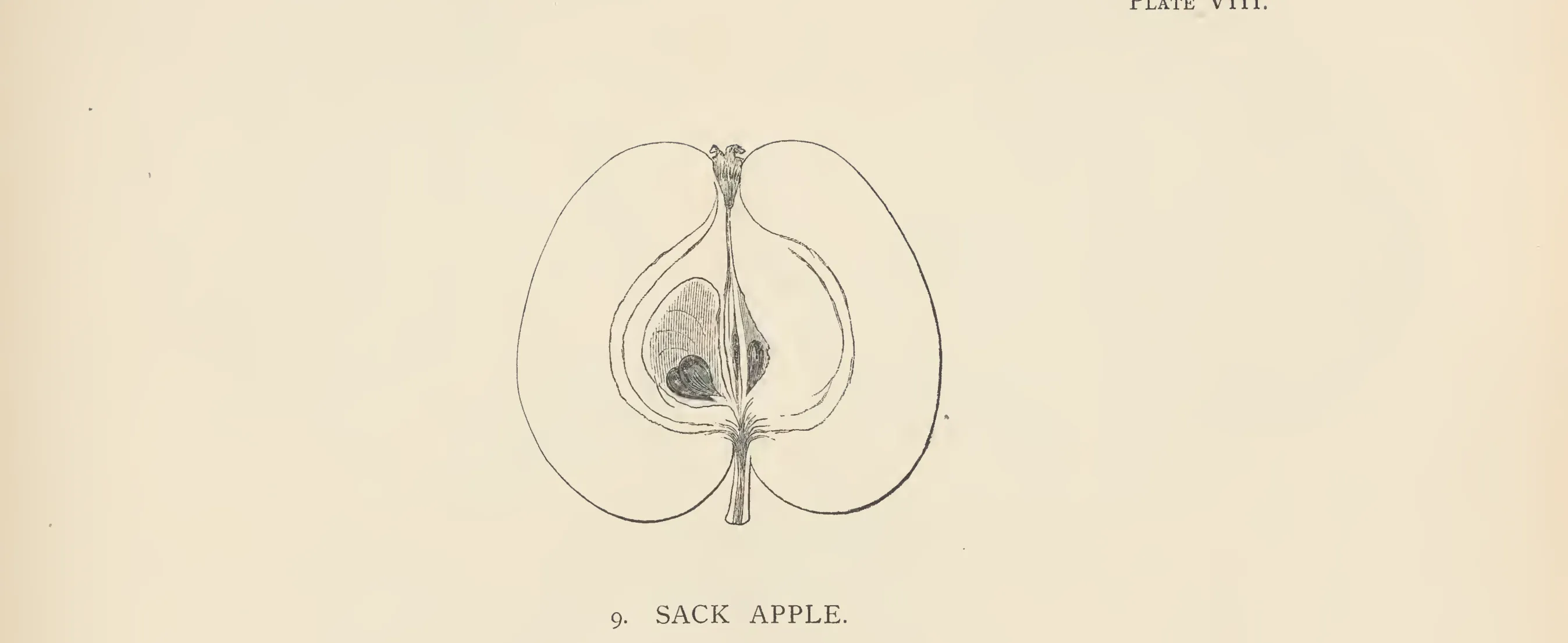
Sack Apple
Origin and History
Sack Apple is noted as one of the oldest historic varieties, though no additional historical details are provided in the source.
Tree
Not described in source.
Fruit
Size and Form. Below medium size, conical in form with uneven outline. The sides are ribbed in the manner of the Margil variety, and the fruit is ridged around the eye.
Skin. Smooth and shining with a varnished appearance. Almost entirely covered with deep bright crimson, which is streaked and mottled with darker crimson on the sun-exposed side. Where shaded, the skin is yellowish and mottled with crimson.
Eye and Basin. Small and closed, with erect pointed segments. Set in a deep, plaited basin. The tube is funnel-shaped, with median stamens. The style is very stout and thick at the base, filling nearly half the tube.
Stalk and Cavity. The stalk is very short, thick, and fleshy, set in a very shallow cavity.
Flesh and Flavor. Tender, crisp, fine-grained, and sweet, with a pleasant subacid flavor. The overall character is pleasant, vinous, and aromatic.
Core. The cells of the core are open; the cell-walls are ovate.
Season and Storage
In use during October and November. An early apple that keeps fairly well.
Uses
The Sack Apple is more commonly used in the present day as a dessert or pot fruit than for cider-making.
Other
Chemical Composition
Chemical analysis conducted by Mr. G. H. With, F.R.A.S., from fruit of the 1878 season, revealed the following composition:
- Density of fresh juice: 1.039
- Density after 24 hours' exposure to air: 1.044
- Sugar: 6.400%
- Tannin, Mucilage, Salts, etc.: 5.220%
- Water: 88.380%
Book Sources
Described in 1 period pomological work
View original book sources (1)
— Woolhope Naturalists Field Club, The Herefordshire Pomona (1885)9 SACK APPLE
[Syn : Spice Apple : Fox's Kernel.]
This Apple is one of our oldest historic varieties.
Description.—Fruit, below medium size ; conical, and uneven in its outline, being ribbed on the sides in the way of the Margil, and ridged round the eye. Skin, smooth and shining, as if varnished, almost entirely covered with deep bright crimson, which is streaked and mottled with darker crimson on the side next the sun ; but where shaded, it is yellowish and mottled with crimson. Eye, small and closed, with erect pointed segments, set in a deep and plaited basin ; tube, funnel-shaped : stamens, median ; the style very stout and thick at the base, filling nearly the half of the tube. Stalk, very short, thick, and fleshy, set in a very shallow cavity. Flesh, tender, crisp, fine-grained, sweet, and with a pleasant subacid flavour. Cells of the core, open ; cell-walls, ovate. In use during October and November.
The chemical analysis of this Apple, season 1878, by Mr. G. H. With, F.R.A.S, gives the following results:—
Density of fresh juice ... ... ... 1·039 Ditto after 24 hours' exposure to air ... ... 1·044 100 parts of juice by weight contained : Sugar ... ... ... ... ... 6·400 Tannin, Mucilage, Salts, &c. ... ... ... 5·220 Water ... ... ... ... ... 88·380
The Sack Apple is more used in the present day as a dessert or pot fruit, than for cider. It is an early apple, but keeps fairly well. It has a pleasant vinous aromatic flavour.