Scarlet Pippin
Apple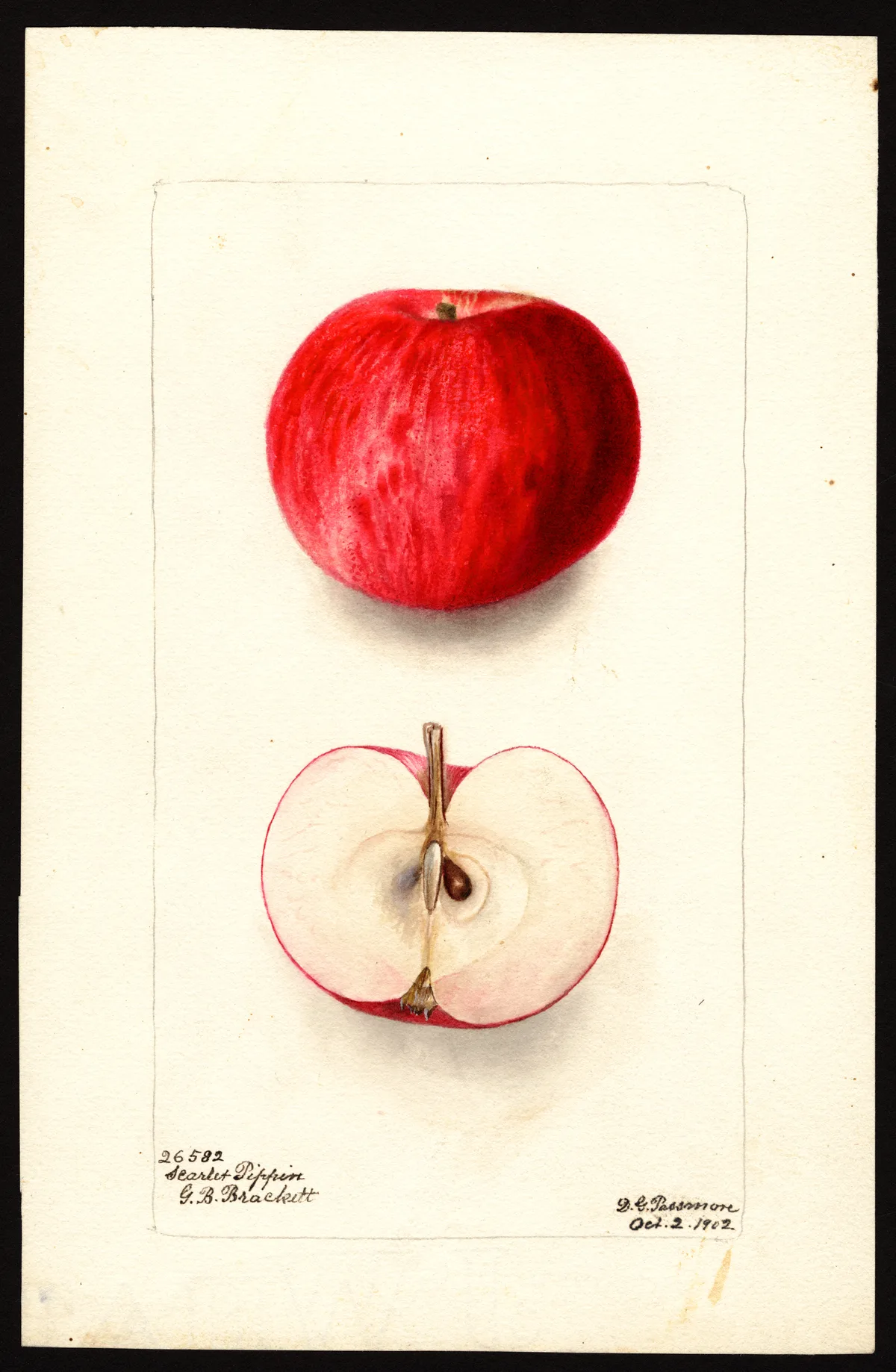
USDA Pomological Watercolor Collection
Scarlet Pippin
Origin/History
Scarlet Pippin originated about 1860 at Lyn, Leeds County, Ontario, near Brockville, where it was locally grown for some years before wider introduction. Mr. Harold Jones of Maitland, Ontario, Experimenter for Ontario for apples in the St. Lawrence River district, had most to do with bringing the variety to notice as an autumn dessert fruit of value (Beach); however, the report that it originated with him is incorrect (Beach). Hedrick notes that its culture is confined to Canada, New England, and nearby states. It is an apple of the Fameuse group.
Tree
Tree vigorous, upright in form, and said to be a heavy bearer (Beach, Budd-Hansen). Twigs long, straight, stout; internodes short. Bark dark brown or reddish-brown, lightly streaked with scarf-skin, pubescent near tips. Lenticels numerous, very conspicuous, medium size, oval, slightly raised. Buds medium size, flat, obtuse, appressed, pubescent (Beach).
Fruit
Size
Medium.
Form
Roundish inclined to oblate (Beach, Hedrick); Budd-Hansen describes it as oblate to roundish oblate. Regular in outline across all sources.
Stem
Short (all sources). Beach adds stout to slender; Hedrick specifies stout.
Cavity
Conflicting accounts: Beach describes the cavity as acute, shallow to deep, moderately wide to wide, sometimes lipped; Hedrick similarly calls it acute, shallow, wide, sometimes lipped. Budd-Hansen, however, describes it as deep, regular, wide, and obtuse, with a trace of stellate russet — disagreeing with Beach and Hedrick both on depth ("shallow" vs. "deep") and angle ("acute" vs. "obtuse").
Calyx
Closed or open (Beach, Hedrick). Budd-Hansen specifies open, with segments divergent.
Basin
Beach and Hedrick agree: narrow, shallow, slightly wrinkled (Beach: "or almost wanting"). Budd-Hansen gives a conflicting description: nearly flat and smooth.
Skin
Budd-Hansen provides the only detailed skin description: smooth, waxen, yellow ground, almost wholly covered with brilliant bright and dark crimson, washed and splashed, coloring solid on the sunny side, with a thin, light bloom; described as "a beautiful fruit." Dots distinct, many, minute, white (Budd-Hansen). Beach notes the fruit as "very attractive looking" and said to sell better than Fameuse in the market.
Flesh and Flavor
Flesh white (Beach, Hedrick); Budd-Hansen specifies very white, slightly stained with pink. Firm, crisp, fine-grained (Budd-Hansen), tender, melting, juicy. Flavor mild subacid with a pleasant but not high flavor (Beach); Hedrick concurs with "mild subacid with a pleasant flavor." Budd-Hansen gives simply "subacid." Quality rated very good by all sources. Beach and Hedrick note it is firmer in flesh and slightly more acid than McIntosh, and Hedrick adds that it is not so good in quality as McIntosh.
Core and Seeds
Core small (all sources). Budd-Hansen provides additional detail: core closed, meeting; tube conical; stamens median; seeds plump, short, few.
Season
Fall and early winter (Beach, Hedrick). Beach notes the season as about the same as Wealthy or earlier. Budd-Hansen gives early winter.
Uses
Valued as an autumn dessert fruit. Said to sell better than Fameuse in the market, though it does not equal Fameuse in quality (Beach, citing Macoun). Beach judged it worthy of testing in New York, particularly in regions where Fameuse and McIntosh succeed best.
Subtypes/Variants
Not described in source.
Book Sources
Described in 3 period pomological works
- Beach, The Apples of New York Vol. 2 (1905)
- Budd & Hansen, Systematic Pomology (1914) — listed as Scarlet Pippin (Leeds Beauty)
- Hedrick, Cyclopedia of Hardy Fruits (1922)
Nursery Catalog Sources
Found in 5 catalogs (1901–1913) from Illinois, Missouri
- Benjamin Buckman (personal inventory) , Farmingdale , Illinois — 1901
- Stark Bros. Nurseries & Orchards Co. , Louisiana , Missouri — 1906
- Stark Bros. Nurseries & Orchards Co. , Louisiana , Missouri — 1910
- Stark Bros. Nurseries & Orchards Co. , Louisiana , Missouri — 1911
- Benjamin Buckman (personal inventory) , Farmingdale , Illinois — 1913
View original book sources (3)
— S.A. Beach, The Apples of New York, Vol. 2 (1905)SCARLET PIPPIN.
REFERENCES. 1. Jones, Ont. Fr. Gr. Assn. An. Rpt., 27:13. 1895. 2. Craig, Can. Hort., 19:381. 1896. fig. 3. Ib., 19:117. 1896. fig. 4. Ib., Amer. Gard., 20:27. 1899. figs. 5. Waugh, Vt. Sta. Bul., 83:91. 1900. 6. Macoun, Can. Dept. Agr. Bul., 37:41. 1901. 7. Abbott, Can. Hort., 24:18, 123. 1901. 8. Budd-Hansen, 1903:172.
SYNONYMS. CRIMSON BEAUTY (3). Crimson Pippin (2). Crimson Scarlet Pippin (2). Leeds Beauty (4, 5, 6, 8). SCARLET PIPPIN (1, 2, 4, 5, 6, 7, 8).
An apple of the Fameuse group which quite closely resembles McIntosh (2), but is firmer in flesh and slightly more acid. "A very attractive looking apple said to sell better than Fameuse, which it does not equal in quality. Tree a strong, upright grower and said to be a heavy bearer" (6). Season about the same as Wealthy or earlier (1). It appears to be worthy of testing in New York especially in those regions of the state where Fameuse and McIntosh succeed best.
Historical. Originated about 1860 at Lynn, Leeds county, Ontario, near Brockville, where it has been locally grown for some years (4, 7). Mr. Harold Jones, Maitland, Ont., Experimenter for Ontario for apples in the St. Lawrence river district, has had most to do with bringing this variety to notice as an autumn dessert fruit of value (6), but the report that the variety originated with him is incorrect (7).
TREE. Tree vigorous. Form upright. Twigs long, straight, stout; internodes short. Bark dark brown or reddish-brown, lightly streaked with scarf-skin, pubescent near tips. Lenticels numerous, very conspicuous, medium size, oval, slightly raised. Buds medium size, flat, obtuse, appressed, pubescent.
FRUIT (4, 6). Fruit medium size. Form roundish inclined to oblate, regular. Stem short, stout to slender. Cavity acute, shallow to deep, moderately wide to wide, sometimes lipped. Calyx closed or open. Basin narrow, shallow, slightly wrinkled or almost wanting. Core small. Flesh white, firm, crisp, tender, melting, juicy, mild subacid with a pleasant but not high flavor, very good. Season fall and early winter.
— J.L. Budd & N.E. Hansen, American Horticultural Manual, Part II: Systematic Pomology (1914)Scarlet Pippin (Leeds Beauty). — Originated at Lyn, Leeds Co., Ontario, near Brockville. A choice variety of the Fameuse type recently introduced. Tree of strong, upright growth, productive. Fruit medium, regular, oblate to roundish oblate; surface smooth, waxen, yellow, almost wholly covered with brilliant bright and dark crimson, washed and splashed, coloring solid on sunny side, with thin, light bloom; a beautiful fruit; dots distinct, many, minute, white; cavity deep, regular, wide, obtuse with trace of stellate russet; stem short; basin nearly flat, smooth; calyx open; segments divergent. Core closed, small, meeting; tube conical; stamens median; seeds plump, short, few; flesh very white, slightly stained with pink, fine-grained, crisp, melting, tender, juicy, subacid, very good. Early winter.
— U.P. Hedrick, Cyclopedia of Hardy Fruits (1922)SCARLET PIPPIN. Crimson Beauty. Crimson Pippin.
This is a Canadian apple of the Fameuse type; the fruits are somewhat similar to those of the well-known McIntosh, but differ in being firmer in flesh, more acid and not so good in quality. Scarlet Pippin originated about 1860 near Brockville, Ontario. Its culture is confined to Canada, New England, and nearby states.
Tree vigorous, upright. Fruit of medium size, round-oblate, regular; stem short, stout; cavity acute, shallow, wide, sometimes lipped; calyx closed or open; basin narrow, shallow, wrinkled; core small; flesh white, firm, crisp, tender, melting, juicy, mild subacid with a pleasant flavor; very good; fall and early winter.