Red Calville
Apple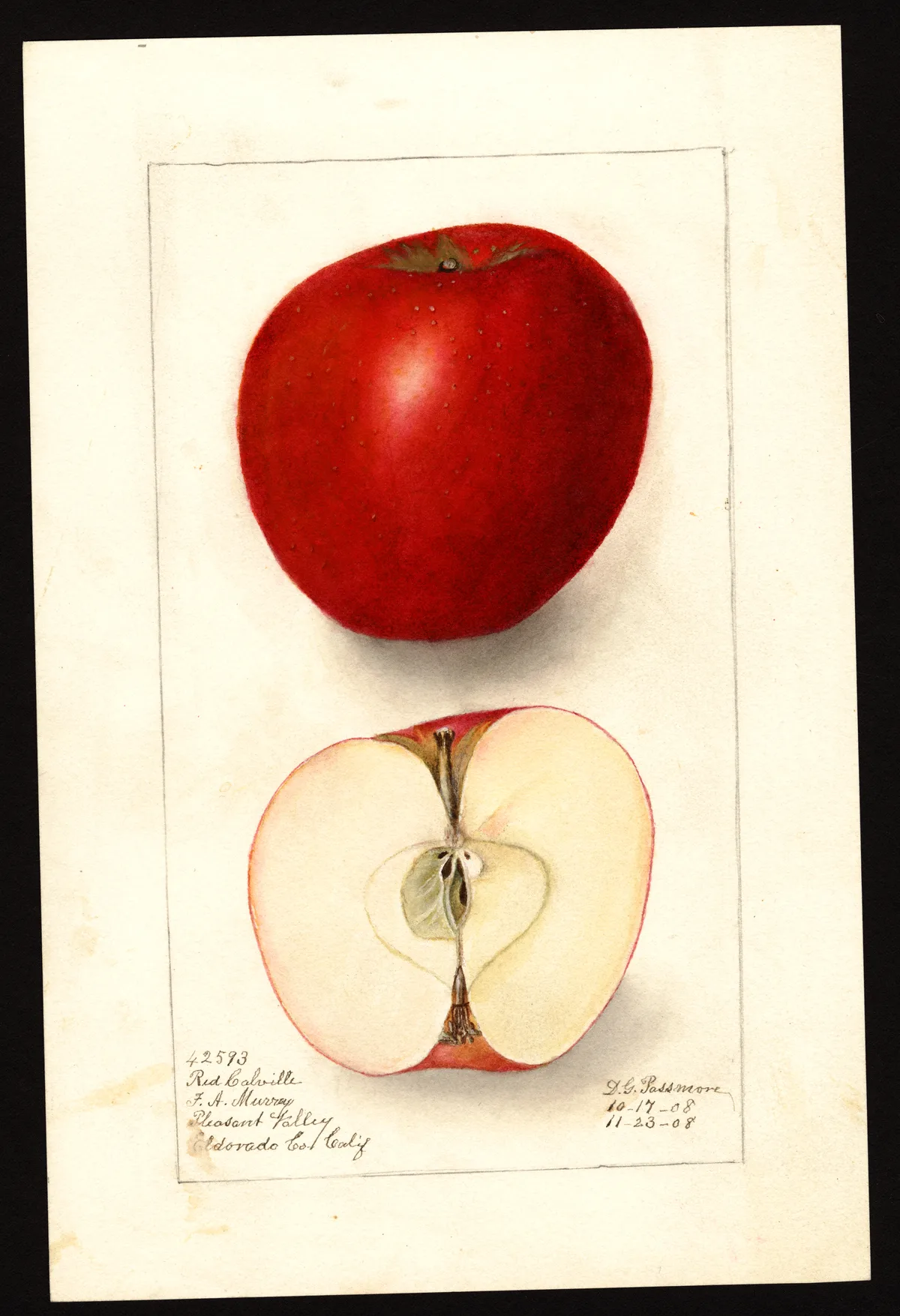
USDA Pomological Watercolor Collection
Red Calville
Origin/History
A French variety, much celebrated for its excellence by French writers. Coxe (1817) notes that it does not appear in America to merit so high a reputation as it has acquired in France, its greatest merits in American cultivation being those of bearing abundantly and keeping well. Known in some western regions as "Spice" (Elliott).
Tree
Not described in source.
Fruit
Size: The two sources conflict slightly: Coxe describes the fruit as about middling in size; Elliott gives it as above medium.
Form: Coxe describes the form as rather round, flattened at the stalk. Elliott gives it as roundish oblong. These accounts are in partial conflict — the fruit is broadly roundish, though whether it tends toward flattened or elongated is unresolved.
Stem: Short and thick (Coxe).
Cavity: Not described in source.
Calyx: Not described in source.
Basin: Not described in source.
Skin: Smooth (Coxe). The color is described differently by the two sources: Coxe states the skin is dark, covered with a white down, which when rubbed off leaves a clear and almost black red; Elliott describes it as pale red, becoming dark red in the sun. These accounts conflict — Coxe's specimen appears to have shown a deep, near-black red overall, while Elliott's suggests a lighter base color with sun-exposed deepening.
Flesh/Flavor: White (Coxe). Sprightly and juicy, but not rich (Coxe). Elliott describes the flesh as tender but rates the quality as poor. Both sources agree the variety is not of superior eating quality.
Core/Seeds: Not described in source.
Season
Ripens in November (both sources agree). Keeps well through the winter (Coxe); Elliott gives the season of use as November through February, consistent with good keeping quality.
Uses
Not described in source beyond its general reputation for excellence among French writers and its bearing and keeping virtues noted by Coxe.
Subtypes/Variants
Not described in source.
Other
Coxe notes the variety bears abundantly. Despite its European prestige, both American sources — writing nearly fifty years apart — give it a modest assessment of eating quality.
Book Sources
Described in 2 period pomological works
Nursery Catalog Sources
Found in 9 catalogs (1884–1900) from California, England
- Felix Gillet , Barren Hill Nursery, Nevada City , California — 1884
- Felix Gillet , Barren Hill Nursery, Nevada City , California — 1888
- Felix Gillet , Barren Hill Nursery, Nevada City , California — 1889
- Felix Gillet , Barren Hill Nursery, Nevada City , California — 1890
- Felix Gillet , Barren Hill Nursery, Nevada City , California — 1891
- Felix Gillet , Barren Hill Nursery, Nevada City , California — 1894
- Felix Gillet , Barren Hill Nursery, Nevada City , California — 1895
- Felix Gillet , Barren Hill Nursery, Nevada City , California — 1897
- George Bunyard & Co. , Royal Nurseries, Maidstone, Kent , England — 1900
View original book sources (2)
— William Coxe, A View of the Cultivation of Fruit Trees (1817)NO. 62. RED CALVILLE.
The size of this apple is about middling; the form rather round, flattened at the stalk—the stem short and thick; the skin smooth; the colour dark, covered with a white down, which, when rubbed off, leaves a clear and almost black red: the flesh white, sprightly, and juicy, but not rich—it ripens in November, and keeps well through the Winter.
This apple is much celebrated for its excellence by the French writers, but does not appear in this country to merit so high a reputation as it has acquired in France; its greatest merits are those of bearing abundantly, and keeping well.
— F.R. Elliott, The Western Fruit Book (1865)Red Calville. Red Winter Calville, | Calville Rouge, Calville Rouge d'Hiver, | Spice, of some, West. Foreign. Above medium, roundish oblong, pale red, dark red in sun ; flesh, tender, poor. November, February.