Anisim
Apple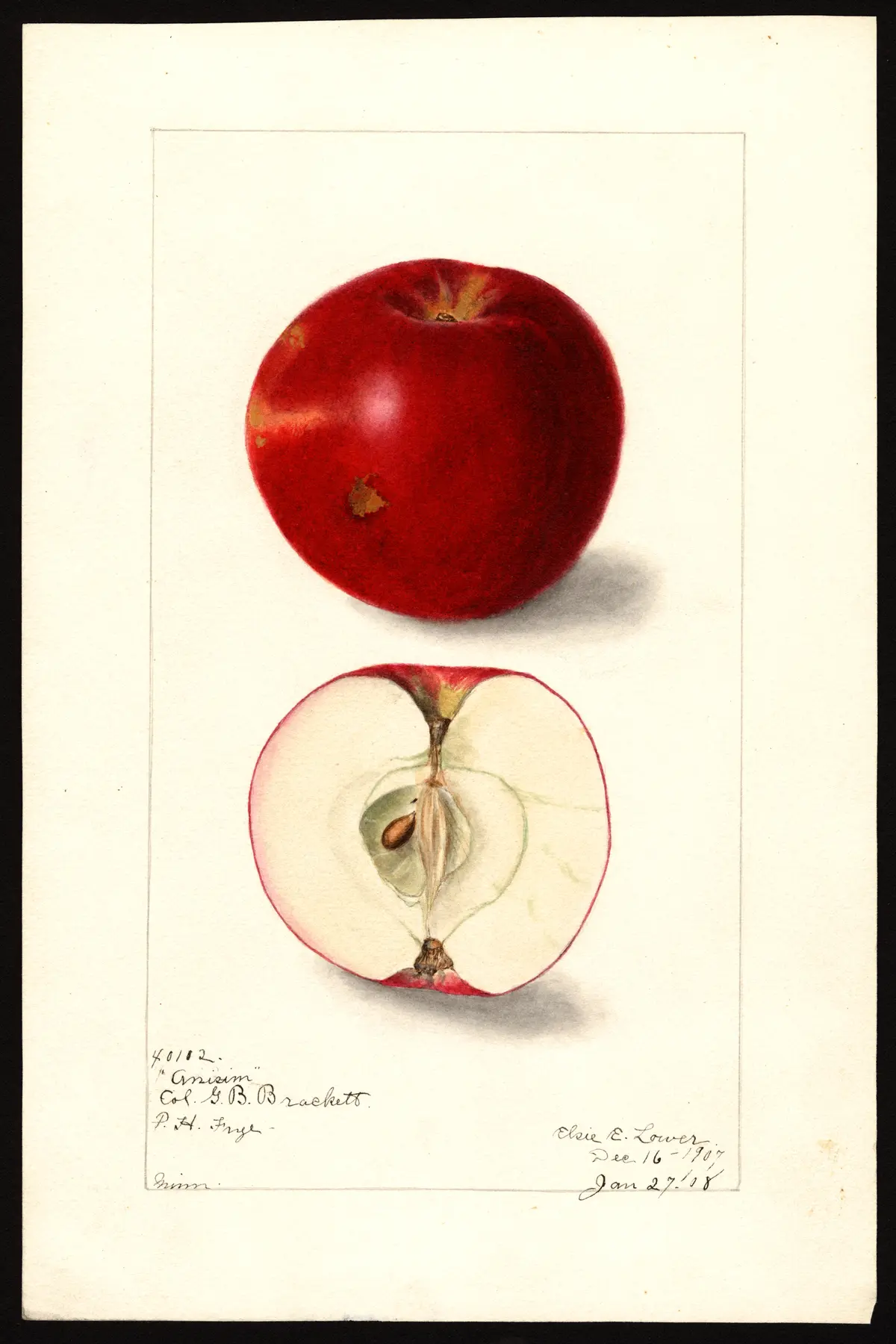
USDA Pomological Watercolor Collection
Anisim
Origin/History
Anisim is a Russian apple variety. It was introduced into Canada about 1885 (Hedrick). The variety was imported into the United States under several different names, all of which now give way to the name Anisim — it had been grown in Wisconsin, Iowa, and Minnesota under names such as 14 M and 18 M of Budd, Zuzoff of Tuttle, Good Peasant of Patten, Borsdorfer of Wragg, Peterson's Anisim, and Swedish Borsdorf of Patten (Hansen). N.E. Hansen reports that at the agricultural fair at Kiev, Russia, he saw the true Anisim exhibited under a Russian name meaning "Beauty," and met with leading Russian pomologists who were endeavoring to correct the nomenclature of their apples. According to Hansen, who was in charge of pomology at the South Dakota Experiment Station, Anisim has proved a most valuable apple in Minnesota and other parts of the Northwest, particularly the northern states of the Great Plains; Hedrick notes that it seems not to be grown elsewhere in the United States. Beach suggests it may be of some value in those portions of New York state where superior hardiness is a prime requisite.
Tree
A strong grower in both nursery and orchard, and a prodigious bearer. Young trees are upright, becoming spreading with age. Limbs are long and slender, with a very strong shoulder — A.G. Tuttle observes that the trees of the true Anisim are strongly shouldered, similar to those of his Rawle's Genet before they winter-killed, and notes that Anisim is one of the very best nursery trees grown. C. Wedge adds that the shoulder in the Anisim limbs is very characteristic. Leaves are narrow, pointed, and dark green. Tuttle further remarks on its quality as a nursery tree. The beautiful color of the fruit attracts favorable attention.
Fruit
Size: Below medium. Hansen's detailed description gives the size as 4½.
Form: Roundish, inclining to conical; slightly angular.
Stem: Medium; Hansen's detailed description specifies short, medium.
Cavity: Regular, acute, usually slightly russeted; described as medium in Hansen's detailed description.
Calyx: Closed.
Basin: Narrow, very shallow, corrugated, sometimes flat. Hansen's detailed description gives it as small, wrinkled, shallow.
Skin: Surface greenish yellow, covered almost wholly with a beautiful dark crimson, with heavy blue bloom (Hansen's detailed description specifies a bluish bloom); dots white, minute.
Flesh/Flavor: Greenish white, with green veins; good. Hansen's detailed description further specifies the flesh as white, fine grained, juicy, with a pleasant subacid flavor.
Core/Seeds: Core closed, clasping; tube short, broad; stamens median.
Season
Early winter. Hansen's detailed description gives the season as November to January.
Uses
Not described in source.
Subtypes/Variants
Not described in source.
Other
Not described in source.
Book Sources
Described in 4 period pomological works
USDA Nomenclature (1905)
From W.H. Ragan, Nomenclature of the Apple, USDA Bulletin No. 56
Same as Anissim.
Nursery Catalog Sources
Found in 2 catalogs (1901–1913) from Illinois
- Benjamin Buckman (personal inventory) , Farmingdale , Illinois — 1901
- Benjamin Buckman (personal inventory) , Farmingdale , Illinois — 1913
View original book sources (4)
— N.E. Hansen, A Study of Northwestern Apples (1902)Anisim—Origin, Russia. Tree a strong grower in nursery and orchard. The beautiful color of the fruit attracts favorable attention—Fruit below medium, roundish conical, slightly angular; surface greenish yellow, covered almost wholly with a beautiful dark crimson, with heavy blue bloom; dots white, minute; cavity regular, acute, usually slightly russeted; stem medium; basin narrow, very shallow, corrugated, sometimes flat; calyx closed. Core closed, clasping, tube short, broad; stamens median, flesh greenish white, with green veins, good. Early winter.
" ANISIM GROUP. Anisim; 14 M and 18 M of Budd; Zuzoff of Tuttle; Good Peasant of Patten; Borsdorfer of Wragg; Peterson's Anisim; Swedish Borsdorf of Patten. This variety is proving very valuable in Minnesota and other parts of the Northwest, and has been grown in Wisconsin, Iowa and Minnesota under several different names as originally imported from Russia, but which now all give way to the name Anisim.
DESCRIPTION: Anisim—Size, 4½; form, roundish, inclining to conical; color, greenish ground nearly covered with a very dark red, with a bluish bloom with minute whitish dots; cavity, medium, slightly russeted, acute; stem, short, medium; basin, small, wrinkled, shallow; calyx, closed; flesh, white, fine grained, juicy; flavor, pleasant subacid; season, November to January; origin, Russia; tree, a prodigious bearer; young trees upright, spreading with age; limbs, long, slender, with a very strong shoulder; leave, narrow, pointed, dark green.
N. E. Hansen: At the agricultural fair at Kiev, Russia, last fall, I saw the true Anisim exhibited under a Russian name meaning "Beauty." I met some of the leading Russian pomologists, who are endeavoring to correct the nomenclature of their apples.
A. G. Tuttle: I find the trees of the true Anisim are strongly shouldered, similar to those of my Rawle's Genet before they winter-killed. Anisim is one of the very best nursery trees grown.
C. Wedge: The shoulder in the Anisim limbs is very characteristic." (Rus. Nom. Com.)
— S.A. Beach, The Apples of New York, Vol. 2 (1905)ANISIM.
REFERENCES. 1. Schroeder, Montreal Hort. Soc. Rpt., 1886-87:71. 2. Hoskins, Rural N. Y., 52:299. 1893. 3. Greene, Minn. Sta. Bul., 32:240. 1893. 4. Budd, Ia. Sta. Bul., 31:334. 1895. 5. Thomas, 1897:626. 6. Budd, Ia. Sta. Bul., 41:66, 69, 71. 1899. 7. Am. Pom. Soc. Cat., 1899:15. 8. Munson, Me. Sta. Rpt., 1902:83, 86, 95. 9. Hansen, S. D. Sta. Bul., 76:23. 1902. fig. 10. Budd-Hansen, 1903:38. fig.
SYNONYMS. ANISIM (1, 2, 3, 4, 5, 6, 7, 8, 9, 10). Anisim of Peterson (9). Borsdorfer of Wragg (9). 18 M (3, 8, of Budd 9). 14 M of Budd (9). Good Peasant of Patten (9). Jonathan of the North (4). Swedish Borsdorf of Patten (9). Zusoff of Tuttle (9).
Hansen (9) reports that this Russian apple is proving very valuable in Minnesota and other parts of the Northwest. It may be of some value in those portions of New York state where superior hardiness is a prime requisite. Hansen's description is given below. "Tree a strong grower in the nursery and orchard and a prodigious bearer; young trees upright, spreading with age; limbs long, slender with a very strong shoulder; leaves narrow, pointed, dark green. The beautiful color of the fruit attracts favorable attention.— Fruit below medium, roundish conical, slightly angular; surface greenish-yellow, covered almost wholly with a beautiful dark crimson, with heavy blue bloom; dots white, minute; cavity regular, acute, usually slightly russeted; stem medium; basin narrow, very shallow, corrugated, sometimes flat; calyx closed. Core closed, clasping; tube short, broad; stamens median, flesh greenish white, with green veins, good. Early winter."
— J.L. Budd & N.E. Hansen, American Horticultural Manual, Part II: Systematic Pomology (1914)Anisim.—Origin, Russia; tree a strong grower in nursery and orchard; the beautiful color of the fruit attracts favorable attention. Fruit below medium, roundish conical, slightly angular; surface greenish yellow, covered almost wholly with a beautiful dark crimson, with heavy blue bloom; dots white, minute; cavity regular, acute, usually slightly russeted; stem medium; basin narrow, very shallow, corrugated, sometimes flat; calyx closed. Core closed, clasping; tube short, broad; stamens median; flesh greenish white, with green veins, good. Early winter.
— U.P. Hedrick, Cyclopedia of Hardy Fruits (1922)ANISIM. According to N. E. Hansen, in charge of pomology at the South Dakota Experiment Station, Anisim is a most valuable apple in the northern states of the Great Plains. It seems not to be grown elsewhere in the United States. The variety is a Russian sort introduced into Canada about 1885. The following is the description given by Hansen: "Tree a strong grower in the nursery and orchard and a prodigious bearer; young trees upright, spreading with age; limbs long, slender with a very strong shoulder; leaves narrow, pointed, dark green. The beautiful color of the fruit attracts favorable attention. Fruit below medium, roundish-conical, slightly angular; surface greenish-yellow, covered almost wholly with a beautiful dark crimson, with heavy blue bloom; dots white, minute; cavity regular, acute, usually slightly russeted; stem medium; basin narrow, very shallow, corrugated, sometimes flat; calyx closed. Core closed, clasping; tube short, broad; stamens median; flesh greenish-white, with green veins, good; early winter."